
Bookbuster Book Review
Small is Beautiful: A Study of Economics as if People Mattered
By EF Schumacher
REVIEW BY TIM BARTON
The next instalment of ‘positive views’ book reviews is here – and I’m looking at a seminal 1970s book, from Fritz Schumacher.
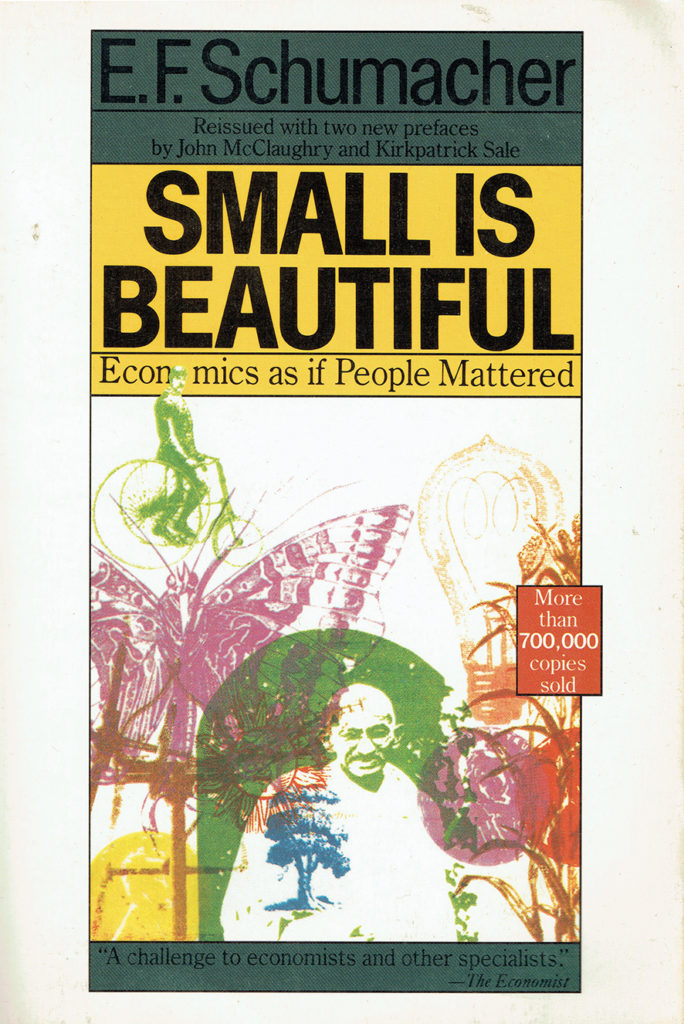
Back in the day, this was a massive bestseller, and it seems odd that decades later the arguments proffered are still seen as ‘alternative’. Today, we are slowly reclaiming the positive ground bequeathed to us through the progressive politics of the 60s and 70s, after years of stagnation
under Thatcherism and ‘greenwash’ corporate co-option. I believe that Schumacher’s core insights are once more moving back into the mainstream.
A MIDDLE-CLASS HIPPY NAVEL-GAZING PARADISE
After his death, I was disappointed to see the charitable work that came from the Foundation divide and take two paths: one, a pragmatic and engaged Institute for Intermediate Technology, that provided solutions to developing countries, and aided autonomy and self-sufficiency, a positive direction that seems to have failed to continue. And two, a middle-class hippy navel-gazing paradise represented by the increasingly detached ‘spiritual’ magazine Resurgence, and by Dartington College near Totnes, both successful under the tutelage of Fritz’s ally Satish Kumar – the magazine recently merged with The Ecologist, the college continues in Falmouth.
Whilst the college and magazine did indeed pursue Schumacher’s vision, it seems to me to be rather exclusive. It was the IIT that was really engaged in promoting the economic and resource ideas that he stood for.

A PULSING BEACON OF POSITIVE CAN-DO IDEALS
Re-reading Small is Beautiful after a few decades, it is striking how dated and patrician some of his arguments feel. I would revise his approach fairly radically today. The ‘small scale’ communities and industries implied by the title seem under-developed in the text. The ‘economics’ aspect is minimal, and where it does appear, seems to be couched in terms that are subsumed under ‘capitalist economics’ even while Schumacher critiques some aspects of capitalism. I think the emergence, in the 1980s, of a ‘green capitalism’ school of thought, an errant paradox, as Schumacher would have certainly realised, in fact emerges from his arguments. As an eclectic thinker, I believe his grounding in economics was meagre, and it shows. The last chapters do, though, look at ownership and the false dichotomy between a ‘free’ private-ownership based market economy and a totalitarian planned collectivist one – he advocates, quoting R H Tawney, ‘decentralised ownership of public property’.
But, at the core of his work is a pulsing beacon of positive can-do ideals, with a wonderfully grounded moral centre, so despite the book’s flaws to a 21st Century reader there is very much here still worth exploring.
SUSTAINABLE AND COMMUITY BASED RATHER THAN PROFIT-DRIVEN SHORT-TERMISM
Minimally, the title and subtitle point directly at the most valuable aspects of his work, aspects to be found in a few other contemporaneous writers, such as Murray Bookchin, aspects as valuable today as they ever were – it is this that merits reviewing his thoughts now. Small scale, as in locally owned and run as well as avoiding excessively scaled technology. Sustainable and community based rather than profit-driven short-termism, and, of course, ecologically engaged. The Centre for Alternative Technology (CAT) in Machynlleth represents the mindset required for a sustainable and renewable economy – founded in 1973, the year Small is Beautiful was first published, and still going strong, with a show-and-tell approach to both practising a green and small-scale people-oriented community and to using the centre as an educational springboard. Like Dartington, but much more pragmatically engaged in their approach, CAT for me epitomises all the best insights Schumacher brings to the table.
In 2001, Joseph Pearce wrote a ‘sequel’ of sorts, Small is Still Beautiful, with a foreword from Schumacher’s daughter, Barbara Wood. This takes a further step toward dealing properly with the ‘dismal science’, for example by using Paul Ormerod’s excellent 1995 book The Death of Economics (to be covered in a future review) to deepen a Schumacherian critique. However, much has changed since then – I think it is fair to say that the time is ripe for a new consideration of ‘economics as if people mattered’!
We hope you have enjoyed reading this article. The future of our volunteer led, non-profit publication would be far more secure with the aid of a small donation. You can also support local journalism by becoming a friend of HIP. It only takes a minute and we would be very grateful.

Leave a Reply