
What Next for Hastings Country Park Nature Reserve?
ANDREW COLQUHOUN shares the story of how we can trace back human activity on what is now Hastings Country Park Nature Reserve for thousands of years. But Brexit and local government reorganisation create fresh uncertainties for conservation.

Walking the dog on the East Hill
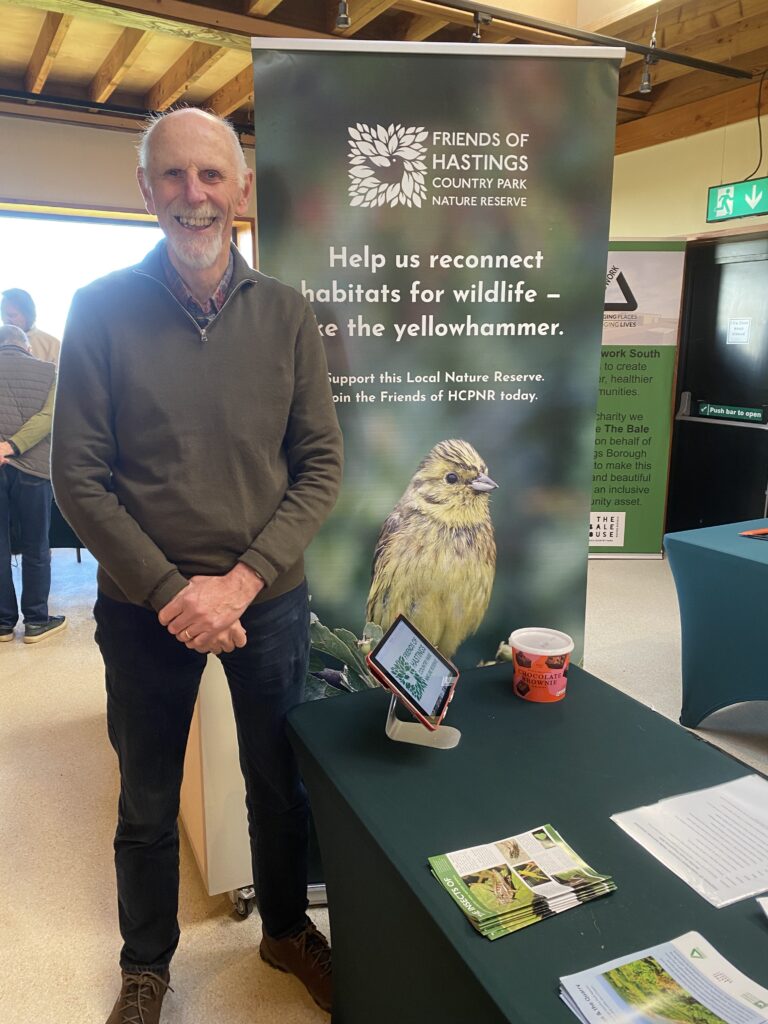
These changes emerged in a talk given by Cllr Jo Walker and Murray Davidson to the Friends of Hastings Country Park Nature Reserve (FHCPNR) in January.
EARLY HISTORY
What is now the Hastings Country Park Nature Reserve has a history stretching back across geological eons. The sandstone cliffs that dominate the landscape are remnants of a time when dinosaurs roamed the Earth, millions of years before humans. But if an iguanodon popped up its head between the ferns when Fairlight Glen was in full leaf, perhaps we wouldn’t be totally surprised. We know that at least one left footprints on the foreshore.

In terms of human beings, flint tools show that the hunter-gatherers of the Mesolithic Period to about 4,000 BCE were active in the area. There might even have been a settlement in that period. And then we have fragments of pots and tools from the subsequent Neolithic period to about 2,200 BCE. The folk of the Bronze Age left ring ditches and barrows which local archaeologists associate with burial practices. The later Iron Age showed evidence of some sort of fort on the East Hill, which would have had economic and social activity, as well as being for defence against other tribes.
To take a line from The Life of Brian, “What did the Romans ever do for us?”, they don’t seem to have been much interested in the area other than for farming. Some Roman coins have been turned up, but there is not much other direct evidence of their presence in the park. The invading Saxons – the Haestingas – were more significant than the Romans. They farmed extensively across what is now the reserve and left evidence of their burial sites on the East Hill.
As we move into the later medieval period, the picture is of small islands of open arable fields around farms. These would have been surrounded by pasture, woodland and scrub. And from that time forward there was quarrying for rock and sand. Indeed, in the Second World War, the sand of the area we call the Quarry was of strategic importance as a source for high-quality optical instruments.

HORRIBLE HISTORIES AND BIODIVERSITY
Turning to ‘Horrible History’ from about 1500 onwards, we see the intensification of farming, and then the unpopular process of enclosure of common land. About three hundred years ago, the Milward and Collier families came into the picture as big landowners and general bigwigs, holding the mayoralty many, many times. Among other things, their names are remembered through road names on the West Hill.
Over the years into the 20th century, the same two families gradually sold off the land to Hastings Council, sometimes at a pretty steep, and controversial, price. But it was Sarah, Countess Waldegrave who, as a local benefactor, made sure that the land of what is now the reserve remained free of the sort of development which scars so much of the South Coast.
As industrialisation and urban expansion encroached, the area was officially designated as a Country Park in 1974, a move which marked a real turning point, ensuring that the area would remain safeguarded for future generations to enjoy and cherish.
Hastings Borough Council, as the owner of the area, later designated the area as a Local Nature Reserve in 2006. And the Friends came into existence not long afterwards. Cllr Jo Walker, the Council’s lead on all things environmental, and Murray Davidson, a 30-year veteran of leading the cause for our local nature reserves and green spaces, emphasised the importance of Hastings Country Park as a nature reserve in their talk: it’s not just a park for dog walkers, and its significance extends far beyond its breathtaking scenery. It serves as a critical environmental asset, playing an integral role in ecological conservation, climate regulation, carbon sequestration and sustainable tourism.
BIODIVERSE PARK
One of the most extraordinary aspects of the reserve is its incredible biodiversity. It is home to a huge array of flora and fauna, some of which are rare or endangered. And there are less conspicuous rarities, such as Dumontier’s liverwort. The Dripping Well is the only place in the UK where this is found apart from Devon.
The reserve has such a great range of biodiversity because, as the area where the High Weald meets the sea, it has a rare mixture of habitats – grasslands, heathlands, woodlands, cliffs, and maritime habitats. Each supports a particular community of species. Among the most notable species found within the reserve are peregrine falcons, a few black redstarts, Dartford warblers, stonechats and various species of butterflies and moths. The cliffs provide essential nesting sites for seabirds such as fulmars, making the reserve an important breeding ground for avian species.
Mammals also thrive here: foxes, rodents – and badgers, of course. Sadly, there are the occasional muntjac and roe deer: sadly, because of the damage which a large herd of deer could do to the woodland. Additionally, the park is known for its impressive population of invertebrates, including rare beetles, mining bees, and other pollinators that contribute to the ecological balance of the area.
This means that the flora within the park is equally remarkable. The heathland areas have vibrant patches of heather, gorse, with its coconut scented flowers, and many other species of wildflowers. They play a key role in the food chain for butterflies, moths, and other insects and birds. Meanwhile, the ancient woodlands are home to a wide range of tree species, from oak and birch to holly and yew, offering shelter and food for other organisms.
WHAT DID BREXIT EVER DO FOR US?
So, where does Brexit come into this? Leaving the EU prompted a change by central Government in its support systems for farmers. Less emphasis was to be given to production and more to habitat management and environmental conservation.
This has had an effect locally. The Council had long known that the arable fields stretching along the south side of Fairlight Road were not commercially viable. This shift in the national funding mechanism required a radical rethink by the Council about how to manage the reserve for its primary purpose.
STEWARDSHIP
Jo Walker and Murray Davidson explained the opportunities created by the grant of £1m which the Council had secured from Natural England for a new approach to Countryside Stewardship for the reserve. This 10-year grant, running from 2023, will be used in part to convert the arable fields to mosaic pasture, or woodland pasture as some people think of it.
Murray explained that the full effects of this change of policy might not be seen for 100 years, as the new trees which the Council has already started to plant and protect will take time to fully develop. These are mainly oaks, bought as substantial specimens rather than whips to give them a better chance of survival. Over time, these trees will become surrounded by brambles and scrub, as in the pioneering rewilding project at Knepp in West Sussex. This will give them extra protection from deer and other grazers, as well as providing new habitat for birds and small mammals.
FUTURE PROSPECTS
Peering into the future, one can see how a natural ‘mosaic’ will get created across the former arable fields. Around the mosaic of trees and scrub, grazing herbivores will be brought in periodically: the lovely chestnut-red Sussex cattle are particularly suited to this sort of task of conservation grazing. And in winter, sheep will be brought in because they graze in a different way, dealing with the tussocks which cattle disdain. This will all be managed in partnership with the local farmer who knows the reserve well from existing operations.

Jo and Murray also explained the importance of conservation grazing in other parts of the reserve: using the Exmoor ponies which can range relatively freely through the Warren Glen area; and from time to time Sussex cattle on Firehills to keep the acid heathland open and not overrun by gorse.
Firehills consists of a relatively rare habitat which needs active management to increase biodiversity of birds, plants and invertebrates. That means people too, not just cattle. Jo and Murray paid tribute to the recent work by the team of conservation volunteers, under the leadership of Jill Tyson of Groundwork South, on ‘scalloping’ the gorse of Firehills. This team is out once a week, all year round in all weathers, doing work in different parts of the reserve which the Council wouldn’t now be able to fund. And the Council recognised too the contribution which is made by specialist teams such as the botany group, the ‘lookerers’ keeping an eye on the ponies, as well as the Friends themselves.
CONTROL BY LEWES?
Jo mentioned the uncertainties around the issue of local government reorganisation which was trundling down the track towards Hastings BC and other local authorities. This was likely to mean a single Mayor for the whole of Sussex, and for the current Council’s functions being transferred to a single authority in Lewes. Included in that would be management of HCPNR and other local nature reserves across the Borough. She suggested there was an argument for a better resourced county-wide authority being able to add value to nature conservation; or it might mean that decision-making would be that much more remote.
RING-FENCED GRANT MONEY
Murray was reassuring that the Natural England grant money running to 2033 was safe and legally ring-fenced, so it couldn’t be diverted by a new Lewes-based authority to other areas or purposes. This was an important aspect of continuity. And he was reasonably confident that it would be possible to secure a follow-on grant from Natural England beyond 2033, giving at least a degree of independence to the reserve.
Like the Friends, we see the reorganisation as a double-edged sword: with Hastings BC, we have easy access to plans and thinking, as well as personal links with Council members and officers. One of the current uncertainties is how groups like the Friends and Groundwork South would plug into and work with a new council in Lewes. And we doubt that the new authority would really be able to devote more money to nature conservation: local government reorganisation will not provide a new money-tree. But at least in principle, reorganisation might facilitate cooperation in nature conservation across current District Council boundaries, something for which the Friends have long argued.
Cllr Jo Walker commented: “Having Hastings Country Park Nature Reserve in my portfolio is an absolute privilege. Being more closely involved is incredibly rewarding, and being invited to speak to the Friends was a great opportunity to share the fantastic work already happening and to look ahead to what the future may hold. While Local Government Reorganisation brings a degree of uncertainty, the strong protections in place and the commitment of the local community will ensure the reserve continues to thrive.”
For a fuller account of the history of the area, read Steve Peak’s A History of Hastings Country Park, from which some of the above facts have been taken. For more information visit the Friends’ website fhcpnr.org
We hope you have enjoyed reading this article. The future of our volunteer led, non-profit publication would be far more secure with the aid of a small donation. You can also support local journalism by becoming a friend of HIP. It only takes a minute and we would be very grateful.

Leave a Reply