
What Lies Beneath: exploring an ancient cellar
DAVID CLEGG
We knew when we moved into our house on Swan Avenue that it had a cellar, but we didn’t know quite how big it was – or that it was historically significant. When we came to view the house, a rug covered the trapdoor in the dining room and the estate agent was as surprised as us when the owner of the house asked us if we’d like to see ‘downstairs’. (It wasn’t on the listing and the agent wasn’t aware of it.)
A worse state than we thought
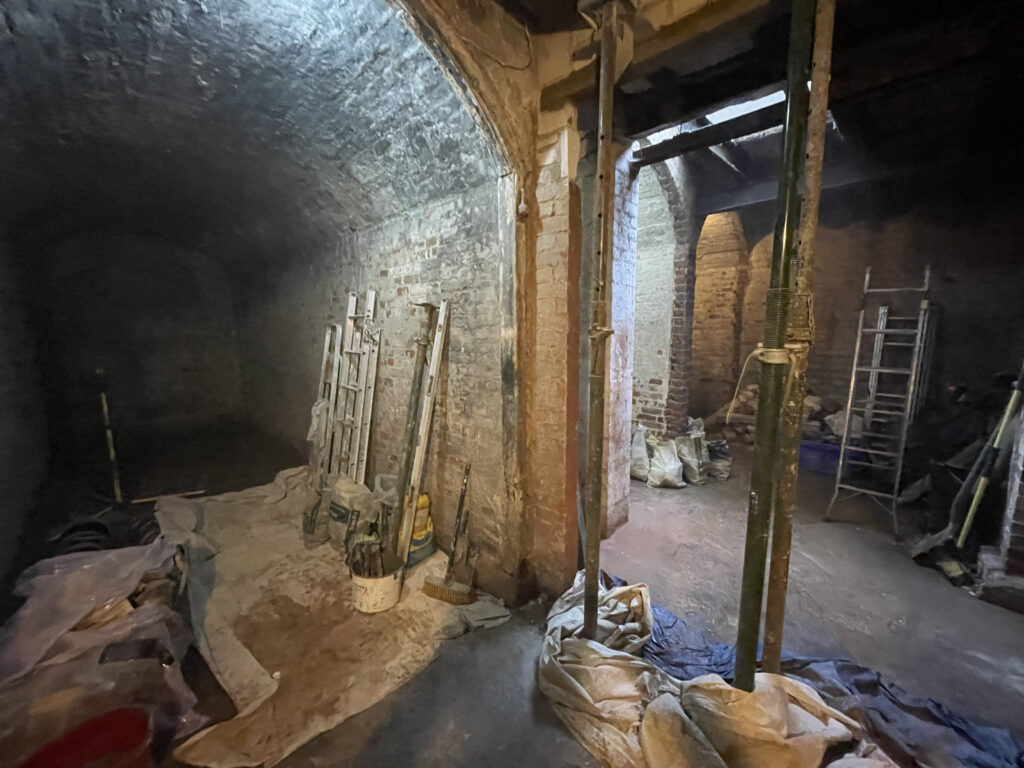
We’d previously renovated a damp, dilapidated cellar so we weren’t unduly phased by the prospect of a bit of hard work but it wasn’t until we moved in that we realised how big, deep and wet the space under the house actually was, and that parts may be medieval. We’ve spent the past two years researching the history of the house and Swan Avenue, while also renovating the house and the cellar – which were in a much worse state than we’d realised: full survey and everything.
The house was built in 1890 and for most of the time owners had either ignored the cellar or made botched attempts to dry it out, including partitioning it off with plastic sheeting and putting bathtubs down there to collect rainwater that poured through a terrace damaged by the bomb that destroyed the Swan public house on Sunday May 23 1943.
Coach House
Our house is built on the site of the old Swan Inn, which changed hands in 1837 when the owner went bankrupt. Between 1838 and 1840 the new owner invested heavily, installing a wood paneled function room and building a huge new coach house over the former ‘skittle ground’. A plan from the time says the new coach house had space for 36 coaches.
The railway arrived in 1851, rendering the coach house obsolete after little more than a decade. By 1857 it was being leased out to Hastings’ first omnibus company, and there are later records of it being used by a dairy and as storage for a brewery. Half of the grand coach house was demolished in 1890 but there are six remaining ‘vaults’ (as the chambers of the coach house were known), four of which are under our house.

Despite their grandeur, the vaults have an insalubrious history. Mr Kerridge, the first lease holder, was found guilty of tax avoidance (he claimed the horses he stabled in the coach house were all for his personal use) and he was also involved in a brawl outside one of the many local pubs during which he hit a prostitute over the head with a metal spittoon, something he later appeared in court for. He is described in court records as “a pugnacious fellow”.
Discoveries

We’ve had visits from several local historians and managed to put paid to a myth that the vaults were part of a tunnel network connecting to St Clements church. And despite Hastings’ love of all things pirate, we’ve found no evidence that the cellar was used for smuggling. The brick vaults were built on the front of a much older wall made of cut stone. It’s been suggested that the stone wall – which would have been about 30m long and 4m high – might be part of medieval hillside terracing, though we like to imagine it could have been a building platform within the West Fort.
There have been efforts to get the vaults listed, but because only half of the original coach house structure remains and they are no longer in their original context (they were buried when Swan Avenue was built and the street level raised), they were not deemed worthy.
Henry Ward, the acclaimed architect responsible for the street, wrote to the council to complain that the work on the houses could only begin when the vaults were cleared of rubbish and the walls were strengthened.
We found a lot of butchered animal bones jammed into the weep holes at the back of the vaults. We had a notion to fit a cement floor in the cellar until we discovered a small area of intact cobbles still set in lime mortar under the mud. We’ve spent two years uncovering the original floor surface, digging out a thick, smelly layer of silt and mud (120 rubble sacks of the stuff), animal bones, clay pipes, oyster shells and broken pottery (the previous owner also left a bathroom suite down there!). To make the original cobbled floors, the builders set beach pebbles in chalky lime mortar and used broken kerbstones to make tracks for the coach wheels. The cobbles extended out of the coach house and down to the High Street – we wonder whether the surface may still exist under the grass between the houses on Swan Avenue.
One of the vaults still has the original green painted surround for the long-gone 3.5m-high double doors and there are also the remains of gas lighting and fittings for securing carriages in place. In times of heavy rain there is a small stream at the end of the vaults carrying run off (and freshwater leeches) from the West Cliff, but opening up a skylight and demolishing a later partition improved ventilation, which dried out the entire cellar and made it a usable and characterful space.

Next Steps
The cellar remains a work in progress – we hope we have turned what was for years considered a liability into an asset.For the past two years our priority has had to be restoring the house, which was damp, lined with asbestos and still showed evidence of the bomb that destroyed the Swan public house. We recently took up the hallway floorboards in the hall and found a solid, dry floor underneath that could have been the floor of the barn or stable that sat on top of the coach house. At the moment we’re simply trying to conserve the vaults, though we asked people who came to last year’s open day what they would do with the space and suggestions included an art gallery, wine cellar, a dungeon and renting it out for photo shoots.
We are once again inviting people to visit – on the weekend of 29 & 30 July (10.30am-4pm) Swan Avenue has its annual bric-a-brac sale on the Saturday. We’re asking people to make a small donation (if they can) to visit so we can carry on with renovation. There is a relatively steep wooden staircase down so people are entering at their own risk.
David Clegg is a Hastings-based artist and curator, his latest project can be seen at thekeepersproject.com Visits welcome: 29 & 30 July (10.30am-4pm) 5 Swan Avenue, Hastings TN34 3HX
We hope you have enjoyed reading this article. The future of our volunteer led, non-profit publication would be far more secure with the aid of a small donation. You can also support local journalism by becoming a friend of HIP. It only takes a minute and we would be very grateful.

very interesting thank you for sharing