
Vendelis: The History of Old Winchelsea
David EP Dennis
Was there ever such a place as Old Winchelsea? Myth or a fisherman’s tale?
The truth is that in the early part of the 13th century, Old Winchelsea was in its period of greatest prosperity. It had a large commercial capability, and its wide bay was the usual rendezvous for the English Fleet. More than once the French attacked it. To summarise its maximum development, we can say from charters and other sources written by historians that it probably had:
Six thousand working people each day, seven hundred houses, fifty inns, three churches, a monastery, a leper hospital, a causeway, several bridges, covered shipyards for the King’s ships, several boatyards, a fish dock, a herring salting factory, salt pans, two tide-mills, a prison, sea walls, a harbour arm, a ferry service, crops, cattle, and horses in stables. It had wine cellars in nearby cliffs. It had accommodation for meetings and for permitting the king and queen to sleep over in the town – and they did. Its vast harbour could contain at least one hundred ships. It was known all over Europe and was a constant source of trade with the continent – specially France, Spain, the area of Gascony and Flanders. At one time, one of its residents, a Satanist, ruled the Channel Islands. It sent warships to Ireland, Wales, Scotland, France, Spain, and Portugal. It was the home of some of England’s greatest pirates.
Yet what is there now? Nothing but a ripple from the breeze across the Camber and Rye Bay. The sea has consumed all of it, and Neptune rules where Old Winchelsea once stood.
Origins

Historian William Durrant Cooper (1812-1875) described the area of the town’s eventual development as:
“A low flat island at the south-east extremity of the county, two miles south-southeast of the rock on which the town of Rye now stands. It was then bare and insulated.”
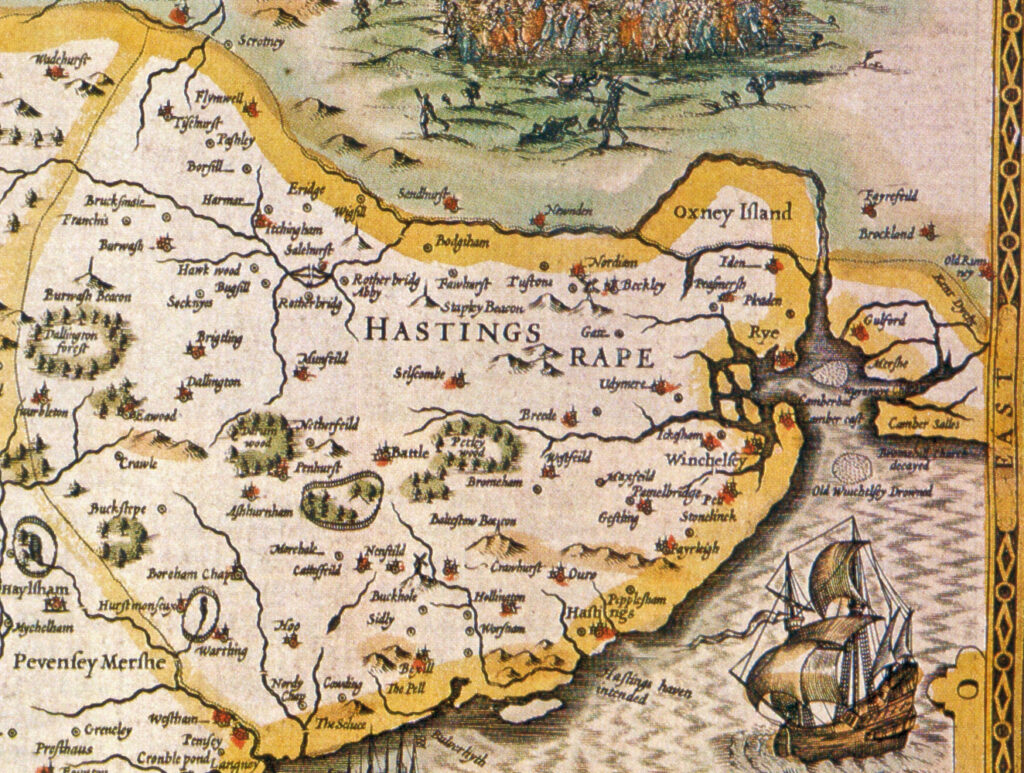
John Speed Map (1551-1629) date of map probably 1627
By ‘insulated’ he means ‘an island’ – it was certainly not ‘insulated’ from the elements! In fact it was a long peninsula – a giant shingle bank. Cooper’s description places Old Winchelsea between modern Rye and Camber. Here is a map dated to the 16th century giving readers an idea of its probable location:
There is no evidence that it was known to the Romans, but the Saxons certainly knew it as Wincel = corner and ea = water. However, although the Normans used it, they never put its name into the Domesday book. Instead it was hidden within Rameslie, along with Rye and Hastings – a huge area that was considered part of Normandy, not England, governed by the monks of Fecamp on the Normandy coast and commanded by the Norman Abbott of Fecamp. He would come over the Narrow Seas from time to time to visit it and ensure the monks were acting in the abbey’s best interests.
Remarkable Inhabitants

It is thought that King William the Conqueror (1066-1087) added Winchelsea to the Cinque Ports at the same time as Rye – as two Antient Townes. King William landed at Old Winchelsea in 1067 on his way back from Normandy after his coronation. These two landing places were certainly brought into the Cinque Ports before the time of King John (1199-1216), since in the first year of his reign, 1200, both Winchelsea and Rye rendered ship service in the small English navy and stated that they were members linked to Hastings. Their Latin motto was ‘Nobilium Membra Quinque Portuum.’
Old Winchelsea’s notable pirates developed an almost superhuman and Satanic reputation and consequently myths developed about them. They could do impossible things like disappear and reappear at will, make saints rise up into the sky and speak, be killed, cut into small pieces, thrown into the sea, and yet be miraculously resurrected to fight other battles and plunder foreign ships. Their notorious names are Eustace the Monk, Stephen Crabbe, the Alards and Simon, the son of Simon de Montfort.
It is therefore of the greatest sadness that this town, with such remarkable inhabitants was eventually destroyed. Old Winchelsea was a characterful and key part of the fabric of England from around 980 to 1287 – say three hundred years, and then it was gone in a single night.
Tragic Events
During the first half of the thirteenth century great storms, hurricanes and sea surges of enormous power pounded the coastline here. Up to 1250, Winchelsea had escaped pretty well, but in that year three hundred homes were lost, and events became progressively more tragic. Between 1250 and 1287, the foundations of the town were gradually taken into the sea with great loss of life – and yet the survivors rebuilt repeatedly until it became impossible, and they called for the king’s help. On 4 February 1287, a roaring great tide came in and never ebbed. Everyone foolhardy enough to remain on Vendelis was killed. Nothing remained except a tottering church steeple and after five more years that fell into the all-consuming sea. This is a severe lesson to us all as the coastline of Sussex is constantly challenged by the rising seas due to global warming. Millions of pounds are being spent to shore up our shores.
The historian John Leland (1503-1552) states: “The Ould Toune of Winchelsey of a vi or vii yeres together felle into a very soore and manifest ruine be reason of old rages of these.”
A New Town
Five years before it was totally destroyed in 1287, the King’s emissary, John de Kirkeby, Bishop of Ely, and Treasurer of England came to meet the surviving people of Old Winchelsea in its ruinous state left by the storms of 1250 and afterwards. He told them that the king would pay for a new town on the cliff top at Petit Iham (now New Winchelsea). By 1290, three years after the total destruction of the shingle-bank town, the new Church of St Thomas was being built on the clifftop. A new harbour was developed with a ferry and docks below the Petit Iham cliffs.
I do not think the immense value of Vendelis to our nation’s heritage is properly understood. Old Winchelsea was a vital entrepôt port for London and the monarch’s fleet rendezvous. Its inhabitants were hard-as-nails, self-serving pirates and plunderers, but with hearts of oak, prepared to die to defend their way of life, and yes, just sometimes if the money was right, to defend England too.
I am writing a book giving greater detail, to be published by Outset Publishing, and an academic paper on Old Winchelsea which will be published on Academia.edu in the next few months.
• David EP Dennis BA (Hons) FCIPD LCGI RAF Website: www.ddimages.org
We hope you have enjoyed reading this article. The future of our volunteer led, non-profit publication would be far more secure with the aid of a small donation. You can also support local journalism by becoming a friend of HIP. It only takes a minute and we would be very grateful.

Leave a Reply