
The Treasures of Galley Hill
By David EP Dennis
Many people in Hastings and Bexhill will know of the orange sandstone cliffs of Galley Hill, St Leonards-on-Sea, rising on either side of Glyne Gap – the old entrance to Bulverhythe medieval harbour. The cliffs stretch from the end of Bexhill Seafront and go on, with some gaps filled by beach huts, towards Bridge Way, where the wreck of the Amsterdam appears like a blackened Flying Dutchman in the low-tide sands.
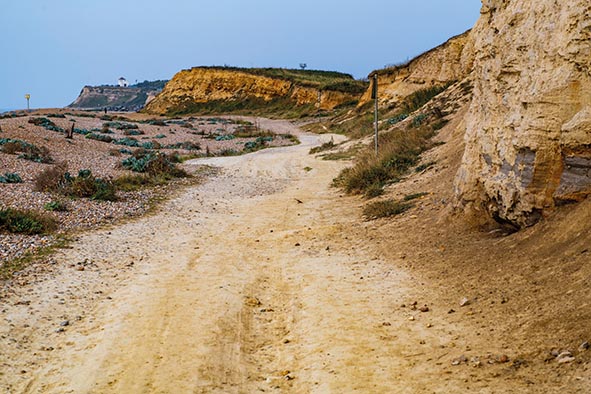
View of Galley Hill’s ancient cliffs
CREDIT: DavId EP Dennis
In earlier times, dinosaurs, ancient crocodiles, and huge turtles roamed these shores. The sands of the beach are Wealden Clay – where the dinosaur fossils are to be found, but the cliffs are not fossil-bearing, being Lower Cretaceous in age – that is, for budding geologists: Early Cretaceous epoch (Berriasian – Valanginian stages) approximately 143-139 million years ago.
As you walk through the coast path from Bexhill to Bridge Way railway bridge, please do study the cliffs and think about the community of Bullington, mentioned in the Domesday Book but now lost to the sea. It was once the main village for the port of Bulverhythe – a limb of the Cinque Ports. Ships and boats sailed in and out of Bulverhythe harbour between the Galley Hill Cliffs from the earliest times, and it was possible to reach Crowhurst by boat. Longshore drift put an end to the harbour hundreds of years later, but around the time of the Conquest, Robert – the Count d’Eu – established a new monastery here, with Norman monks from the Abbey of Saint-Michel du Tréport, and this was linked by sea to St Mary’s Chapel at what is now called ‘Abbey Drive’ above Glyne Gap marshes where there is still a ‘Monk’s Walk’.
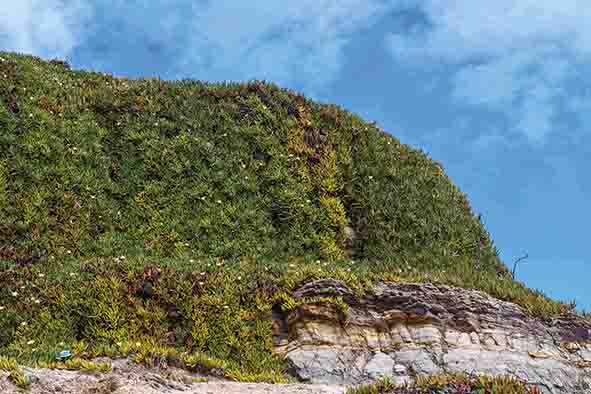
Hottentot Figs invading the cliffs
CREDIT: DavId EP Dennis

Harbour docking records show that in an Assembly of those in charge of harbours for the Cinque Ports held at Bulverhythe (then called Bulverhide) on 22 September 1676, it was decreed that all:
“shallops and other outlandish vessels, which put into Bulverhide haven, or stretch a rope or line, and if any the maisters or men thereof doe come on shore wherever within the libertie of this towne, shall paie 12d. for everie vessell to the pierwardens.”
In recent times, due to global warming and the threat of sea level rises, the clay edge to the Galley Hill Cliffs has been overlain in places by 100,000 tons of Norwegian granite, acting as sea defences – so fossil hunters need to look at the shingle foreshore, rocks, and sand at low tide. Dinosaur footprints have been found!
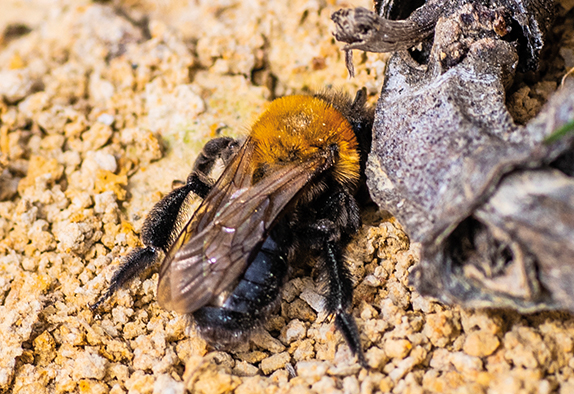

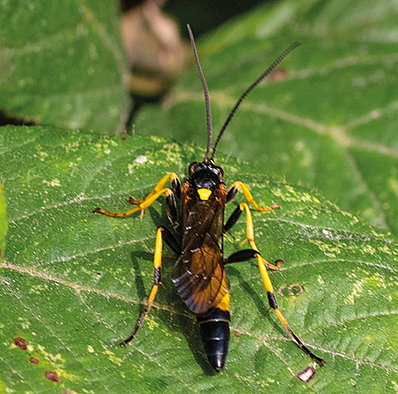
Left to right: Early Colletes rare mining bee tunnelling; Yellow-horned Poppy; Ichneumon parasitoid wasp
CREDIT: DavId EP Dennis
The Wildlife of Galley Hill
There is no doubt that what was formerly considered to be rare or threatened wildlife has been made ‘normal’ by global warming. There is a spread of life from the Continent. For example, in Combe Valley to the north of the Galley Hill area, we have the spread of the small red-eyed and willow emerald damselflies, both seen in far greater numbers in the last two years.
This Galley Hill area is inside the Combe Valley Countryside Park boundary, but not yet inside its Site of Special Scientific Interest (SSSI). So what wonders can we offer? First of all, it is a pleasant and beautiful area to walk in, with sun and sea breezes – and huge areas of sand at low tide.
Sea kale (Crambe maritima) patches have spread extensively along the beach. Many cormorants (Phalacrocorax carbo) that roost at Pebsham Lake, come to the Galley Hill foreshore and rocks to feed. I have managed to photograph 22 of them on one rock. Next, we have a high number of turnstones (Arenaria interpres) that move between Bexhill and Greenland each year – and wheatears (Oenanthe oenanthe) that migrate each year from Africa. They see Galley Hill as a refuge – ‘first landfall’ and need to fatten up on insects before making the return journey to Kenya and Senegal, south of the burning Sahara. They feed on the cliff faces by catching insects that fall out of the grasses on top of the cliffs. Then they fly to hide or perch in the sea kale beds, among the pebbles. Obviously, we don’t want to disturb them, so please don’t go too near between April and August – early September, but you can hear them making their chirping noise whilst hidden away in the greenery.
Along this beach section in front of the cliffs, many interesting plants grow, including the Yellow-horned Poppy (Glaucium flavum). There are other special plants that attract the rare Six-belted Clearwing Mothvwhich feeds on their flowers (see https://en.wikipedia.org/wiki/Bembecia_ichneumoniformis).
There is a colony of fairly rare mining bees called Early Colletes (Colletes cunicularius Linnaeus 1761). These burrow into the sandstone of the cliff faces (see photo). There are also small numbers of Ivy Bees (Colletes hederae) and the Bee Killer Wasp, also called the Bee Wolf (Philanthus triangulum).
Goldfinches (Carduelis carduelis) are often seen pecking the seed heads of the many teazles. On the clifftops we may see pied wagtails (Motacilla alba) and down on the seashore we have a flock of oystercatchers (Haematopus ostralegus).
I have also included a shot of the fascinating (but not rare) Ichneumon wasp – yellow and black Diphyus quadripunctorius which settles on the blackberries. Migrant Hawker dragonflies (Aeshna mixta) are also seen here, which is unusual for sea cliffs. A number of butterfly varieties can also be seen, included Clouded Yellow (Colias crocea) and Painted Lady (Vanessa cardui), as well as the usual large and small White, Red Admiral, Peacock and Holly Blue.
Well, there’s a few history and wildlife treasures for you. I know that the people of Hastings and Bexhill, in the main, are lovers of nature and so please tell your friends that if they do walk their dogs beneath or over the Galley Hill cliffs, that there are some special creatures to be protected. I know it’s difficult because you want to give your pet a good run – but if you can keep them out of the sea kale beds, that would be a great help. Thank you.
We hope you have enjoyed reading this article. The future of our volunteer led, non-profit publication would be far more secure with the aid of a small donation. You can also support local journalism by becoming a friend of HIP. It only takes a minute and we would be very grateful.

Leave a Reply