
The Net Shops – Part Two
Local historian, author and honorary curator of the Fisherman’s Museum, STEVE PEAK, explores the history of the net shops. See the last edition for Part One.

All the unique and famous Hastings’ net shops in Rock-a-Nore Road were built from an 1835 town plan, aimed at squeezing as many buildings as possible on to what was then a very small piece of new ground.
They all had a roughly similar design: a very slim frame, with diagonal bracing to give strength against the wind, and overlapping planks on the outside. Headroom on each floor was low, making it easier for fishermen to lift up and hang heavy nets on the beams supporting the floor above. In each ceiling there was an opening, about two feet square, with a ladder attached to the wall going up through it. The net shops all used to be covered in black tar, as were the boats, which was readily available at a cheap price from the Hastings Gasworks.
BURNING NET SHOPS
Sadly the tar made the buildings very combustible, and many net shops were lost to fires. The biggest fire, in 1846, burnt down about 20 net shops on, and to seaward of, today’s Winkle Island. A public subscription to help the owners of these lost net shops covered their rebuilding cost, and there was also enough surplus to build the East Well, the fresh water supply tank still standing next to the East Hill Lift. Fresh water was a commodity hard to find in Hastings Old Town in the early Victorian years, and the East Well was a valuable resource for fishermen and their families.
From the 1840s, Hastings Old Town expanded along under the East Hill, with many industrial and commercial businesses being set up along the foot of the cliff. To make room for these buildings and their traffic, several net shops were moved from the inland end of their rows to the seaward end. In 1859 the track was given the official name of Rock-a-Nore Road.

HOLIDAY-MAKERS
But in the 1850s, Hastings also started becoming an increasingly popular holiday resort, following the arrival of the railways, and Hastings Council then began gradually trying to clear the net shops to make way for tourist shops and cafes. This started with removing the pre-1835 net shops and sheds that stood between the Cutter Inn and the High Street, and all were gone by about 1860.
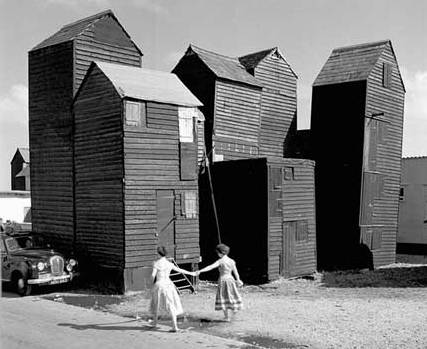
However, getting rid of the many net shops and other fishing-related buildings from the High Street along to Rock-a-Nore was more difficult, being very intensively used. In the late 1860s and early 1870s the Council was improving the town’s sea defences by building new groynes all along the seafront, but none were put up in front of the Old Town: the town hall hoped this would literally wash the fishing industry off the Stade, forcing the fleet to move to Rye so that tourist attractions could take their place.
STORM DAMAGE
And this nearly happened. In November 1875 a storm washed away 14 net shops, and in the early 1880s a large number were destroyed in several severe gales, including the whole block opposite the London Trader pub. But this policy created such a public outcry that the Council had to back off from its anti-fishing industry strategy, and instead to build a large new groyne at Rock-a-Nore, which was completed in 1887. Number Three groyne, as it is officially called, made the beach much bigger to the south, thereby stopping the sea from threatening the net shops, and creating more space to build new ones.
FISHING IN DECLINE
From the 1890s the Hastings fishing industry began a long period of decline that was to last until the end of World War Two. As the fleet shrank and the town’s tourist industry grew, Hastings Council steadily took over parts of the Stade for use as car parks, amusement centres, coach parks and other trades. The last major loss of net shops took place in 1929, when the large mixture of old buildings forming Mercers Bank (on, and to seaward of, today’s Winkle Island) were nearly all removed so that Rock-a-Nore Road could be widened to what it is now. There were about 13 net shops in Mercers Bank, and all bar three of these were removed, along with all the other buildings. The only survivors of Mercers Bank are the three net shops opposite Winkle Island.
When the fishing industry revived after World War Two, the remaining net shops began to be used less: from the 1950s most of the natural materials used in fishing gear were being replaced by nylon and other weather-resistant synthetic substances that did not need to be kept dry and did not have to be stored inside buildings. The fishermen were also constructing their own sheds out on the beach, primarily to house a winch to haul their boat out of the sea, but also to store gear.
OHPS TO THE RESUCE
By the mid-1950s, it had become clear that the net shops were a tourist attraction, while at the same time their future was in doubt because they were much less used by the fishermen. How were they to be looked after? From 1956, the Old Hastings Preservation Society (OHPS) took the initiative and did its best to maintain and restore the net shops as they fell out of use.
Then the second biggest fire amongst the net shops after that of 1846 took place on 24 June 1961, destroying four at the seaward end of Rows T and U, and damaging net shop U3. This spectacular blaze actually helped the surviving net shops, for it highlighted their deteriorating condition and prompted more public help. A restoration fund was set up, and it received enough donations to pay for four new three-storey net shops to be put up on the same sites.

But by the late 1970s, many of the net shops were in an advanced state of structural disrepair, and much investment was needed in order to preserve them all. Spurred on by the OHPS, Hastings Council in 1984 launched an ongoing annual maintenance programme of all the net shops, which I (Steve Peak) have been involved in ever since.
Also in the mid-1980s, I collected many old items of fishing gear, which I have on display in a net shop bequeathed to me, close to the Fishermen’s Museum. I call it the Net Shops Museum (now owned by the OHPS) open to visitors most Sunday afternoons between 2.00 and 3.00pm, if the weather is OK.
The full story of the net shops is on Steve Peak’s new website hastingshistory.net, and in his book Fishermen of Hastings, on sale in the Fishermen’s Museum.
We hope you have enjoyed reading this article. The future of our volunteer led, non-profit publication would be far more secure with the aid of a small donation. You can also support local journalism by becoming a friend of HIP. It only takes a minute and we would be very grateful.

Leave a Reply