
Should Hastings follow the Basque Country’s lead?
After attending a talk on bottom-up regeneration, regular contributor and former Community Editor, ROD WEBB, visits a grassroots community project.

ROD WEBB writes about the recent inspirational talk on social change by Gorka Espiau who was invited by Hastings Borough Council Cabinet.
The regeneration of the Basque Country in Spain after fifty years of conflict is an uplifting story. Gorka Espiau was an active member of the Basque Peace Movement but for the last ten years has been involved in untangling the ingredients that enable change to happen.
It’s also uplifting living in a town where social connections are so readily available. In this case, Cllr Simon Willis happens to be a friend of Gorka from his time as CEO of the Young Foundation where Gorka worked on transformation projects in the UK. And Hastings being a town of strange connections, Gorka has already been here before – when his father was learning English, and he was learning to walk.
At the heart of Gorka’s talk is the way change can lead to more equality, as was the case in the regeneration of the Basque Country, rather than less (as we have become so used to). Almost immediately the word ‘collaboration’ came up, something this town strives so hard to achieve, not always successfully.
Gorka pointed out something we all know but rarely manage to apply: “Transformation is never about one person” which is why it’s important to represent successful transformation as a “collective action”. The West has become too attached to individual action and that needs a strong counter-narrative.
Gorka is well aware that Hastings is in a moment of transformation and understood that his talk was particularly pertinent to this town, where some people feel a sense of disconnect with the change that is coming.

THE BASQUE TRANSFORMATION
The first half of the talk was about what happened in the Basque Country, also known as the Basque Autonomous Community, and how standard analysis of ‘structural changes’ within society often miss the dynamics of social change.
Something that is normally considered a negative driver–the flight of capital from Bilbao to Madrid–led to a far more fundamental change such as worker cooperatives taking over businesses. One example he mentioned was the transformation of an arms factory into one of the most successful bicycle factories in the world.
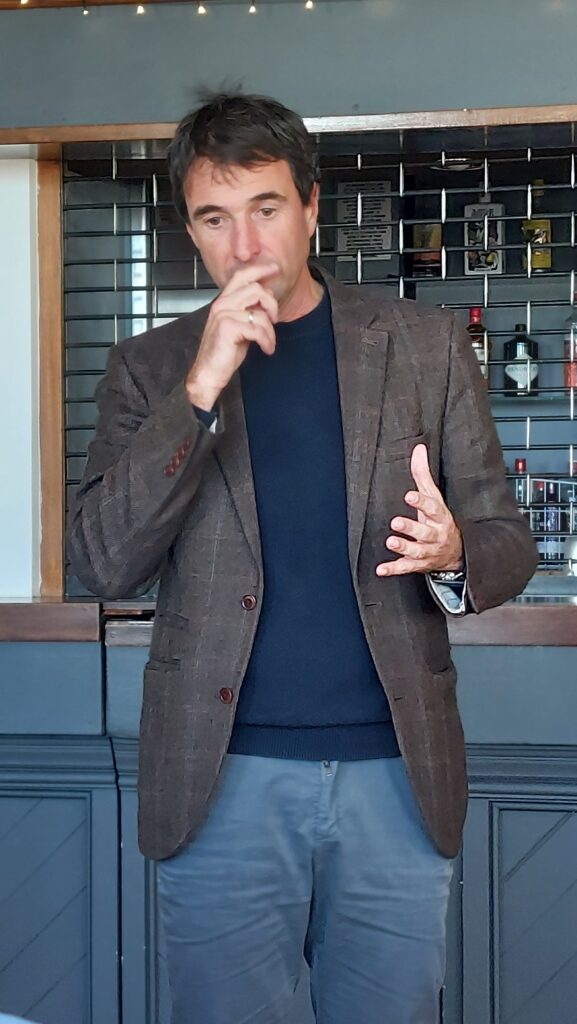
Gorka collects his thoughts
Over time, this kind of economic change enabled local government to raise substantial amounts of money through taxation. They could do this because central government, seeing little future for the region, had offered to devolve the power to raise taxes, which was accepted. Breaking the safety net of central government funding in a serious slump was a risky decision. But a willingness to take risks is part of the story that Gorka had to tell. This risk certainly paid off once the economy had revived.
The famous Guggenheim Museum played a role, but not because it was imposed on the general population as so often happens with high status projects like that, rather because they bought into the idea. In effect they were saying, ‘We need an artefact to show the transformation that is already taking place. We are Basque and have a plan’. And bear in mind that the proposed museum had already been touted round the capitals of Europe and rejected by them.
At the start of the transformation, only 15% of the population spoke the Basque language. Twenty or so years later, it is about 37%, with the majority of the Basque students being taught in the Basque language. Not only that, but according to a BBC report from 2016, “Almost 48% of the working-age population has a degree-level qualification, similar to the levels in Finland and Norway,” as well as, “An unusually high proportion of these graduates, almost half, have studied science, maths and engineering.” All this required investment: “If the Basque region were ranked as a country, only Denmark and Austria would have higher levels of per-pupil spending in Europe.” So how was such enormous change brought about when there was no money?
THE DRIVERS OF CHANGE
According to Gorka, it was all down to a collective narrative. They had a social story that ended up becoming reality: “Basque people throughout history have always survived and nobody has helped us”. So the values are collective action rather than individual action. With the schools, for example, people were prepared to mortgage their houses to rebuild a Basque language education, Gorka explained. So the values also included sacrifice for the common good.

As already mentioned, one of the key factors that emerged from the study was how the transformation had led to more equality rather than, as so often is the case, to more inequality. Gorka points out that, when studying transformations that have occurred in other parts of the world, the correlation between the drivers of change become clear. Change dominated by individual action would lead to more inequality, change led by collective action led to more equality – as was the case in the Basque Country.
As all narratives, the Basque ‘story’ was not always entirely accurate. Gorka gave the example of a gastronomic movement that was based on the idea that ‘good food was in the Basque genes.’ Apparently not so. The movement was generated by borrowing from the French over the border and doing it better – and ‘doing it better’ came about by restaurants working together to create the change. The Basque Country quickly became renowned for their good food. In 2020, Recette Magazine wrote: “… it is said that the Basque Country boasts the highest concentration of Michelin-starred restaurants, per-capita, of any other region in the world.”
WHAT ABOUT HASTINGS?
The general perception is that the town is changing and although much of the change is welcome, there is a constant worry that what is perceived as gentrification will benefit those new to the town at the expense of the less well off as has happened throughout the country.
But as Gorka explains, buying into the process of change is often the most difficult step to achieve and is a good starting point, leaving simply the concerns over consequences to be tackled. He sees the problem as the ‘appearance of change’ while things basically remain the same underneath, especially with deepening inequality. His message is that “change is possible without inequality”.
Taking housing as an urgent problem that needs to be tackled in the town, it was clear that he was advocating a very different solution than the piecemeal way things are currently carried out: creating a portfolio of experimentation. This would involve “generating a safe space for experimentation” where it is possible to test different things at the same time.
The portfolio would contain low-risk solutions, safe options that are known to work (to some extent at least); pilot projects that have worked elsewhere but contain some risk in a new location; and pure prototypes, new ideas that have never been tested.
All this involves the capacity of the town to visualise its own ecosystem, including who is doing what, and the ability to listen in a profound way, as opposed to the ‘tick box’ listening which provides the transactional information discussed above. Rather it requires collective sense making, a collective interpretation of all the information available.
All this would clearly be a challenge for a cash-strapped, risk averse local council. But with the invitation coming from the Hastings Borough Council Cabinet, it could be a step in the right direction.
For a talk on Conflict Resolution by Gorka visit thailandsocialinnovationplatform.org/gorka-espiau-basque. For more information on the Young Foundation visit youngfoundation.org/about. For related information on community participation visit participatorycity.org
Celebrating Progress
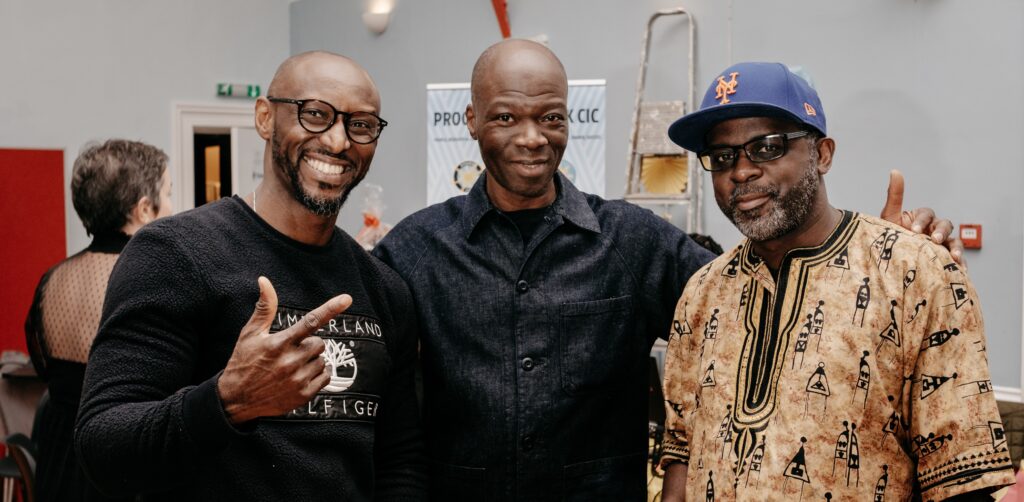
Directors of Progress Network, Jerome Odibi, Anthony Odegbami, and Aaron Hosannah
After living in this town for ten years I thought I was used to all the work going on behind the scenes to create and maintain a thriving community. But I was still surprised by the scene that greeted me when I walked into the Concordia Hall to join the Big Celebration two weeks ago.
The hall was not only packed with people but was also generating an intangible sense of energy and purpose that gave the gathering a genuine festive feel. There were well over 150 people there with others still arriving. There was music, there was drumming, there were stalls displaying artwork and poetry written by participating children. At the front of the hall, children were being entertained by the founder and chairman Aaron Hosannah with interactive drumming and storytelling. At one point, a dragon danced down the aisle and out the door.
Aaron explains: “As a man of Guyanese descent, gatherings are opportunities to bring people together to celebrate as one and to eat, dance, and communicate with one another and to connect with our neighbours. It’s also a great opportunity to showcase the richness, creativity, and vibrancy of our community through showcasing our talents and skills, and to encourage everyone to bring and do their best.”
The Big Celebration Is an annual event, now in its third year, where the organisers of the Progress Network pay tribute to the local community members who make a positive impact throughout St Leonards and the wider area. This includes a series of award ceremonies for children and young people and recognition for outstanding community contributions.
Not long after I arrived, Aaron gave an inspirational talk about the struggles he faced in setting up the Progress Network. It’s taken seven years and some false starts to get the project to where it is today, since only really gaining traction in 2020. But, after watching the video presentation that night, Progress Network’s story validates what Aaron went on to say: “Don’t give up on something good.”
Progress Network works with the local community in “establishing primary needs, setting aims, designing solutions, and facilitating activities.” They also help local community members to acquire skills that can be used in leading workshops and other roles in the organisation with a focus on finding solutions to everyday problems in the community.
“Our aim is to provide an environment with activities that reverse the lack of opportunity by supporting talent and skill development via youth-led social engagement programmes,” he says.
Two of their main weekly clubs are the Great Work Creativity Club supporting STEAM and life-skill development through creativity and St Leonards Sparks Football Club, which supports mental and physical well-being.
The celebration was also an opportunity for Progress Network to review what has been achieved throughout the year with the support of the organisation’s many volunteers, such as the Reimagining & Repurposing of Misused Spaces project. This is where I learned about all the things that have been going on – sometimes only a few metres away as I walked around St Leonards – referring particularly to the site in St Leonards just behind the row of shops on Kings Road.
“Up until now this has been an eyesore, left derelict and abused,” Aaron explains, but has been transformed into a “safe vibrant community space through an inclusive community-led beautification project,” which has allowed participants to take ownership.
Aaron describes how the transformed space has been used for creative workshops including arts, mental health & well-being, drama, entrepreneurship for children and young people, skincare, drumming, as well as social events and meetings with local community members, businesses, and residents.
The accompanying film for the year review demonstrated clearly the enthusiasm generated by the events which also include:
Super Family Funday to support and promote health and fitness within the larger community.
Young Stars Entrepreneur Fair to young people and children to recognise skills and abilities and gain skills in entrepreneurship.
Progress Camping to go beyond the daily grind and take away a group of local people to enjoy nature, de-stress, and relax.
Movie Nights in the Park, bringing the cinema to the people in natural spaces to congregate and enjoy.
Progress Network is a truly multicultural community organisation welcoming young people and children predominantly in the St Leonards area, but also in parts of Hastings, Ore, Hollington and as far as Eastbourne. They currently work with over 150 families locally and bring people together from all walks of life and ethnicities.
As the Progress Network’s website declares: “Saint Leonards is in one of the most deprived council wards in East Sussex with inequalities caused by various socio-economic factors, lifestyle, and poor access to services.” And they are determined to do something about it, believing that all individuals regardless of age, ethnicity or humble beginnings should have the opportunity to become “the best version of themselves.”
Other commitments forced me to leave the Big Celebration before the food arrived, provided by Jerry Odibi of Mama Putts who is also secretary of the Progress Network. But I couldn’t resist the mouthwatering smell as I passed the kitchen and took a peek. As with all great community events, sharing food is at the heart of it.
Find out more about The Progressive Network, the people behind it and what they do, by visiting progressnet.org or their Facebook page @progressnetworkcic.
We hope you have enjoyed reading this article. The future of our volunteer led, non-profit publication would be far more secure with the aid of a small donation. You can also support local journalism by becoming a friend of HIP. It only takes a minute and we would be very grateful.

Leave a Reply