
Poison Pen
Hastings once had another community newspaper, Poison Pen. DAVE YOUNG investigates its anarchic story.

The alternative press has a venerable history in the UK. From the radical pamphlets of Victorian chartists, via Claud Cockburn’s antifascist The Week in the 1930s, to Oz and International Times, both grounded in 1960s counterculture. Community-based papers like the Rochdale AlTernative Press, frequently took on topics that mainstream media wouldn’t, such as revelations about their local MP Cyril Smith. In the early 2000s, The Hastings Trawler, edited by Stuart Christie, (see HIP 136 Untimely death of an anarchist) flowered briefly, while Poison Pen, a grassroots samizdat newssheet, fitfully appeared during the decade 1978-88.
Anarchic inspiration
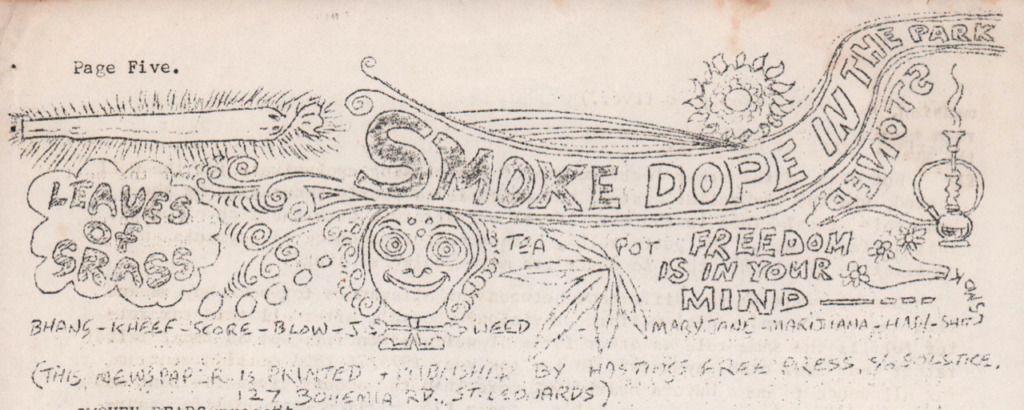
Poison Pen (PP), “Britain’s only anarchist weekly”, resembled a counter-cultural Venn diagram, where left-wing fellow travellers met new-age dope smokers. Hand-typed and illustrated, PP’s agitprop-orientated editorial content was eclectic. Mixing insightful environmental awareness with support for gay rights and the unemployed; often undermined by self-indulgent paranoia and horrible sexual politics.
Exhorting welfare claimants to protest, and ranting impotently about Thatcher and Reagan, PP often resembled an exercise in self-parody. Unsurprisingly, the paper seems to have been roundly ignored by the working classes it claimed to support. Conversely, it also ran perceptive news stories on declining local NHS and bus services that remain wearily familiar today.
The 1978 archives for Hastings Observer, a paper vehemently hated by PP, reveal: “A free local radical news magazine called Poison Pen was started by Michael Bloxham.” Hastings Anarchists and Poison Pen shared a joint address in London Rd, St Leonards, an occult bookshop. Solstice was run by Phillip Bloxham, who wrote in the paper under the nom de plume, The Druid. His brother, Michael, worked at Hastings Unemployed Centre, writing as Sir V. A. Lanc and The Vicar. “All articles printed verbatim,” declared PP. Hence this awful example from ‘Rat’ in issue 2, volume 4: “Walking the streets of Ore last Friday in the hope of being raped by a gang of schoolgirls wearing gymslips and navy-blue knickers…” Despite espousing equality, most of the by-lines were male, with Claire, Janet and Wendy only namechecked for typing and “clearing up the printing place…”

Earnest environmentalism
Within its crudely typed pages, Poison Pen displayed a prescient grasp of environmental problems, including asbestosis, whaling and sea pollution. “All life on this planet depends to a large extent on oxygen generated by microscopic marine organisms… that suffer most from pollution. Over the last 25 years, pollution has gone from a few cases to today, where… fish and seabirds lie dead…”
Nuclear fuel as a power source was questioned: “Since… last week’s PP, in which an anonymous caller warned of the true extent of the danger of leakage at the Dungeness nuclear power station, we have received confirmation… the only means of disposing nuclear waste from Dungeness is to give the less radioactive material to a haulage company who then drive up and down the country looking for somewhere they can bury it…”’
The article continued: “A protest march against nuclear power… supported by Friends of the Earth, the Ecology Party, and Hastings Anarchists, …went from the Old Town to the town centre. They were especially concerned about plans to build a third nuclear power station at Dungeness. The Hastings Anti-Nuclear Group… tried to have a stall in the town on Saturdays, but… the police confiscated their literature.”
See you in court
Poison Pen’s would-be fifth columnists frequently lamented “feeble trade unions” and disliked the Labour and Liberal parties, often descending to personal abuse. The Hastings Observer reported: “Mr. Bloxham, plus Keith Rodway and former Labour councillor Penny Beale, were sued for libel by the deputy mayor, Jack Cook, for claims about his attitude to migrants. Cllr Cook won the case [in] April 1980, and the defendants were ordered to pay his costs of many hundreds of pounds.” Cook later defected to the SDP.
A recent Guardian report on the marriage of Simon Kirby, MP for Brighton Kemptown, revealed another changed political affiliation: “On the day of the marriage of Prince Charles to Diana Spencer, Kirby snubbed the street parties in his hometown… for a day of drinking with a group then known as the Hastings Anarchists.
“It wasn’t 16-year-old Kirby’s first encounter with the ragtag group of 20 or so believers in a leaderless society. A fellow anarchist at that time, Melita Dennett, said: ‘Simon was a regular fixture for about a year… We used to write a Private Eye-style magazine, the Poison Pen, and I believe he read that, liked what we stood for and that is how he got involved…’”
Poison Pen wrote: “Assorted anarchos, friends and others equally fed up with the crappy day came together on West Hill… the weather was fine, [and] we all had… fun in various states of inebriation.”

In July 1980 a new Hastings Rights Centre was set up by the Hastings Anarchist Group and the Association of Single Parents. According to PP, it provided: “Free advice, information and general assistance, up on the West Hill in Whitefriars Road. You might have noticed the write-up… in last week’s Hastings News, the town’s only other free paper.” (This is the only known reference to this publication, if anyone can shed light please get in touch with HIP.)
End of an era
A contributor to the alternative press forum at e-zine, Urban75 commented: “The good thing about many of the cut and paste magazines coming out from the 1980s onwards was people expressing opinions based on how they felt, rather than… political or ideological structure, perfect grammar, [and] punctuation. “Honest and straightforward… the emotional responses of ‘ordinary’ people can never be as articulate as ‘trained’ journalists, but neither are they… so bland, or sycophantic to their advertisers and readership.”
In July 1988, the Hastings Observer noted: “Outspoken welfare rights campaigner, Mike Bloxham, announced he would be leaving Hastings. For many years he’d played a leading role in radical political movements in the town; his departure was welcomed by the Labour Party.”
An editorial in PP commented: “[It] has received much criticism, some in the form of praise and some in the form of outrage and anger, and we feel that the fact it is free gives us an excuse… to print what we want to. However, feelings within the collective and from some… readers suggest Poison Pen is rapidly outliving its usefulness, it’s become jaded and predictable, or “irrelevant” as one journalist put it.”
Further reading available on the following websites: archive.org/stream/PoisonPen/Poison%20Pen_djvu.txt; urban75.com; thesparrowsnest.org.uk; hastingschronicle.net/key-events/1950-1979
Always broke
Poison Pen was produced on a duplicating machine – funds didn’t stretch to typesetting. Consequently, production standards were amateur. “Thanks to the astonishing reaction to our appeal for funds, PP is on the streets for another week. We collected £13… Costs vary depending on how many sheets we print… to produce each issue is about £10.00, half collected in donations, the balance made up by the Hastings Anarchist Group.”
Later an urgent plea: “We have hit a financial crisis. Our duplicator… needs a service, costing £26.00. If you want to see Poison Pen continue… donate. If you don’t, we will be off the streets, perhaps permanently!”
Small ads from the pages of Poison Pen
SOLSTICE: The Vicar and the Druid sit in splendid squalor and invite you into their Dickensian Emporium of faded parchment mould for a browse among their ancient tomes. Also available, crystal balls, psychic pendula… everything for the home Occult enthusiast. 127, Bohemia Road.

UNNORMALITY: Hastings’ most historic record shop. A quaint back-street emporium containing everything for the vinyl fetishist. The very legendary and wonderfully Large Richard invites you to come and get it… 90b, High Street, Hastings.
We hope you have enjoyed reading this article. The future of our volunteer led, non-profit publication would be far more secure with the aid of a small donation. You can also support local journalism by becoming a friend of HIP. It only takes a minute and we would be very grateful.

Re. Poison Pen article The Hastings News was a free paper which ran from the ‘70s to the late ‘80s(?) I’d imagine The Observer doesn’t mention it in the archives because it was a rival & impacted on their sales at the time
Ah, the rattle of the Roneo machine every Friday afternoon in my front room… Funny article, you seem to take it far more seriously than we did! As an aside to the Jack Cook story, the 3 PP defendents never paid a penny, and apparently the local Labour party met the costs (naughty). And I still have the photo of Simon Kirby at the West Hill r*yal w*dding pissup!
Well, what a blast from the past. Mike Bloxham and I founded Hastings Anarchist Group (HAG). Mike was not my brother. We were friends and ran the Solstice bookshop together, specialising in magic and the occult. Shortly after we started producing Poison Pen (PP) we discovered our phone in the shop was being tapped. It remained so all the time we were there. We later learned that the Chief Constable of Sussex had referred to HAG as scum who should be wiped from the face of the Earth. A proud moment.
For a couple of years, the duplicator on which PP was produced lived in my spare room. Every Friday, we’d run off copies and take them to the Lord Nelson in the Old Town, our main distribution hub. On Saturdays, a couple of CID officers would turn up at Solstice and grab a couple of copies to pass around the police station. There were at least two attempts to insert police informers into our midst. I suspect they misunderstood us. They probably thought of us as cartoon anarchists carrying round bombs with ‘BOMB’ written on the side. We were actually more of a social club and mostly staunch pacifists. We set up a branch of the Claimants Union to help people get benefits they were entitled to. We campaigned to save a local cinema. We uncovered corruption in local politics. We campaigned on ecological issues. Clearly scum…
Mike defended himself in the Jack Cook/Labour Party libel case. The judge took a shine to him, so the JC/LP lawyers offered him a deal. They’d drop the case against him if he agreed to pay a penny in damages. He asked what they’d do if he didn’t pay the penny. They said nothing. The case was heard at the High Court in London. In one of the corridors, we discovered a large glass case with a stuffed judge in it. Very surreal.
I ceased to be involved with HAG in around 1980 out of exasperation with some of its members. Not you, Melita, in case you were wondering.