
Happy Birthday Hastings Pier
Steve Peak presents the history of Hastings pier on its 150th birthday
Hastings Pier celebrates its 150th birthday on 5 August. It started a new phase in the history of the British seaside piers, being the first pier designed as a multi-purpose entertainments centre rather than a seaside promenade and steamboat landing stage.
On 5 August 1872, the new Hastings Pier was declared to be a ‘peerless pier’ because of its unique 2,000 seat grand pavilion. None of the 29 British piers built before then had had such an attraction included in their design – a venue for bands, theatre and many other forms of leisure, whatever the weather. The success of the unprecedented Hastings venture prompted many of the then-existing British piers to follow the example, and such pavilions were to become a common feature of both the pre-1872 piers and the 55 piers built after then.
Leading attraction
The new Hastings Pier straight away become the town’s leading tourist attraction, and was to remain so until the late 1970s. The 910 ft-long pier was constructed at the west end of the town of Hastings, on its border with the rival up-market resort of St Leonards-on-Sea. On that August bank holiday in 1872, crowds of visitors and local residents thronged the streets to see the grand procession and opening ceremony, but it rained hard all day and strong winds lashed the seafront.

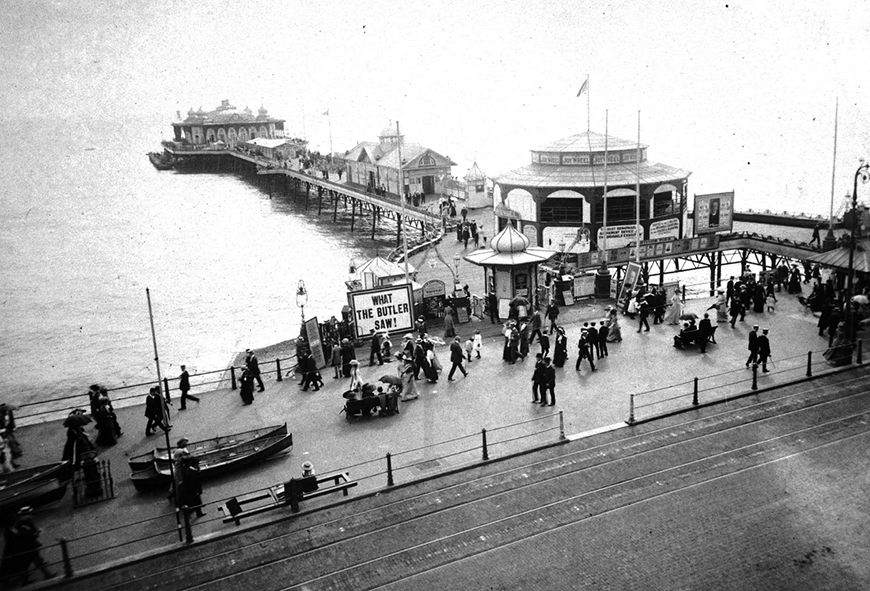
Opening day (1912)
The pier was an unexpected and immediate success, attracting hundreds of thousands of visitors every year and giving a significant reward to its investors. The pier’s triumphant early years also helped boost two decades of expansion and investment throughout the town, turning it into a popular destination for the new generation of day-trippers and holiday-makers. This boom in the fortunes of Hastings and its pier prompted the building of a rival pier less than a mile away, in St Leonards in 1891.
But by the late 1890s the two towns had begun a long period of steady decline, forcing both piers to rethink their priorities. In 1910 Hastings Pier began a non-stop era of constantly changing its attractions, a move that helped renovate the town as a major seaside resort in the 1930s.
First world war
An American bowling alley and a large joywheel roundabout were built in 1910. In 1914 the 220ft of the pier nearest the promenade were sold by the Pier Company to Hastings Council, just as the First World War broke out. Work began immediately on creating the ‘parade extension’ by widening that part of the pier to 220ft, and this officially opened in April 1916. Over the following four months two curved shelters were built around a new bandstand, along with a well-designed building which formed the Pier Company’s frontage onto the Council’s parade extension. The western bandstand shelter was the only building on the pier to survive the 2010 blaze.
An unexpected and immediate success (1912)
The Pier’s 1872 pavilion was destroyed by fire in July 1917, and it took five years to replace it, but with a frail and unattractive barn-like structure. Attempts were made to improve it several times in the following years.

In the late 1920s the section of the pier that was 45ft wide was widened to 90 feet, and several new buildings were put on it, including a medium-sized pavilion.
Liberty from legal constraint
A little-publicised ingredient in the Hastings Pier Company’s financial success in its early years was that just over half of the pier lay outside the town boundary, and therefore this section did not have to pay an annual council tax to Hastings Council, or to any other local authority. Until 1937 the borough boundary ran across the pier just under half way out from the shore, and only this inland portion had to pay the annual tax, or had to bide by local authority rules on planning consent, building regulations and public health. This beneficial liberty from local legal constraints and heavy taxes significantly helped the pier and its shareholders in the early decades.


Life continues as the pier burns (1917); Live music from, The Kinks, Jimi Hendrix, Sex Pistols, X-ray Specs…
The pier was rejuvenated after the Second World War, and it remained a popular and profitable enterprise until the early 1980s. From then onwards, however, piers nationally became unfashionable, with Hastings Pier also suffering from repeated storm damage, poor structural maintenance and lack of investment. The pier finally closed its gates in 2008, and then suffered a catastrophic fire in 2010, which could have brought its life to an end.
Local people to the rescue
However, a group of local people who were then campaigning to save the pier refused to give up, and instead increased their efforts, led by Jess Steele. Their outstanding success in obtaining grant money for large-scale restoration resulted in the re-opening in 2016 of a new ‘peerless’ pier.


Re-building with the barge (CREDIT: Kevin Boorman); New life (CREDIT: Dave Young)

But its owner the Hastings Pier Charity suffered from poor management, mainly in failing to build a large-scale weather-proof entertainments centre (its 1872 hallmark), and the charity went bust in November 2017. In a highly controversial move, the administrators Smith & Williamson sold the pier in late May 2018 to the eccentric Eastbourne hotelier Mr Abid Gulzar (also known as ‘The Sheikh’), who already owned Eastbourne Pier. The 2014-16 restoration of Hastings Pier had cost £14 million; Mr Gulzar paid £50,000 for it.
• The full story of the Hastings and St Leonards Piers is in Steve’s book A Pier Without Peer, published 2016, which is on sale in the Hastings History House in Courthouse Street (open Thursday-Saturday) and in the Fishermen’s Museum in Rock-a-Nore Road (open every day).
We hope you have enjoyed reading this article. The future of our volunteer led, non-profit publication would be far more secure with the aid of a small donation. You can also support local journalism by becoming a friend of HIP. It only takes a minute and we would be very grateful.

Leave a Reply