
David Brockhurst – Dinosaur Hero Of The 1066 Coast
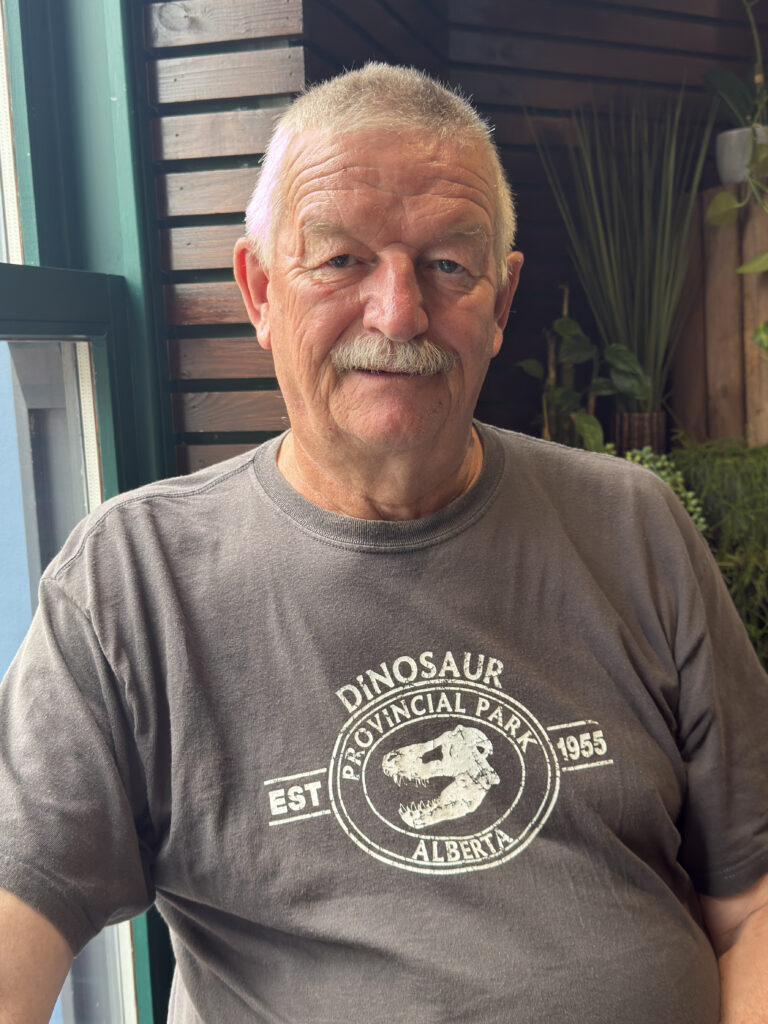
In which our intrepid hero DAVID E P DENNIS meets Dave Brockhurst, dino hunter!
Dave Brockhurst is now a retired quarryman. Over the last thirty-four years of his working life, he has discovered twenty-six dinosaur species, including the world’s smallest dinosaur, in the Wealden Clay beds of a quarry in Turkey Road, Bexhill-on-Sea.

Dave explained to me that millions of years ago, the coast from Beachy Head to Dungeness was a vast delta braided by many rivers and streams. In the rainy seasons and humid climate period, the rivers ran fast, causing flash floods that overwhelmed the dinosaurs. In the drier periods lakes formed. Here at the lakesides, 140 million years ago, there roamed rounded-toothed dinosaurs feeding on vegetation. These were preyed upon by carnivorous monsters whose sharp teeth were endlessly replaced, just like the sharks of today.
The names of these dinosaurs do not easily trip off the tongue. For example, the Dromaeosaurs, Iguanodon, the fish-eating Baryonyx spinosaur, Ankylosaurs, Polacanthus, Megalosaurus and the famous Tyrannosaurus rex, which Dave tells me were of a special ‘Bexhill variety’. These were joined by crocodilians, fishes, turtles, small mammals, insects and many kinds of plants. The area from Bexhill through Hastings to Pett Level was especially rich.
LOCAL DISCOVERIES
Dinosaurs were first recognised in the Hastings area in the 1830s when Gideon Mantell (1822-1896) found, near Battle, the remains of the Ankylosaur named Hylaeosaurus foxii. Later, the notorious faker of the Piltdown Skull, Charles Dawson (1850-1916), did find a real type of Iguanodon now named Barilium dawsoni in Shornden Quarry, now a part of Alexandra Park, Hastings. Many years later, at the Ashdown Quarry in Turkey Road, Bexhill, Dave Brockhurst discovered a new genus–the gracile Iguanodon named Hypselospinus fittoni.
Now there is mounting evidence that the 1066 coast area from Bexhill to Pett Level could easily be a rival to the Jurassic Coast of Dorset, although neither the 1066 Coast nor the Jurassic Coast are quite as rich as the amazing Isle of Wight fossil beds.

The Evolution of Birds
Dave Brockhurst has been instrumental in finding links between dinosaurs and birds. Just how did this amazing evolutionary transformation occur?
It is hard to imagine that the robin on your fence or the sparrow in the hedgerow is the direct descendant of a ferocious dinosaur — but science now confirms that birds are not just related to dinosaurs. They are dinosaurs. More specifically, birds evolved from a group of fast, two-legged carnivores known as theropods, a lineage that includes famous predators like Velociraptor and Tyrannosaurus rex. But while Hollywood focuses on teeth and claws, the real story of bird origins is written in feathers — and remarkably, part of that story was uncovered right here on the Sussex coast.
The evolutionary link between birds and dinosaurs was once controversial, but over the last three decades, fossil discoveries, particularly from China, have cemented the connection. Fossils of small theropods like Anchiornis, Microraptor, and Sinosauropteryx show clear impressions of primitive feathers, and some even had wings capable of gliding.
These creatures weren’t ‘almost birds’ — they were feathered dinosaurs. Their skeletons include wishbones, hollow bones, and even backward-pointing pubic bones, all shared with modern birds. Yet, these were not tropical animals. Some of their close relatives once lived in what is now Bexhill and the Weald of Sussex, in the dense river-valley forests of the Early Cretaceous, around 130 million years ago.
In 2009, Dave Brockhurst, our local fossil hunter from Bexhill, made an extraordinary discovery while sifting through sediment at the Ashdown Quarry. Among the clay and ironstone nodules, he uncovered the delicate bones of a tiny meat-eating dinosaur. Realising its significance, Brockhurst passed the specimen on to professional palaeontologists for study.
Two years later, in 2011, palaeontologists Darren Naish and Steve Sweetman formally described the fossil as the remains of a tiny maniraptoran theropod, part of the same group that gave rise to birds. Although no feathers were preserved, the skeletal structure — including long arms and delicate legs — placed it firmly within the feathered dinosaur lineage.
This fossil, now known informally as the Ashdown Maniraptoran, may be the most direct evidence yet that feathered, bird-like dinosaurs were living in what is now East Sussex, flitting between ancient conifers and hunting insects in the undergrowth.
“It was a very exciting find,” Brockhurst later recalled. “You don’t expect to find the dinosaur that led to birds when you’re digging in clay with a trowel.”
The specimen now resides in Bexhill Museum’s collection, continuing to inform research into the Early Cretaceous ecosystems of Britain. This is what the Bexhill Bird Dinosaur may have looked like.
Surely a great achievement in anyone’s lifetime, Dave has found twenty-six species of dinosaur in the Bexhill to Pett Level area and may be on his way to his twenty-seventh – although scientific secrecy shrouds what may be to come! But the actual density of dinosaurs in the vast river-rich landscape was as low as one or two per kilometre. What pooled them all together in a mass of finds at the Ashdown Quarry beds was almost certainly catastrophic flash flooding.
Today Dave still helps with searches, supports museums and schools with advice and conducts parties of amateur palaeontologists to experience the thrill, first-hand, of finding the remains of amazing creatures from millions of years ago. Long may his work continue, and we hope for new announcements as the remarkable past is gently teased out of clay with trowels on the 1066 coast.
Dave says that his searches and discoveries are admired by a possible future generation of dinosaur hunters–his grandchildren think it’s cool to have a grandad who finds dinosaur bones.
We hope you have enjoyed reading this article. The future of our volunteer led, non-profit publication would be far more secure with the aid of a small donation. You can also support local journalism by becoming a friend of HIP. It only takes a minute and we would be very grateful.

Leave a Reply