
A History of Hastings Country Park Nature Reserve
We recently marked the 50th anniversary of the establishment of the Country Park. Local historian, STEVE PEAK adds to the celebration with a history.
The beautiful cliffs and glens to the east of Hastings have for centuries been an inspiration for many people, including Pre-Raphaelite artists like William Holman Hunt, pioneering ecologist Grey Owl and television inventor John Logie Baird. Today the whole area is part of the Hastings Country Park Nature Reserve, with 853 acres (345 hectares) of sustainably managed farmland, ancient gill woodland, heaths and grassland, plus three miles of dramatic sandstone cliffs and coastline.
The reserve owes its existence to the Collier and Milward families, who accumulated thousands of acres of land in eastern Sussex in the 18th and early 19th centuries, but in the following decades did not sell the reserve area for development. The town’s most powerful land-owning families of two centuries ago became its main environmental benefactors.
The early history of the reserve up to about 1700 AD is mainly that of farmland, with some woodland and wasteland (also often known as ‘common ground’), and with the unworkable steep slopes of the three glens – Ecclesbourne, Fairlight and Warren – left as natural habitats. In 2019 an archaeological survey of the open areas of the reserve (excluding the East Hill) using a magnetometer, found widespread evidence of continuous farming since at least Neolithic times, but no evidence of substantial buildings or large-scale settlements. The survey discovered prehistoric flints, pottery, field systems and circular burial enclosures, plus widespread mediaeval ridge-and-furrow plough marks and small farmsteads.
A 2008 English Heritage report on the East Hill concluded that the top of the hill may well have been an Iron Age promontory ‘fort’ before the Roman invasion in 43 AD. These ‘forts’ were important cultural and economic centres, where people (‘tribes’) living in the surrounding area met for reasons still not fully understood. But they were clearly places of great significance – probably a combined church, market, town hall, sports centre, theatre, hospital and farm, as well as a possible fortification. There was probably another, smaller fort on the West Hill, on the site of the Castle and Ladies Parlour, but there were few others elsewhere in eastern Sussex.

It is not known if, or how, the Romans used the Nature Reserve, although they may have had a signalling station on the East Hill, where the barbeque area is today. This would have been to communicate with their ships trading with the major iron ore site at Beauport Park. In Saxon times, before 1066, there was a possible high status 10th-11th century Saxon burial site and stone building on the East Hill, by the lift.
Through the Middle Ages until the 18th century, the most notable farm was Fishponds Farm in Barley Lane. The farmhouse there today is on the site of the ‘hall’ of the manor of Brede from 1402 onwards. The only mediaeval church in the area was the one at Fairlight, built in 1180 and replaced in 1846 by today’s Fairlight Church, although there was no settlement at Fairlight until modern times.
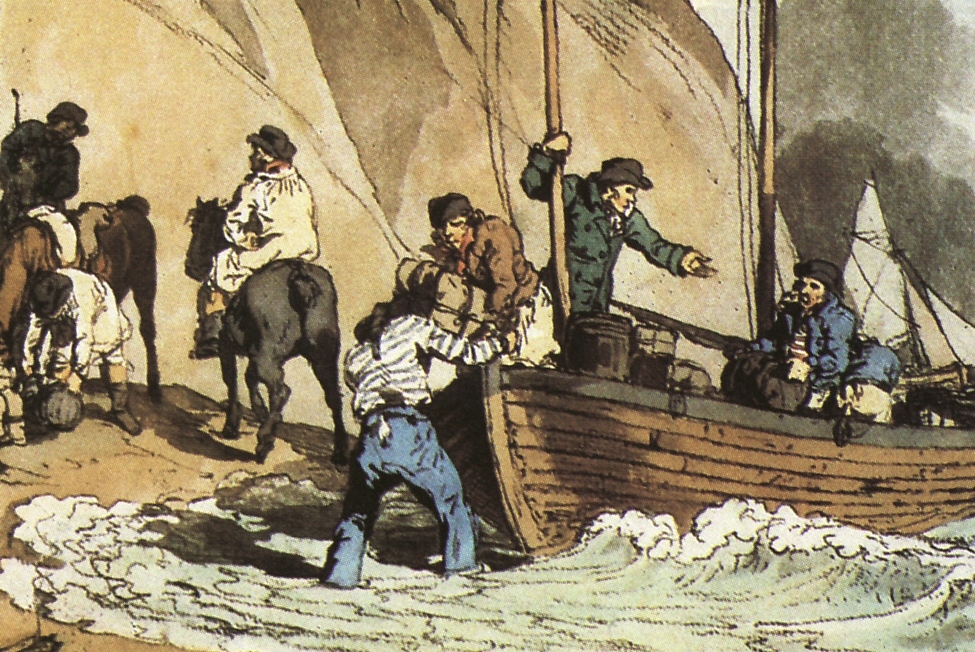
In the 18th and early 19th centuries the second most significant activity in the reserve, after farming, was smuggling. The indented cliffs and glens created ideal obscure landing beaches, while the deep, dark glens provided concealed routes for transporting goods inland. Smuggling was, technically-speaking, a crime, but it was common practice engaged in by many ordinary people, like breaking the 30 mph speed limit is today. However, there were also some well-organised, and sometimes violent, gangs of smugglers carrying out the large-scale movement of goods from France to the big market of London, sometimes going through the reserve.

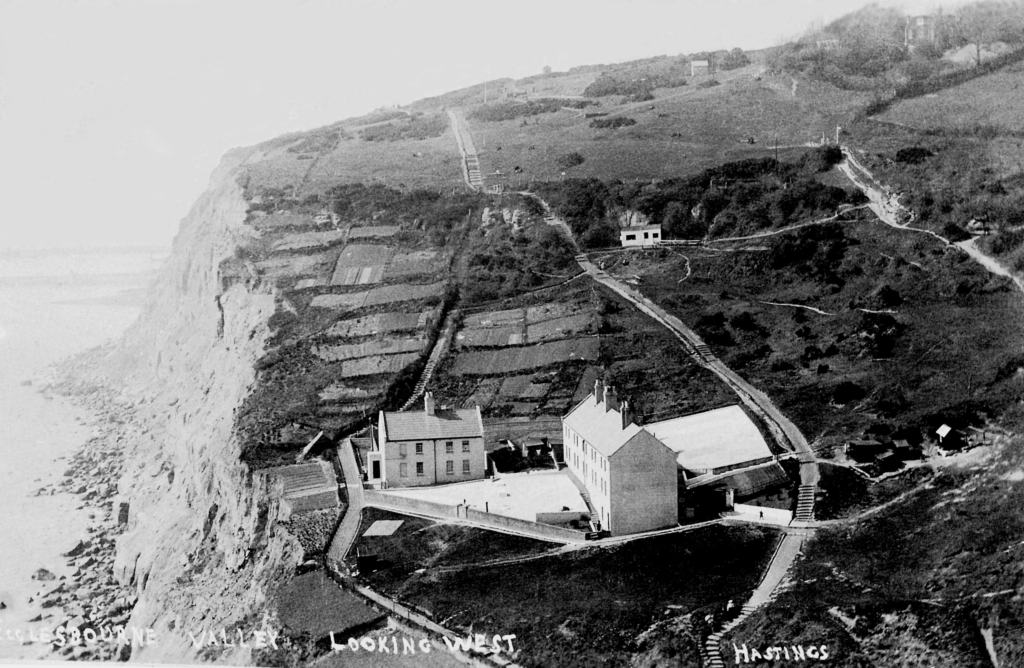
Smuggling became both a bigger drain on the government economy and a serious threat to public order after 1815, when the end of the Napoleonic war left many Royal Navy crew members redundant. Large numbers then became smugglers, forcing the government to build Coastguard stations along the South Coast. One was built at Fairlight Cove, another on Fairlight Head and a third near the foot of the cliff at Ecclesbourne Glen. This was washed away by a storm in 1859 and was replaced by another on the cliff-top in 1864, which became a well-known feature of postcards until it had to be demolished following cliff falls in 1963.
A turning point in the history of the town was the appointment as town clerk in 1705 of Eastbourne-born solicitor John Collier (1685-1760). Collier and his two descendant relatives, Edward Milward senior and junior were the dominant individuals in the Hastings establishment throughout the 18th century, becoming the rich owners of thousands of acres of land. Collier and the Milwards were mayors many times. They also ran the borough politically on behalf of the powerful Whig the Duke of Newcastle, who in return paid them and also appointed them successive managers of the Customs service in Kent, which brought them into close (and probably profitable) contact with the many smugglers along the coast.

By the end of the 18th century the Milwards owned most of the undeveloped land between the West Hill and Warren Glen, plus much other property across eastern Sussex. When Edward Milward Jnr died in 1833 his estate passed into the hands of his widow, Sarah (1787-1873), who became the Countess Waldegrave in 1846.
Sarah was a well-known local benefactor, a strong Protestant, of stern character but great generosity. She did her best to preserve what is now the nature reserve by stopping any unnecessary development from taking place. It is to her that we owe much of what is now a unique environmentally and ecologically protected area.

When she died childless in 1873, the Milward Estate passed to the Sayer-Milward branch of the family. In 1888 they sold 60 acres of the East Hill and 24 acres of the West Hill to Hastings Council, and then the majority of what is now the nature reserve in 1963. The Hastings Country Park was officially created in 1971, then comprising 512 acres, becoming the Hastings Country Park Nature Reserve in 2006.
The full history of the nature reserve is on Steve Peak’s website hastingscountryparkhistory.com.
We hope you have enjoyed reading this article. The future of our volunteer led, non-profit publication would be far more secure with the aid of a small donation. You can also support local journalism by becoming a friend of HIP. It only takes a minute and we would be very grateful.

Leave a Reply