
You Know Me
By Nick Pelling
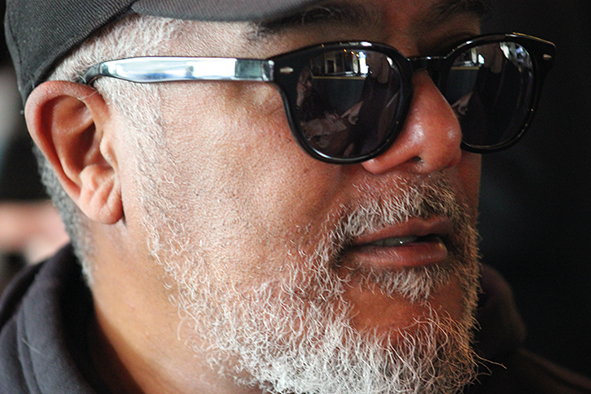
Just occasionally I like to hang out with royalty. Particularly when the person in question is reggae royalty. Henry ‘Matic’ Tenyue probably has the most impressive dub-line pedigree of any living exponent of the trombone. And for over twenty years he has found a kind of spiritual Jamaica here in Hastings. We caught up in Heist for a bit of a chat, along with his illustrious companion, Pablo McFee.
Conversations about reggae have a habit of revolving around the idea of roots. But going back to your roots is not as easy as you might think. Henry explained that his roots are quite complex. His mother and father were from Jamaica, but Henry was born in Beckenham. His education consisted partly of the baggy-trousered chaos of English state school life but also of the musicality of the Baptist church. And the Salvation Army band. It was through the church that Henry began to learn his music. The black dots and everything. However, thanks in part to his Jamaican born older brother, Henry began to listen to genuine Jamaican music. In no time, the playing of Don Drummond in the Skatalites had him hooked. The dots gave way to something more instinctive, more joyful.
England in the 1970s had some unsavoury aspects. The National Front was spewing forth but Henry still feels that his place in time has been “lucky.” In reggae and in life, timing is everything. By the time Henry was proficient on the trombone something was happening in England. In 1976, when Henry was only seventeen, the punk explosion frothed up. But people too often forget that Punk also opened the doors for homegrown ska and reggae. A weird sort of fusion unfolded between the frenetic punk vibe and the hypnotic circling of ska. The Two-Tone label took the music into the mainstream. Henry played with the Beat and even appeared on Top of the Pops, doing their hit ‘Hands Off She’s Mine.’ (It should be added that Henry had already starred on the Beeb’s weirdly important cultural nonsense in 1979, with Matumbi’s rather wonderful ‘Point of View.’)
For all his talent and achievements, Henry is an easy man to talk to – he punctuates many lines with the familiarising phrase, ‘you know me.’ Maybe that is why he has had such a prolific career, and he is such a great musician: he listens to other people. His musical gregariousness has seen him play with an amazing cast of talented groups and individuals, some of whom can only be described as legends in their own back catalogue. The names he has worked with should come with a kind of neon halo, but no such font is available. James Brown for example, who was apparently, shall we say, not a people person. And Miles Davis, for heaven’s sake. He has backed up Mick Jagger, Ronnie Wood (“a bit of a character”) and even Marvin Gaye. And the list goes on. Henry was very funny about Chuck Berry’s dislike of any drivers other than himself. He may have had ‘no particular place to go’, but it was definitely going to be him who drove there. Henry had a particular affection for Robert Palmer and reflects ruefully on the crooner’s doomed struggles with booze. He is delightfully enigmatic about his own relationship with it, “people know I like a drink but they don’t know how I drink.”
Within Reggae and Ska circles, Henry has been highly sought after. He has played with Aswad and Matumbi and spent ten years as a key part of UB40 – he gives much credit to Chrissie Hynde for the success of the latter. He has also played with the splendid Soul II Soul. he has, on occasions, travelled back to Jamaica and worked with reggae giants such as Sly and Robbie and Levi Roots.

For a man whose formative years immersed him in the ugly antagonisms of seventies England, he is not obviously militant in his politics. Having said that, it is important to stress that, his band, Matic 16, was a key part of the protest gig in response to the New Cross house fire of 1981. He has a great sensitivity towards the Rastafarian movement, but it seems that his youthful experience of church discipline has left him with a disinclination towards belief systems. “I don’t believe in anything,” he says with a smile, “I like to know.”
And Henry knows what he knows. And that is something almost ineffable, how to conjure emotion from a brass horn. His articulacy in this field grows, it seems, with age. He is now 63 but his latest EP, Henry Matic Renditions combines his trademark lyricism with a vintage echo-laden off-beat. Particularly impressive is Henry’s warm baritone voice. On top of everything else, it seems – almost annoyingly – the man can really sing.
I couldn’t resist finally asking Henry why he came to Hastings. He explained that “something about the sea” drew him here. A sort of connection to the wider world. The heart has strange affinities, I suppose. But Henry is a natural globetrotter; he was off to Hawaii in a few days. He is, after all, a hard-working musician, even in paradise locations. But, as somebody once said, home is where the groove is.
We hope you have enjoyed reading this article. The future of our volunteer led, non-profit publication would be far more secure with the aid of a small donation. You can also support local journalism by becoming a friend of HIP. It only takes a minute and we would be very grateful.

Leave a Reply