
When is a Tree not a Tree?
By Helen Murphy and Nick Pelling
Just beyond the now scorched grass at the old swimming pool site, along Seaside Road, can be found the quietly impressive Electro Studios Project Space gallery. We went along to see an exhibition with the most understated of titles, ‘On Wood.’ Inside we found a series of ostensibly landscape paintings, on wood. Foraged plywood, to be precise. The artist who created these was Nick Snelling. The works riffed around a repeating theme of woodland.
The initial inspiration for much of this exhibition was Nick’s visit to the Derreen Garden in County Kerry, down in the far west of Ireland. The garden is not really a garden. It is sixty acres of sprawling woodland, accessible by a short boat trip across a stretch of water at Kilmakilloge Bay. An enchanted world unto itself. Nick’s exhibition is in some ways a kind of recollection of the spirit of this unique place. He agreed that he is often prompted by a sense of place. But that, it seems, is just a starting point.
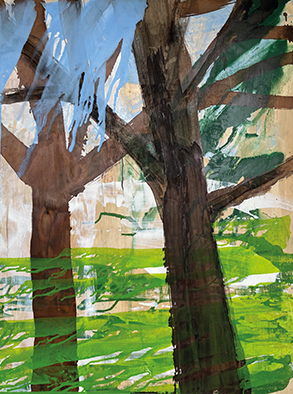

The way the paint is applied, it is also apparent that these works were not about delineating a horse chestnut. The paintings, in many ways, are about paint – vivid, dripping, viscous and translucent paint. Paint, at times, as a trans-parent glaze. Paint meandering along the grain of the wood. We wondered if these trees were not trees at all.
We sought out Nick at his home, off Mercatoria, a couple of days later to ask some follow-up questions. It might be a clue that his studio was hidden away at the end of his splendidly overgrown garden. (Rather wonderfully Nick’s studio sits right next to that of his wife, Adrienne Hunter’s. Adrienne is also a successful painter and it is clear that, whilst the two studios are set slightly apart, there is an invisible creative flow from one to the other.)

Inside Nick’s studio, we came across a lonely, large piece of work on diagonally interacting shafts of plywood that struggled to encase an image of the outwinding branches of what Nick described as a “tree of life” design. It was a piece in which the loose emerald greens and sinewy browns pulled in all the multiple diagonal directions available while drips fell away. We asked, “Why is this painting not in your current exhibition?” Nick’s reply captured some of his whole approach – “Oh that defeated me,” he said quietly. As if his bout with the tree had been some sort of aesthetic boxing match in which the wooden fighter had somehow won on painterly points. But he explained a little further, “it was too figurative, too much like a description of a tree.” We were beginning to sense that down at the end of the garden things had a tendency to get a bit zen.

Nick Snelling and Adrienne Hunter
His son William observed acutely, in the gallery notes, that Nick has been influenced by the classic American “abstract expressionism of the New York School” but also by an almost “synaesthetic love of colour.” His paintings are not meant to be representations but more like interactions in which oil colour, thinned by a glazing agent, is loosely applied and drips and runs as it will, pulled along both by intention and chance. This is perhaps painting as a record of a prolonged interrogation of nature and of the moments spent thinking about painting. A recording of an attempt to record something, maybe.
Nick’s artistic journey has undoubtedly been a winding one. A journey that encompassed several notable art colleges, including Chelsea, but within which he somehow avoided the smoke-filled, hedonistic paralysis that used to define art college life. After college, it was travel beyond England’s drab shores that opened his eyes to colour. He spoke fondly of Seville as a particular inspiration. Certainly, his work has a brightness and enjoyment of colour that is a little unEnglish. But curiously talking to him, and listening to his gentle ruminations and thoughtful pauses, you can’t help feeling that he is absolutely a perfect English gentleman. Polite, understated, sensitive but always discretely shifting and re-thinking.
We hope you have enjoyed reading this article. The future of our volunteer led, non-profit publication would be far more secure with the aid of a small donation. You can also support local journalism by becoming a friend of HIP. It only takes a minute and we would be very grateful.

Leave a Reply