
Up in Arms

“Claudine and Tracey” Image Credit: Anna Maria Nabirye and Annie Saunders, Greenhalf Studios, Home Live Arts, St Leonards, 2023.
Removing boundaries to create meaningful dialogue on topics of race, gender and friendship, artists Anna Maria Nabirye and Annie Saunders present their interdisciplinary project, Up in Arms, at the De La Warr Pavilion, running until 21 May.
Up in Arms is an ongoing collaboration between artist and community, focused on human conversation and interaction. The project was initiated by Nabirye and Saunders in 2016, and has been hosted in various venues. In each new context the artists start with a series of sessions in which they invite Black women to bring a friend of a different race, and together re-create and re-embody the iconic 1971 portrait of activists and friends Dorothy Pitman Hughes and Gloria Steinem. This process becomes a ritual that opens up the space for transformative conversations around female friendship, feminism and anti-racism.
For their latest iteration of Up in Arms at the De La Warr Pavilion, Nabirye and Saunders have invited participants from across the local area – Bexhill, Hastings, and St Leonards. The results of their conversations and performance have been incorporated into an expansive exhibition comprising photography, film and archival material in DLWP’s first floor gallery. It’s the most ambitious presentation of the project to date.
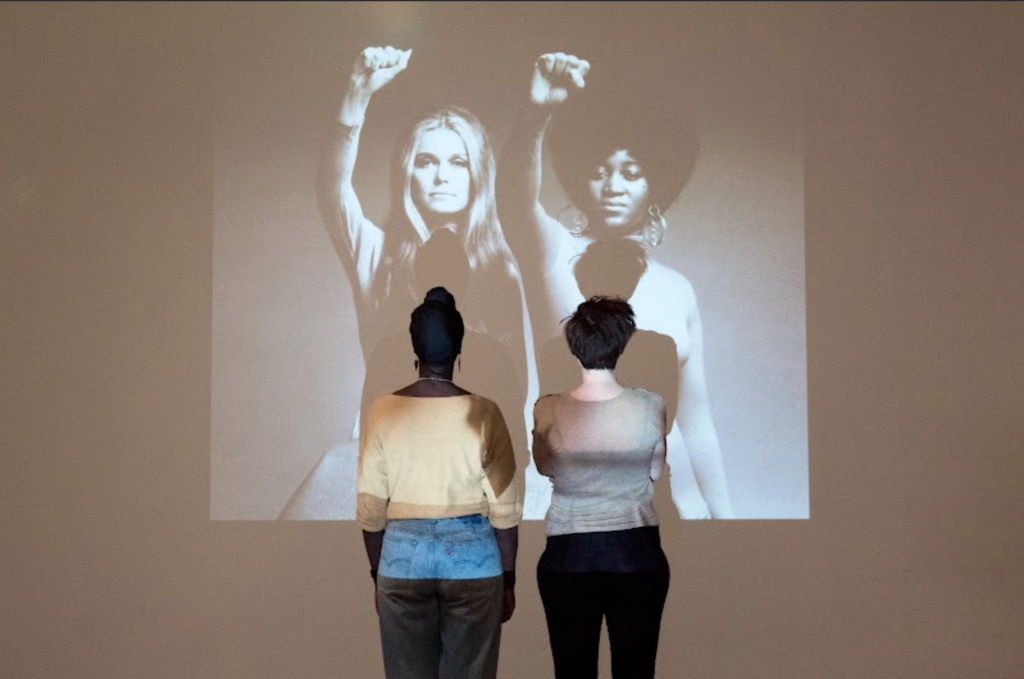
Gloria and Anna, Dorothy and Annie. Credit: Julia Gaisbacher
HIP’s Shannon Ghannam held a roundtable conversation with the artists, Anna Maria and Annie; participants Claudine Eccleston and Elaine Mullings; and DLWP organisers Sally Ann Lycett and Joseph Constable.
Shannon explains: “We wanted to talk about the significance of the Up in Arms project, from a variety of perspectives. The project very much involves social practice, that is: collaborative, holistic, community-driven work that engages with social issues. We liked the idea of using a social practice methodology for this feature as a way to best represent the many voices involved.”
Curating a community of participation
Anna Maria: When thinking about this work, it reminds me of contrast dyes that are used in medical procedures to help create images with enhanced detail and clearer distinctions in the body, the dye exposes everything – so much detail can be seen this project feels like it does the same. Being local to the exhibition space means I’ve felt its waves and the ripples in the community, and that has been really extraordinary.

I was dancing at the Printworks and had a conversation with somebody who’d seen the work, right by a speaker, a big Afro Brasilica band playing. A woman came up to me and she was shouting over the speaker. “Are you from Up in Arms? I went to see it!” So moments like that, of that connection, feel really powerful, it feels like a sort of privilege to be able to feel those.
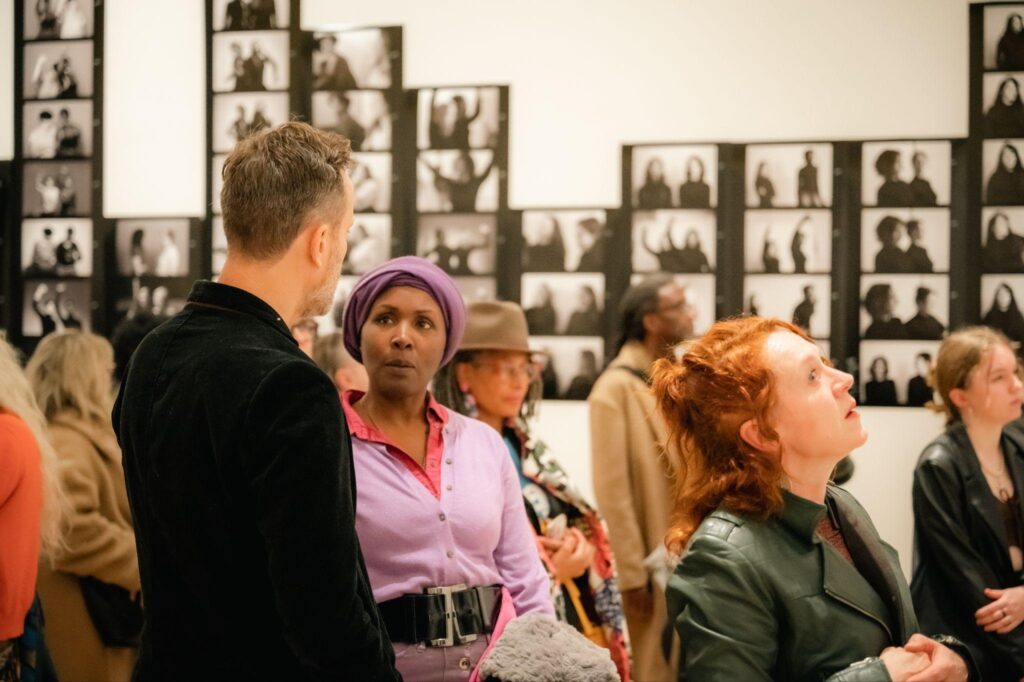
Opening night at the DLWP. Image Credit: Rob Harris
I’ve also seen in the gallery, people read the project description and have an obviously negative reaction, but at least it’s a reaction right? It’s not “I’ve read it and…..whatever”. It seems it’s either a pulling-in or a real repulsion, but either way there’s a strong feeling.
Joseph: When I think about my role as a curator, so much of it is about listening to stories. Whether that’s the stories of artists, or other stories that we tell each other and how artists can steward that and can create these spaces that wouldn’t otherwise be possible. It’s this kind of recipe for love and care that helps us to think through the messiness of the present moment.
I think it’s also really important to take risks and to create these tensions and to invite conversations that actually can deepen our understanding of one another. I think this project is really crucial as a sort of active space for that both within the DLWP but also in that it reflects the wider impetus of the Up In Arms project.
Sally: I think it is worth noting also that this project would be significant anywhere. Because what really struck me when we were filming some press interviews, was that it seemed like an historic occasion. The conversations are very important from a historical documentary point of view. They feel momentous. It feels very significant for us in that it’s not an exhibition of local people, for local people, it’s an exhibition of international importance.
Elaine: When I was invited to take part, I picked my partner Sophie Fuller as my friend. When we first were together, we were very politically active, particularly in student politics, because we were both at college at the same time. As we’ve gotten older and we’ve gotten more involved in our work, we’ve been less active. So this was an opportunity to reflect on what we used to think about and reflect on what progress has been made, along all those different lines: race, sexuality or gender. We looked at the gains, but also the steps backwards.
One of the attractions to doing this was to do it with Sophie. I don’t think many people realize that we’re a couple, for example, and then when they do, it’s sort of like “wow”. And, you know, this interracial couple who are gay, queer, and no one really realizes that until we actually specify – they assume we’re friends. So it was the first time we’d sat in a situation where we were able to talk about ourselves and our relationship as a couple, but also as very strong friends. I mean, you have to be after 38 years, you can’t not get along!
Being involved in the project was very emotional. It was overwhelming on the opening night because of all the positivity in the room. I enjoyed being there and watching our film. I found that really satisfying, and special, you know: in a comfortable setting, with your best friend and partner watching, watching. We’d never seen ourselves before.
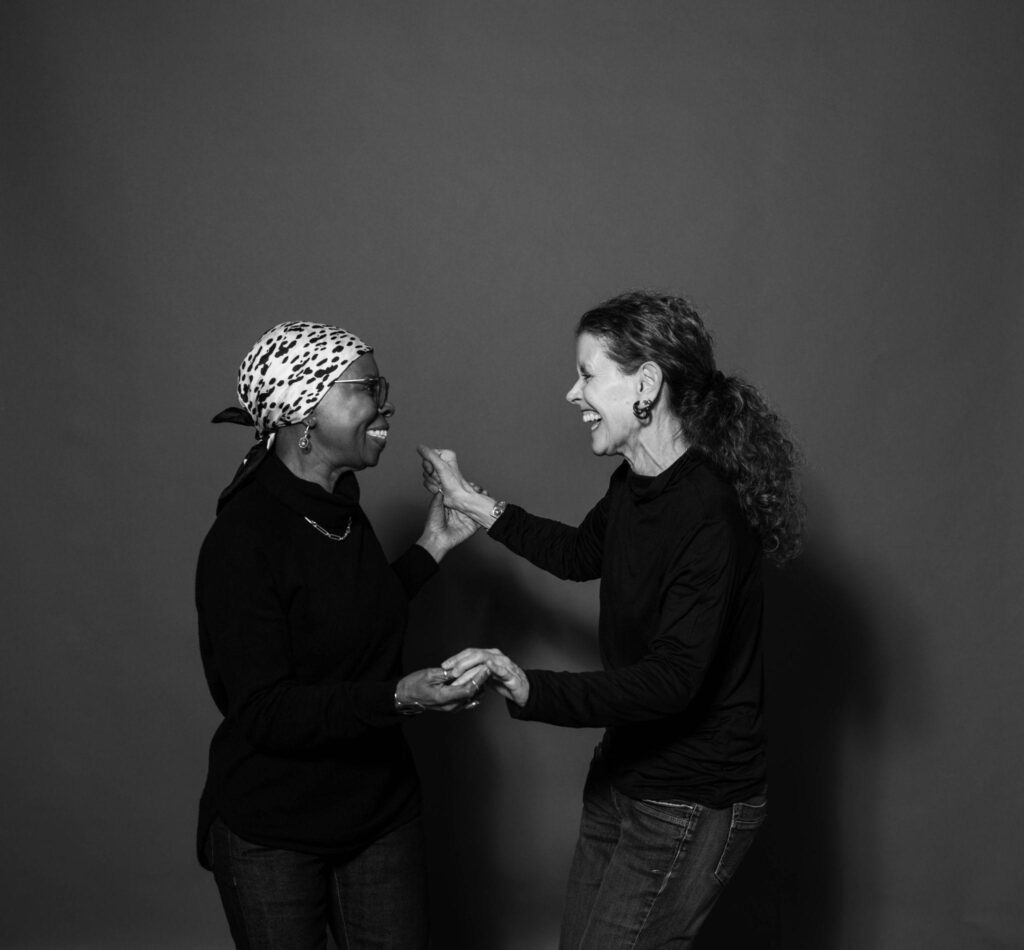
“Elaine and Sophie” Image credit: Anna Maria Nabirye and Annie Saunders, Greenhalf Studios, Home Live Arts, St Leonards, 2023.
Claudine: I went back to the show with my sister (we’re Claudette and Claudine) and it wasn’t a quiet day, but for some reason when we entered the video room, the only person there was Claudia, another participant. So Claudine, Claudette and Claudia all sat there and it was incredible because my sister, who didn’t really understand what it was about or why I had dragged her there, had to leave. I wouldn’t say she was in tears, but it really deeply affected her and it really deeply affected Claudia, watching. I can feel myself being quite emotional talking about it because there was something amazing about listening to the other participants. Some of the themes that came out of those conversations – “Powerful”, you know, “Strong”, those are the themes that come up, just how incredibly beautiful the whole thing was.
Annie: Listening to that makes me think about the transformative power of the conversation – if we are willing to truly go into a conversation, right? A conversation is where you’re stepping into the unknown. That openness and that willingness to engage with what’s possible and also put yourself at risk. As folks have spoken about here, it could go a bunch of different ways. But the willingness to step into that is where the true power of transformation lies. And I think that is also true for the DLWP and the exhibition space.
This work is an invitation to a conversation where anything could happen, including harm, offence, “crunchiness”, as Anna Maria calls it. It has that power to really change a space, an institution, into a place of agency and belonging for the community in a way that it has not been before.
Unlearning racism
Anna Maria: This project is about allyship and anti-racism, and when installing it I was very much aware of being one of very few, or sometimes the only Black person in the building. There’s a real push and pull about the importance of being in such a space. It feels like you’re having to put your head above the parapet.
I’ve been here in St Leonards six or seven years and I think my most racist experience since moving down was in a charity shop in Bexhill, which has always been a place that I love. But the town’s always been a place where, as a Black person, I still have to be a bit on guard, like when I go into a pub. Maybe I don’t feel that as much in St Leonards, though there are places in St Leonards I wouldn’t go to either. It’s just interesting if you walk around Bexhill it doesn’t always feel like the most multicultural space.
Elaine: I really empathise with Anna Maria’s experience – the catalyst for the whole project was her experience in New York: going to this place, expecting it to be like the films, and getting all this racism. I could really feel that because I experience it all the time in different situations, the micro and macro aggressions. It was palpable when she was describing it. And then the way that she was trying to let Annie know, but Annie not being able to really know. How do you express something so powerful to your friends if they’re not experiencing it? It’s a really difficult one – the landmines that are triggered when you get involved in those conversations – because you can lose friends.
I’ve been back again to the exhibition because I wanted to read everything, to spend time with all these different stages that it goes through. Even though it’s all very positive, there were some really difficult moments for Anna Maria and Annie along the way: quiet, painful moments I think for each of them during the process. But ultimately it’s been a very rewarding project and I think it’s a landmark for the DLWP.

Credit: Anna Maria Nabirye and Annie Saunders, Greenhalf Studios, Home Live Arts, St Leonards, 2023.
Anna Maria: I often feel like people jump on board the project, but underestimate the fullness of the issue until they are in it. I was anxious about how the work would sit in the DLWP, what would happen. On the whole, it has been received really positively, but there have been moments of microaggressions.
I remember on the opening day, one of the Black participants was there and an older white gentleman snuck in the barrier and came up to her and was like, “Oh, I really love Caribbean music.” It’s not a comment that was said to wound, but there is a violence to that act, that kind of assumption. Another person came up to me and said, “I really love the work, Gloria Steinem and the other ‘singer’”, meaning Dorothy Pitman Hughes, and I was like, “that’s not a singer”. And I thought: Wow. Everyone recognizes Gloria Steinem, but Dorothy Pitman Hughes is the other woman, the Black woman; she is a mystery.
I think anti-racism is a deep work, and you might not know how far it’s gonna go, and it will be bigger, trickier and crunchier than you imagined, but it will also be more joyous and loving and uplifting. And it’s not just for the particular minority that’s on the sharp end of it. It’s for all of us collectively.
Elaine: It’s a tricky one because you can’t really legislate for people’s behaviour and reaction if they’re not involved in the project. They go, “Oh I’ve been to the Caribbean.” You think: Oh, when was that? 1990? You know, totally irrelevant. But they’ve tried to find some commonality. And it’s always really difficult to know when to go: “Hang on a minute mate, I don’t really care that you went to the Caribbean in 1990.” But at the same time you think, oh, well they’re trying to connect with you at some level, even if it’s offensive.
For me as a Black person, there’s always that difficulty or that tension between giving a person the benefit of doubt or not. It can feel like you’re always educating, and it is hard work.
A community arts venue
Shannon: At Hastings Independent Press we talk a lot about how to create a space, in our case a printed space, that is inclusive of the entire community. I am curious what you all think about that challenge?
Anna Maria: Although social practice is the core of the work, it feels like we were right to have the exhibition in a really highly-regarded institution, to position it that way. Before, we’ve wondered if we should exhibit the project in a found space, but the reaction from so many in the community who have attended has really affirmed our choice.

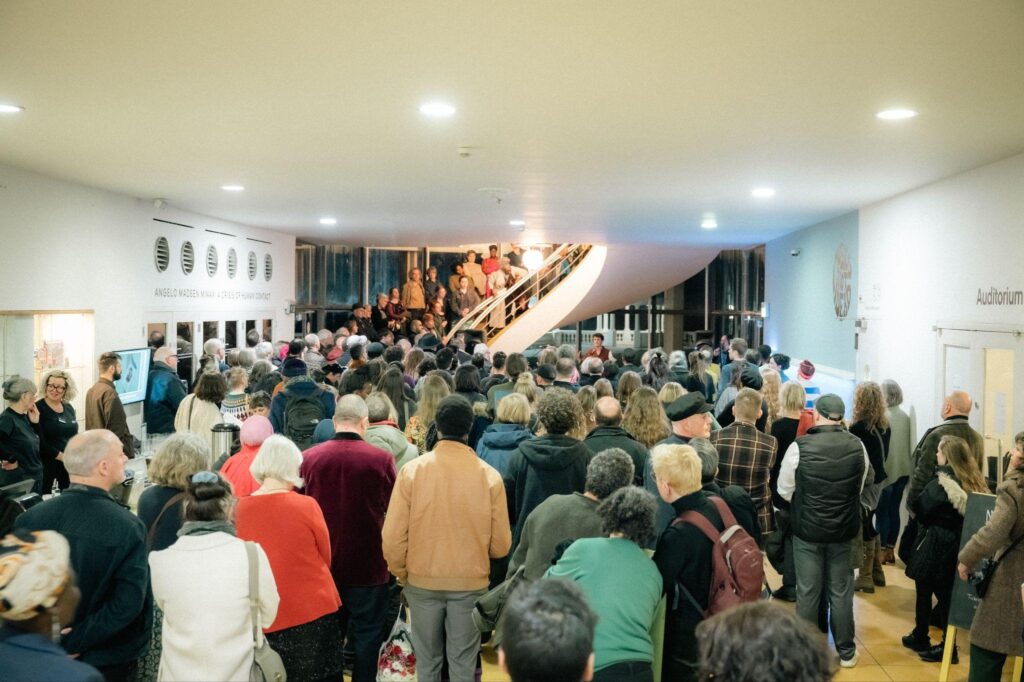
Opening night. Both Images Credit: Rob Harris
Sally: It’s interesting when you go to private views in big cities, they’re not always as open or welcoming as we could be here on the opening night. This was very different, and that’s what we try to do at the De La Warr, we want to be as inclusive as possible. We have worked really hard since we reopened, because we see the need. It isn’t just one community. We have lots of different communities in Bexhill and the surrounding area. So we’ve opened the space for people who live with dementia and their carers. We’ve opened the space for young people, much more than we ever did. We put on a massive neurodiverse music event last year. Just through small moments, keeping the door open and making sure that people can come and join in if they want, you can curate a space that’s for everyone.
Claudine: It’s taken me a long time to feel that the DLWP was my space, or that I was part of a community which had a space in that space. Now I have the painter guy down the road who says, “I saw you in there, I saw that exhibition. I don’t normally do galleries, but this one was good.” For him as well, as a working class person, walking into that space and just looking. There was familiarity there for him as a white friend, if you like, who’s got a Black male friend as well. They actually spoke about it. They joined in too.
Normally when we go to galleries, the first thing you come to is security. Here it was books by Black authors – and that was really something. I think the way the whole thing is set up is much more of a welcoming space now. And being part of Up in Arms here does bring a certain level of acceptance, a kind of belonging, you know. It’s no longer another space we pay for that we’re not members of.
Article and responses edited by Shannon Ghannam and Merlin Betts.
We hope you have enjoyed reading this article. The future of our volunteer led, non-profit publication would be far more secure with the aid of a small donation. You can also support local journalism by becoming a friend of HIP. It only takes a minute and we would be very grateful.

Leave a Reply