
Un-Fairly Killed
Kent Barker looks at a new arts project celebrating Hastings’ historic Rock Fair.
Imagine yourself standing by the fountain on Hastings’ Trinity Triangle. To your right, down Trinity Street, is the library in the stately Brassey Institute. South-west, along Robertson Street, is the sea. Now take yourself back in time. It’s the end of July two hundred years ago. All the buildings, shops and cafes have gone of course, and you are probably aware you’re looking at The America Ground. But this is not just the ragtag of squatter camps and pop-up industrial units you might have expected after reading Steve Peak’s fascinating feature in the last issue of HIP. No, the spectacle before you is the famous – or even infamous – Rock Fair. The land you are standing on is known as Rock Fair Green – named partly after the White Rock headland which protruded out into the sea until it was dynamited in 1835 to form the coast road – and partly after the fair that had been held on this spot since ‘time immemorial’.
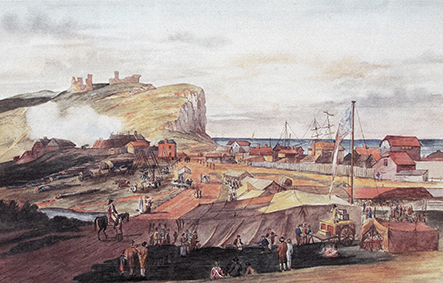
Rock Fair 1811 by Paul Sandby Munn
CREDIT: Jane Bruce
Historically Hastings had three big annual fairs: Spring – on the Tuesday after Whitsun; Town Fair held over three days at the end of November and Rock Fair held on July 26th and 27th. According to the Hastings Guide of 1797, this last was the grandest of them all: “Rock Fair is the only one worthy of notice.”
It had certainly been, for many generations, a highlight of the seasonal calendar. In a letter of July 1734, Cordelia Collier the daughter of a former mayor and one of the Town’s leading citizens, John Collier, says: “Pray tell my sisters I am glad they have such fine weather to go to Rock fair”.
Victorian Hastings historian Thomas Brandon-Brett catalogues among the attractions: “fancy stalls, fruit stalls, gingerbread stalls, oyster stalls, Middleton’s marionettes, Richardson’s theatricals, publicans’ booths, merry-go-rounds, glass-blowing and wax works together with giant dwarfs and other monstrosities.”

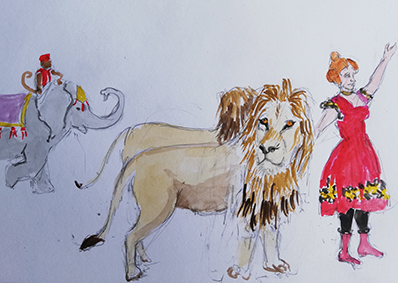
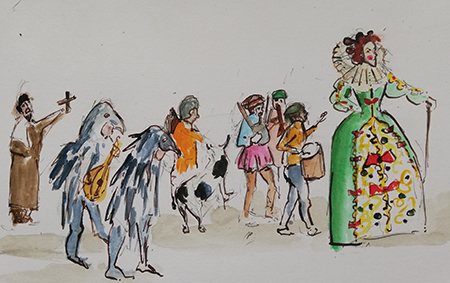
Wild Horn Fair imagined
CREDIT: Jane Bruce
It is perhaps partly this description that inspired writer and storyteller Rosanna Lowe’s new creative work ‘Wild Horn Fair’. As she says, “Fairs allow us to leap boundaries, break rules, connect with ancient, primal rituals, subvert the everyday and transport us into other worlds”.
The concept, overseen by project managers MSL and funded by the Arts council and East Sussex Arts, is based around Rock Fair and came about with storytellers, poets, musicians, and residents helping to create ‘a new musical exploring the history, myth and mystery of Fairs and Festivities in Hastings’. Although regular performances by community groups won’t take place until 2023, there has already been a successful preview this summer at the Shipwreck museum.
With Hastings becoming established as a fashionable resort in the early decades of the 19th century, opposition grew to the increasingly raucous and dissolute Rock Fair. After years of trying, the town council finally killed it off in the mid-1850s.
We hope you have enjoyed reading this article. The future of our volunteer led, non-profit publication would be far more secure with the aid of a small donation. You can also support local journalism by becoming a friend of HIP. It only takes a minute and we would be very grateful.

Leave a Reply