
Twists in the Paintwork
HIP explores the many lives of a real painter man. By Helen Murphy and Nick Pelling.
The Hastings-based artist Chris Roskell, has led an extraordinary life. In chatting to him about his long career in art and design, it is perhaps the word ‘episodic’ that springs most immediately to mind. Each new chapter seems to suddenly give way to an entirely different one. As if some heavenly scriptwriter was madly impatient to keep moving the plot on.
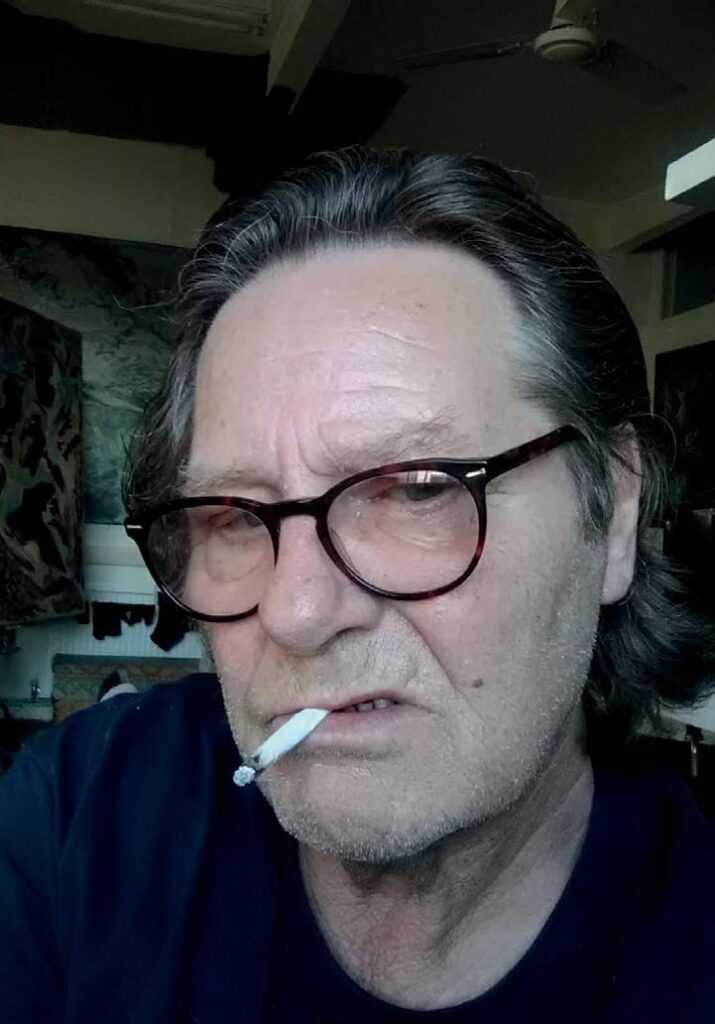
It has been a life that has somehow managed to combine youthful mistakes, lacquering furniture, spiritual breakthroughs, customising Cadillacs, running an up-market interior décor company for the rich and stupid and, absolutely above all, a potent commitment to thinking visually. A life working with and thinking with all types of paint, since 1967. He is in short, a serious artist: practical and philosophical. And yet he is also deeply self- deprecating and antagonistic to any art bullshit. (Rather wonderfully and hilariously, he does have a great tale to tell of an encounter with an actual bull in a transit van in Norfolk that involved an unfortunate torrent of the stuff – but that’s another episode.)
A Navy Lark
Chris was part of that generation who emerged astride the sixties and seventies, that found the best and worst of possibilities. His childhood was knocked off course by a parental divorce and a disruptive relocation to Harlow New Town with his mum. Chris is frank about being a bit angry and impetuous as a youth. He left school at 15 and, like so many spirited lads, ended up in the Merchant Navy. From there, repeated misdemeanours led him into what might be termed ‘Her Majesty’s boarding facilities for the wayward’.
But, unlike so many of today’s rehabilitation centres, the institution seemed to work. He was allowed to attend classes and even an outside college, and this enabled him to study O and A levels. He racked up A grades. In two years he found himself at Harlow College studying on the Art Foundation. Looking back on these twists and turns, he feels he was essentially “lucky”. And this does seem to be a leitmotif in his story. Whether it be institutional authorities or teachers, Chris has proved adept at tapping into whatever positivity people might have to offer. It might be luck but it might also be a talent.

A Lysergic Epiphany
In no time he was at Wolverhampton Art College, and his art career appeared underway. But the growing fad for conceptual art proved to be a bit of a disillusioning experience. And it would only be the pinball of chance that would push him into a direction that made sense. A somewhat “experimental afternoon” turned out to be, for Chris at least, a kind of lysergic epiphany on the road from Wolverhampton. After that, Chris felt himself impelled to get beyond the surfaces of things. After that, and ever since, he has been thinking about perception and even the way the fourth dimension: time, might enter his art practice. He worked with dance choreography as a form that used structured time and movement.
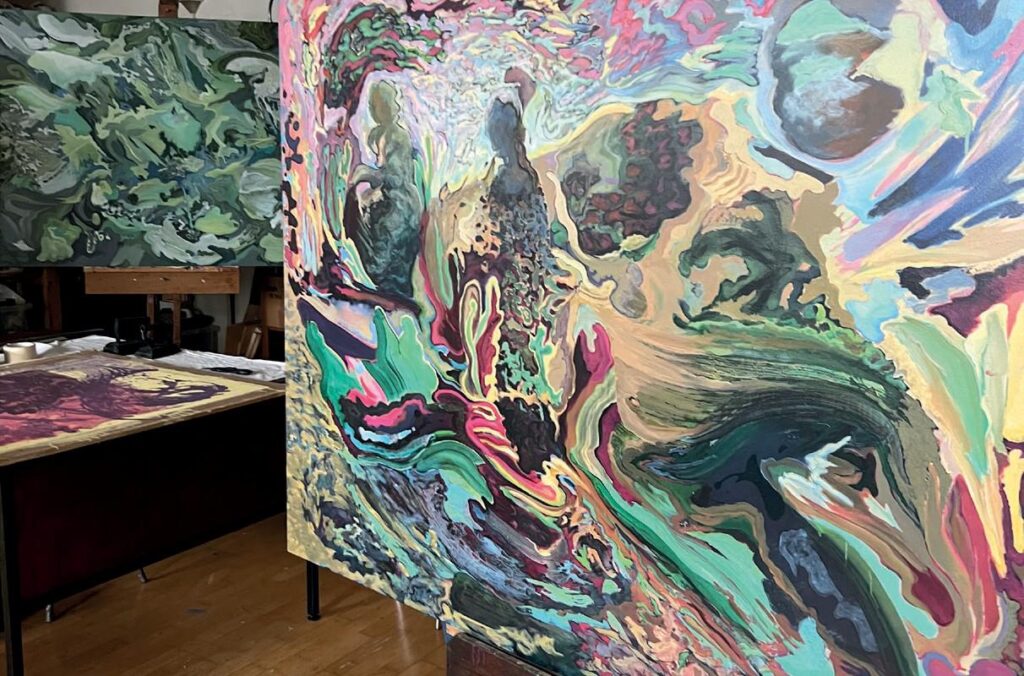
But soon another episode opened up. He began working with an artist who specialised in three-dimensional work that required an exotically high-sheen finish. He quickly learnt the complex art of lacquering involving layers to reach the flawless glossy surface. With these skills in his brain and hands, he moved on into the exotic world of customising American automobiles. From cars he swerved into a high-end furniture business, with lacquering as their hallmark. It was a great success.
It’s Only Rag and Roll
For various reasons, too painful and too personal to go into here, the high-rolling years came to an abrupt end.
In his own words, “things went tits up.” He had to put the paint brush down and head for India just to get time to straighten his mind out. On his return, his wide range of different paint skills enabled him to set up a luxury interior decor company, and he soon found himself painting and rag-rolling the walls of the wealthy. Even the Beckhams became clients.
But maybe his most important moment in his life came when he met Karen, the woman who has now been his partner for 31 years. In all the years and through all his episodes, Chris maintained a discipline of making his own art. Working in a studio next to the acclaimed but grumpy Scottish abstract expressionist, Harry Anderson, he began to see a way of approaching painting that chimed in with some of his own thinking. He explains that “When I paint, I feel I am entering an arena.” Having said that, he adds, “I am not an abstract expressionist, myself, my work is far more controlled.” And neither is his work to be glibly dubbed ‘psychedelic’. What is clear is that, although his work is abstract and highly intricate in design and colour, it is all deeply pondered before brushwork begins.
Take Me Anywhere
He is keen to stress that all painting and drawing begins with spatial decisions: “When I start, I feel it could go anywhere.” It is perhaps a sort of dialogue between Chris and the paint. Like a lot of artists, he shares the sense that art colleges are not what they were. “It’s partly due to funding and partly because institutions have lost respect for the continuum of art history and the need for young artists to be taught the tradition and the skills.”
It’s clear that he is impelled to paint, but the compulsion has little or nothing to do with selling his work. Indeed, he freely admits he does “bugger all” to promote his work. There is an obvious purity in that. But we rather hope that he gets it together to have a full show. He is very slightly attracted to the idea. Maybe it will happen and maybe not. We’ll just have to wait for the next episode, it would seem.
We hope you have enjoyed reading this article. The future of our volunteer led, non-profit publication would be far more secure with the aid of a small donation. You can also support local journalism by becoming a friend of HIP. It only takes a minute and we would be very grateful.

Leave a Reply