
The Rossettis’ Hastings Revisited
SARAH MILNE
London’s Tate Britain is currently hosting a ground-breaking exhibition centring around the Rossettis, one of the most remarkable families of nineteenth-century culture. It is a dynamic immersive show, combining spoken poetry, drawings, paintings, photography, installation, and design, comprising the largest retrospective exhibition of Dante Gabriel Rossetti’s work ever shown by the Tate, alongside Christina Rossetti’s poetry.
Most exciting for me was the inclusion of Dante’s wife, Elizabeth (née Siddall), with the most comprehensive display of her work on show for over three decades. For the first time, Elizabeth’s career and influence are positioned in the context of her place in the Rossetti family, the leaders of Britain’s first avant-garde art movement. This replaces Elizabeth’s mythical role as Dante’s melancholic muse and fragile, opium-addicted lover with the narrative of an independent, talented artist in full control of her life and ambition.
HASTINGS CONNECTION
Hastings features strongly in the Rossetti story. Christina called it “almost my favourite spot in England,” visited often, and she set her short story The Waves of this Troublesome World (1870) here. The exhibition opens with Dante’s painting Ecce Ancilla Domini! (The Annunciation) (1849-50), modelled by Christina. The painting is surrounded by her poetry and smaller works that show how much Dante’s early art was inspired by his sister.
Dante and Elizabeth also visited Hastings several times and were married in St Clements Church on 23 May 1860. I was interested in how new revelations shared in the exhibition may change our understanding of the relationship between Dante and Elizabeth Rossetti and the story of their time here.
ENTER ELIZABETH SIDDALL
Dante attended the conventional Royal Academy of Art, but he had been raised with a revolutionary spirit. He rebelled against the old master’s artistic style and content and formed the Pre-Raphaelite Brotherhood (PRB). The PRB painted in a new style of colourful, often medievalist art featuring scenes from myths, stories, religious scenes, and poetry. They chose models to play the parts in these dramatic scenes rather than those trained in classical artistic pose.

One such model was Elizabeth Siddall, who myth would have us believe was discovered in a hat shop by Walter Deverell, the son of the principal of the London School of Design and a member of the PRB. In her exhibition catalogue essay Myth busting Elizabeth Siddall, Jan Marsh reveals William Ibbitt, the obituarist, was told by Elizabeth how she met the Deverell family through dressmaking for their women and found an opportunity to show Mr Deverell some of her drawings. He introduced her to Walter and the PRB. Elizabeth’s initial role as a model for the PRB was fully intentional: it was her ticket from her working-class origins into the art world.
THE REAL ELIZABETH
Elizabeth became Dante’s student and sweetheart, but this exhibition shows how she influenced him as much as she learned from him. Her work was naïve, today it may have been described as ‘outsider art’, made by someone who has not received formal schooling. Of course, Dante in comparison had all the flair of a fine artist, but this was something he strove to be free from.
Outsider artists do not know the rules of conventional artwork but engage with their surroundings on their own terms. Dante found inventive, raw ideas in Elizabeth’s work. The exhibition shows this through a room that sets their work side by side, showing how Elizabeth would take ideas from Dante’s paintings and make them her own in her recreations. It also shows examples of motifs, poses, composition and colour in Elizabeth’s work inspiring and appearing in his. A key example highlighted in the exhibition is Dante’s Found, a painting of a fallen woman found slumped on a London Street by her former lover. A fascinating set of sketches and studies (1854-5 to 1859-81) show how the piece was composed and worked, including how Dante drew from the subject matter and elements of pose and composition in Elizabeth’s drawing Pippa Passes (1854), based on Robert Browning’s 1841 verse drama.
The exhibition throws some new light on the couple’s time in Hastings in the Spring of 1853 during the early days of their romance. Dante had just lost his father and Elizabeth was in low spirits. It has often been written that this was due to her tendency to become feeble and unwell whenever she was not receiving the attention, she needed and desired from Dante. But Elizabeth was far from weak and dependent. She lived alone and travelled alone across London and throughout the UK and Europe.
RECENT REVELATIONS
New evidence was found last year that shows Elizabeth well and thriving in Warwickshire in 1859. This was during the couple’s separation at a time she was thought to be languishing so much that, when Dante eventually found her in Hastings, he agreed, at last, to marry her to save her. The truth is, though their relationship was turbulent, Dante was drawn to Elizabeth and chose to be with her.
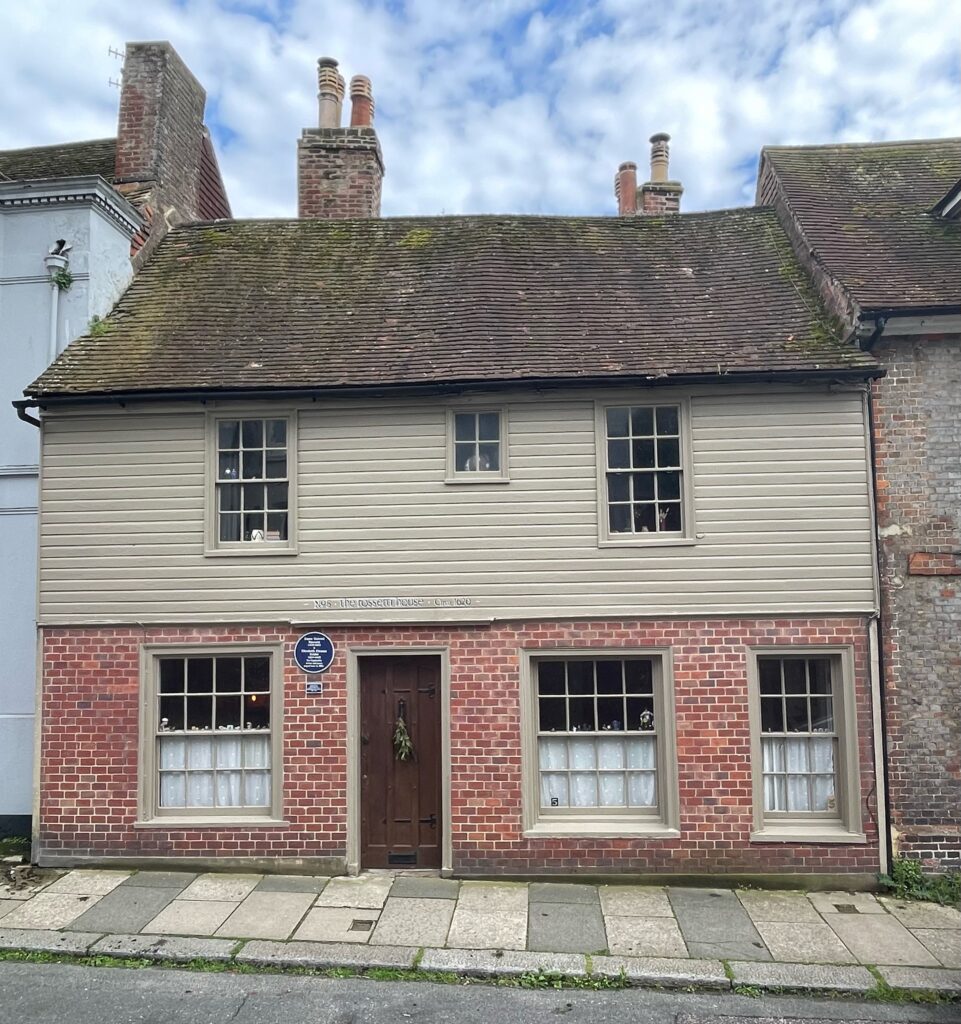
In 1853 Dante is known to have been worried about Elizabeth and turned to his close friends, the artists, writers and campaigners Anna Mary Howitt, Barbara Leigh Smith, and Bessie Raynor, to help. Barbara was living at 9 Pelham Gardens and had an ancestral home at Scalands Farm, near Robertsbridge. The story tells how Elizabeth, ill and low in spirits when she arrived in Hastings, was scooped up by the three women and helped to rest in lodgings at 5 High Street, now known as The Rossetti House.
Anna Mary, Barbara, and Bessie were at the centre of the Pre-Raphaelite Sisterhood, a progressive, dynamic band of women fighting for women’s rights and social reform. Given Elizabeth’s activity and ambition, Dante’s revolutionary mind would have influenced her as much as his artistry. She is now believed to have been part of this dynamic group.
HASTINGS REVISITED
Dante joined Elizabeth in Hastings following his father’s funeral He initially stayed on East Parade, where the Cutter now stands, before moving into a room at Elizabeth’s High Street lodgings. The couple enjoyed walks across East Hill and along the cliffs to Lover’s Seat above Fairlight Glen (sadly now lost to cliff erosion). There they met a ‘gipsy girl’ who Elizabeth persuaded to model, with her baby sister, for her ‘Nativity’ studies. I was delighted to see several of these sketches exhibited.
Elizabeth became a model herself for a series of portraits done by Barbara, Anna Mary, and Dante during a day at Scalands Farm. These are displayed and discussed in a fascinating catalogue essay by Gursimran Oberoi. They show Elizabeth downcast but stoic in a crown of Iris flowers representing sorrow, strength, and resolve. It is now believed Elizabeth was in Hastings to recover and receive support after choosing to terminate a pregnancy. This further supports the idea of her as a modern, independent, new woman of her era.
This is a fascinating exhibition and a must for anyone interested in the story of the Rossetti’s. For me, it was a joy to see Elizabeth emerge from the shadows of her myth of a tragic muse to take her spotlight at the heart of one of the most exciting times in British art and culture.
The exhibition runs at the Tate Britain until 5 September 2023. For more on the Rossettis
in Hastings see sarahmilnewritingandart.com.
We hope you have enjoyed reading this article. The future of our volunteer led, non-profit publication would be far more secure with the aid of a small donation. You can also support local journalism by becoming a friend of HIP. It only takes a minute and we would be very grateful.

Can I draw your attention to the book by Jenny Ridd ‘ A Destiny Defined:: Dante Gabriel Rossetti and Lizzy Siddall in Hastings’? See http://www.edgertonpublishing.co.uk/publications/a-destiny-defined/.
Jenny has also written a history of the occupants of 5 High Street from The time it was built until the end of the twentieth century, entitled Walls, Beams, Love and Dreams. It will be published later this year.