
The Notes are Just the Beginning
VICTORIA KINGHAM
It’s undoubtedly a privilege to watch skilled professors of music talking with gifted young performers about their interpretations of pianistic works of great genius. The weekend event organised by Hastings Piano Concerto competition afforded the audience that opportunity. Saturday afternoon saw wonderful Master classes. On Sunday there were four brilliant solo performances by former Competition winners and runners-up.
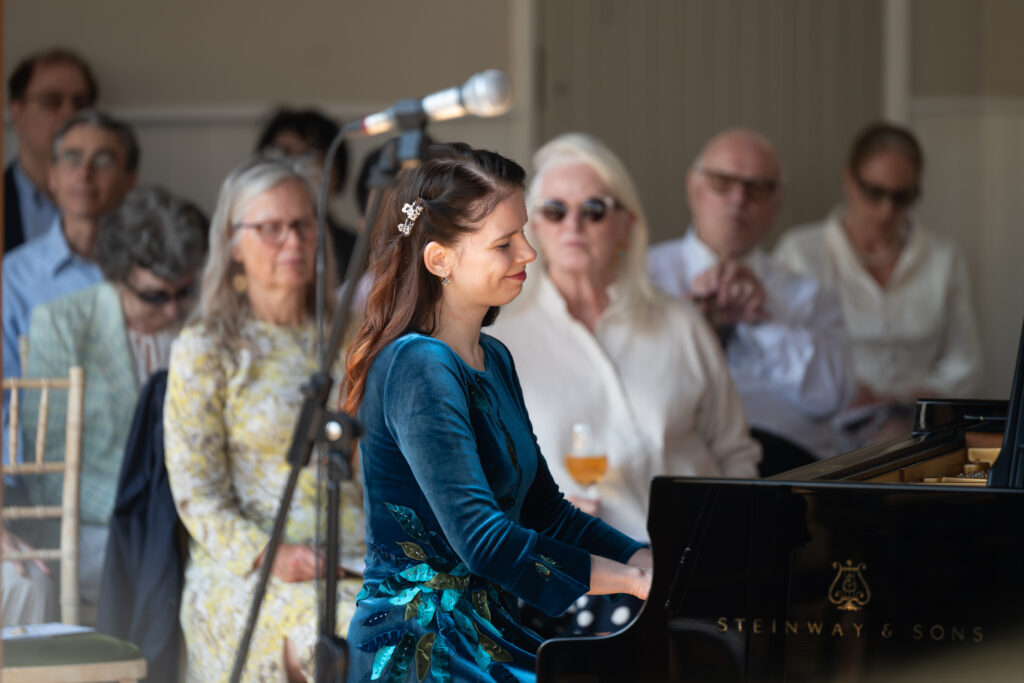
Gabrielė Sutkutė enjoys Ravel
Aaron Storr is head of piano at the Scottish Consevatoire: his emphasis, discussing with Curtis Phill Hsu a fine performance of Debussy’s lovely Voiles prelude, was on the exactitude of Debussy’s phrasing and dynamics; the precise speed for the full effect of a rallentando; the completion of a phrase. Vanessa Latarche is Artistic Director of Hastings International Piano. Having listened to Gabrielė Sutkutė, she concentrated on the dynamics: “Everybody thinks it impressive to play the piano fast and loud,” she remarked. “What you learn as a performer is that the most difficult thing is to play it slowly and softly.” She also noted an infinitesimally small mistake that nobody without her extraordinarily tuned ear could have picked up – “you’ve done that three times now,” she tells Sutkutė (incidentally also one of her regular pupils), “it has to stop!” She explained that as a pianist your hands tend to replicate a mistake, which must be eradicated before becoming ingrained.
PICNIC PERFORMANCES
One of the more telling things one learnt from these unique, expert insights is that to make a piano piece sound fresh and new and exciting, as though it has just come out of the composer’s mind, in fact it takes years of dedicated, exacting and gruelling practice. Foregrounding this idea was a remarkable performance of Chopin’s Fantaisie-Polonaise II by Harmony Zhu at the Sunday afternoon picnic event. She played with great panache and with what seemed to me, tremendous daring. Chopin’s polonaises are based on a traditional Polish dance; the ‘fantasy’ title however allowed him to write something relatively ‘free’ like the introductory slow section to this piece, with its statements, pauses, and questions. Zhu added to this section rhythmic originality, dynamic phrasing, drama, and romance. Mariamna Sherling played two Chopin Mazurkas and Ravel’s fabulous Alborada del Gracioso, French impressionist music based on Spanish melodies and dramatic traditions. Curtis Phill Hsu, who won last year’s competition, at 21, while modest and unassuming, already a seasoned professional, gave superb renderings of Granados and Debussy.
Sutkutė played an older piece – a Rameau ‘Joyeuse’ with intense joy and delicacy. She followed this with an altogether astonishing performance of Ravel’s La Valse. Ravel must himself have been joyeuse after finishing this most complex piece: it incorporates huge fortissimo runs up and down the entire length of the piano, and challenging arpeggios in the extreme bass, requiring from the pianist exceptional strength and control. It was originally written for orchestra; Ravel transcribed it later for solo piano, but as a piano piece it is rarely performed because of its extreme difficulty. Sutkutė’s achievement seemed to me outstanding: the high spot of a unique weekend event.

INTERNATIONAL SUCCESS
An acquaintance remarked to me during the interval “Isn’t it amazing to hear this? In little Hastings!” And indeed this is one of many events that make little Hastings a wonderful place to live. The competition (this season’s patron is eminent British pianist Stephen Hough) now draws world-wide attention, and four flags were flown on the roof of Fairlight Hall to celebrate the internationality of the performers: Lithuanian, Taiwanese, Canadian, and Russian. And none of them currently live in the country of their birth. “Such is the life of an international pianist” remarks Nicky Webb, the organisation’s communications director.
An ‘entry-level’ concert pianist can earn perhaps £45,000 a year. Over the twenty unpaid years it takes to achieve even this status, that probably makes a classical pianist one of the lowest-paid professionals in the world. A world-class music professor who happened to live in the flat below us in Islington once said to me “some people think, that just the notes are enough.” If the effect of a solo piano piece on a listener is one of joy, or wonder, or simply ‘relaxation’, it’s only because the endless work behind its accomplishment makes it look effortless. The effect of this piano weekend was to demonstrate to the audience the truth that indeed, the notes are only the beginning.
Since winning a place in the competition, Gabrielė Sutkutė has remained to work locally, giving concerts and talks on behalf of Hastings International Piano at St Michael’s Hospice, in schools, and other community settings. For more about the work of Hastings International Piano both in outreach locally and competition nationally, see hastingsinternationalpiano.org.
We hope you have enjoyed reading this article. The future of our volunteer led, non-profit publication would be far more secure with the aid of a small donation. You can also support local journalism by becoming a friend of HIP. It only takes a minute and we would be very grateful.

Leave a Reply