
The mystery of agency in a world full of forces
CALLUM THOMSON
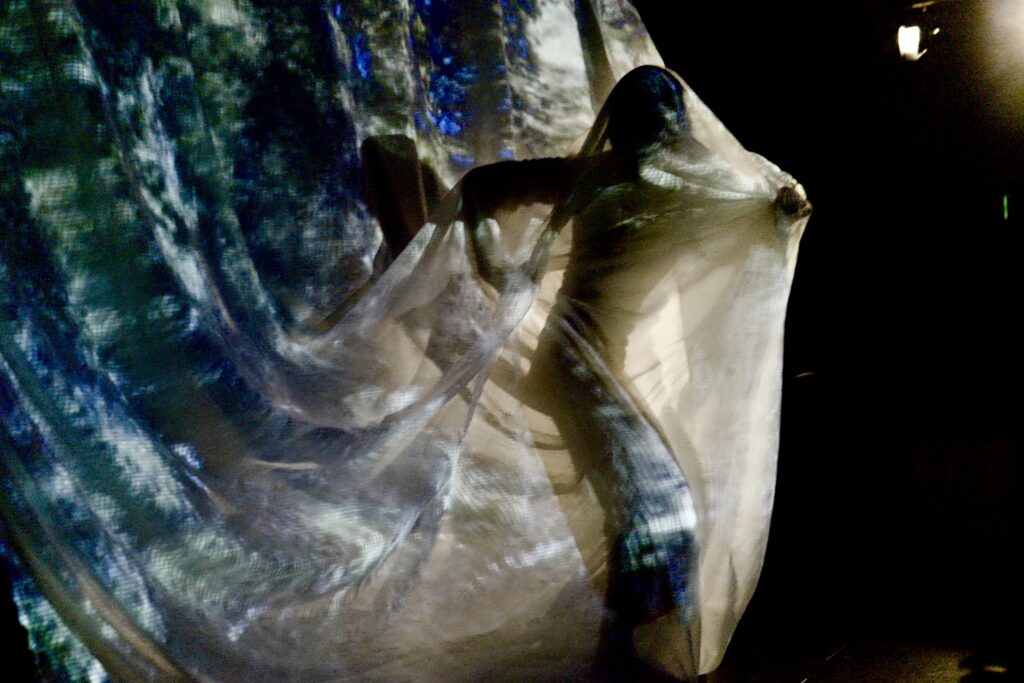
As the performance begins, a long curtain drops from the ceiling to the floor. It does not take up the full width of the stage. Afrit Nebula, a three piece band, are set up to one side. The stage is plunged into darkness, and a voice emerges: “She wasn’t there in the beginning, and then she was. And she moved, she was moving. She moved. She came from something else, which was she, and which was ‘she’, before. She was there, and is there, and she came from what was before.” The stage awakens: a projection appears on the curtain, a shimmering watery luminescence, and the band ignites. First there is a rumble, then an eruption as the sound of a soprano saxophone pierces the room. Slowly, the sound settles, leaving only ambient, residual ringing. From behind the curtain, the face and fingers of a figure push out.
DANCING TO A MYSTERIOUS TUNE
The Spirit In The Dust is the product of a three-way collaboration between renowned Japanese Butoh-influenced dancer Yumino Seki, St Leonards-based three-piece band Afrit Nebula, and filmmaker Mark French. Seki plays the role of a world spirit who has been conjured into being “from darkness” and, brutally exposed to the world, “learns what it is to be human.” The piece takes its inspiration from a quote attributed to Albert Einstein: “Human beings, vegetables, or cosmic dust, we all dance to a mysterious tune, intoned in the distance by an invisible piper.” It is about the mystery of human agency in a world full of forces: what animates us, and whether it emerges from within or without. The performance of this mystery is beautiful. Multiple agents act on one another; sound, light, material, body, but it remains unclear who or what is the primary agent: what acts and what reacts. By extension, it is unclear where the boundaries of each agent begin and end. As the eerie voice (the only detached entity from the interplay of actions and actors) describes, Seki’s world spirit “came from what was before” and was conjured in a flash. There is a new reality, yes, but the material essence has not changed, only moved. “She was moving out of nothing” the voice says, “into a new space which had come out of nothing.” Once alive, she is a part of what now surrounds her. She is part of the ebb and flow of the new reality and the causation within, and it is difficult to pick apart.
THE STRUGGLE OF THE WORLD SPIRIT
The feeling of dynamic interplay between agents pervades the entire piece, including the performers. I spoke to Ken Edwards, founding member and bass player of Afrit Nebula, about the intuitive nature of the relationships between each member of the band and Seki. Embodying the spirit of the piece, they intuitively allow the direction of influence between them to shift. At times, the world spirit is commanding, pulling around the curtain in tight step with the band’s rhythms, demanding they keep up. Yet other times her movement lags in jolts behind them, and she seems distressed.
Both Afrit Nebula’s avant-jazz influence and Seki’s Butoh-influenced practice suit this scriptless approach to performance. Butoh is a dance form originating in Japan, born in the late 1950s as a rejection of the constrained and refined traditional Japanese dance traditions. It is associated with ‘unsocialised movements’ and, befitting this piece, addresses the question of human control. Butoh begins, one practitioner describes, with an “abandonment of the self”, creating an empty shell in which external stimuli can enter and move the body. Though Seki’s world spirit is not an empty shell, she struggles for influence against the powerful forces of light and sound.
A MOVING METAPHOR
There are many reasons to find this performance moving. In it, I found a metaphor of infancy, in that my new nephew has just learned to walk. Though he came from “what was before”- the material essence of his parents- he is also a new force, slowly exerting his own agency on the world, fundamental to reality rather than a late addition. “That was before, and this is after. After is different in some way”, the voice says. But it also speaks about a fundamental human anxiety around control. It is distressing to feel that life, with its demands and forces, is merely happening to you. As an audience, then, we welcome the world spirit, finding joy in the moments of calm when the sound and light settle and afford her respite to move for herself. The performers, too, have learned to relish those moments.
Over time, Ken Edwards says they have learned “less is more, to make use of the silence, to rein back at times and enjoy the space.” These moments were the most moving: they are hopeful and optimistic. Recently leaving my job, I personally am craving space from the rolling demands of life to cultivate a new path forward. I cannot wait to see The Spirit In The Dust again.
The Spirit In The Dust perform again at Fabrica, Brighton on 23 May.
We hope you have enjoyed reading this article. The future of our volunteer led, non-profit publication would be far more secure with the aid of a small donation. You can also support local journalism by becoming a friend of HIP. It only takes a minute and we would be very grateful.

Leave a Reply