
Stored Out of Sight: Disability and Society
VICTORIA KINGHAM
3D printing is now part of mainstream culture. A small ‘starter’ printer can be bought on Amazon for £99. A more advanced one that uses ‘all metal hotend’ and can weld at 300°c is only £400. Yet I find it continually unnerving that we are able to create credible three-dimensional images of, well, anything. Remember the grim piece of news that someone printed a real gun and used it. Furthermore, scientists have created a replica of a real, growing embryo. There’s nothing we can’t do. Allegedly.
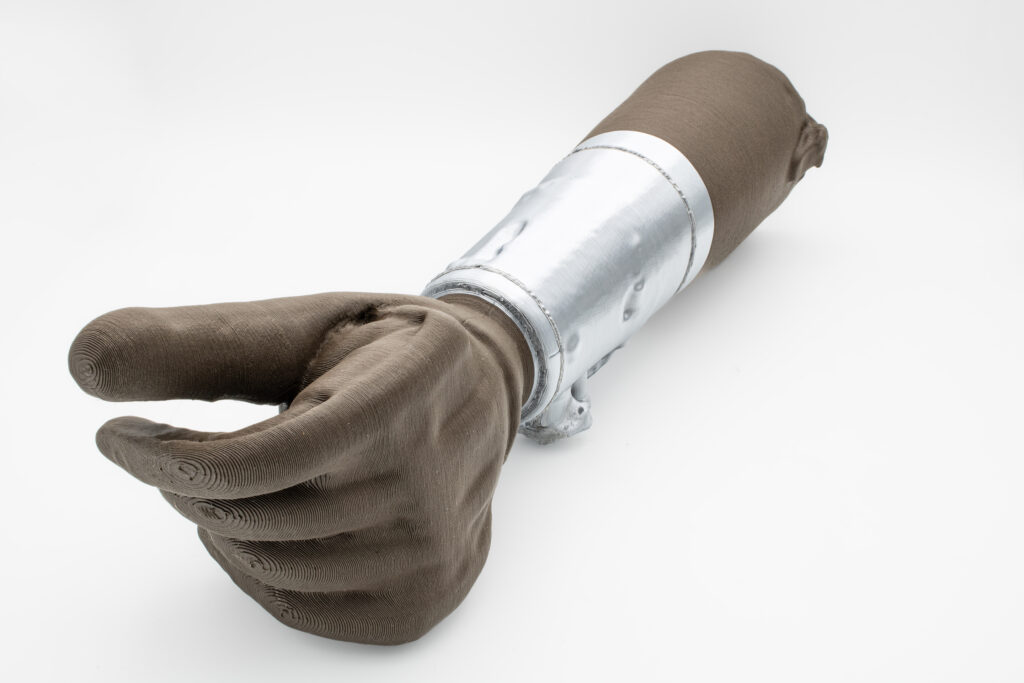
In spite of these modern-day miracles, the new exhibition at Hastings Museum and Art Gallery, Stored Out of Sight, does a great deal to inform society of what could be done much better. Designed by and for differently abled or neurodivergent people, it explores their reactions to particular museum objects. One of these objects is a complex prosthetic arm designed at the beginning of the century. Lifelike models have been created by a 3D printer in three or four pretty colours, and unusually, they are available to be picked up, waved around, and generally examined.
The exhibition, in addition to being a curatorial exercise, stands as an art installation in itself. It isn’t any kind of traditional exhibition of art by disabled people that one might have expected. It is an exhibition about a group of people, variously divergent, and their reactions to objects in the museum. Further, it is about their own place in the world and how they maintain it. It is joyous and telling at one and the same time. People’s personal reactions become part of the exhibition, enabling it to become more than just the sum of its parts. For all the technological advances available to society, there are still people dying from lack of financial, or other kinds of support. There’s a particularly stark exhibit – a simple wall full of official forms. People are, they say, perpetually filling these in just to prove that they exist and that they cannot remain useful members of society without a small amount (and we are talking fairly small amounts here, say £40 or £50 a week) of extra financial help. One person said she always seemed to be hanging on the phone waiting for an answer. “The stress caused” remarks Jack Guy, “is ridiculous. With disabilities some days you have a bad day, and some days you feel better. So people see you and think you’re OK, and you lose your claim.”
Jack Guy is the genial and articulate young curator of this exhibition. He considers himself neurodivergent (he is dyslexic) so feels that he has a broad understanding of the term. “It’s difficult,” he remarks, “because you don’t want to take away the term and use it, but you do need a general term to bring everybody together.” After a history degree in Wales and a Masters in Museum Studies at Glasgow he did a four-month internship at Llanerchaeron, a National Trust house in Wales, to gain some practical experience. He applied to Curating for Change, to run a project as an offshoot of the Accentuate program, designed to create a cultural shift in general attitudes to disability.
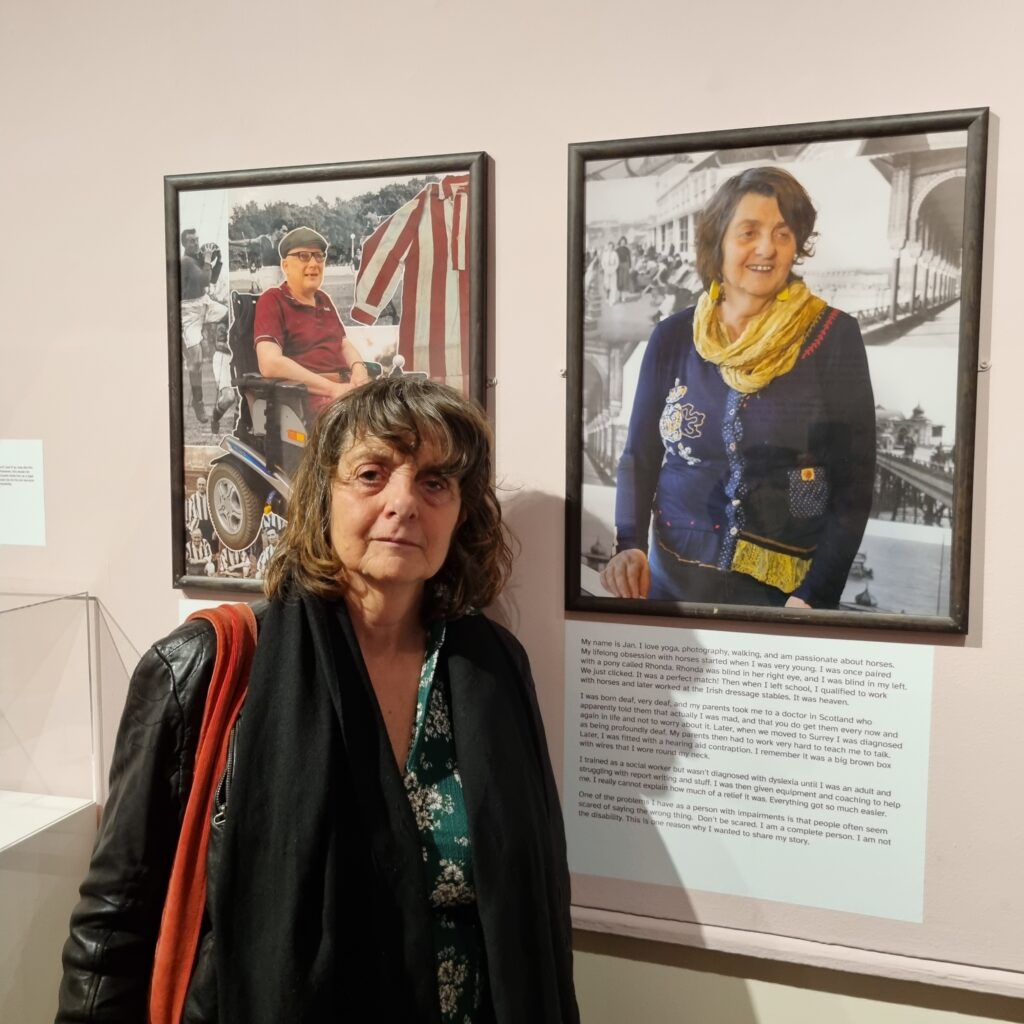
The end result of his appointment speaks very much for itself, and has also allowed the participants to speak for themselves. Most of them were there at the inaugural view, happily surrounded by their work and their own photographs, each carefully placed against appropriate backgrounds and composed by another member of the group. The textual descriptions under the photos were deliberately composed, Jack tells me. “We tried to get the description in the right order. It would be nice to ignore the disability, but it has to be shown, because unfortunately disabled people aren’t represented. They have to continually self-advocate.” Hence the wall of government forms. “It’s like a punishment for having been different for most of your life.”

The objects chosen by the participants vary enormously. There are some astonishing works by artist George Graham, created towards the end of his life, when an increasing deafness was a catalyst for his total change of style and the production of a set of wonderfully gifted ‘Creation’ paintings. These were an inspiration to one of the group, Frankie, whose own disability excluded her from the traditional world of art and design. She has made the most moving video comparing Graham’s vision to Beethoven’s ninth symphony (Beethoven’s deafness is well-known) and noting that both were inspired by the Creation myth. The link to this – and please watch it) can be found at the end of this article.
The narrative that emerges from these discussions, continues Jack, is striking. “Small alterations here and there would allow disabled people to do everything. Why do we always have to have steps, for instance? The Romans used ramps all the time, and it’s a great way of moving around.”
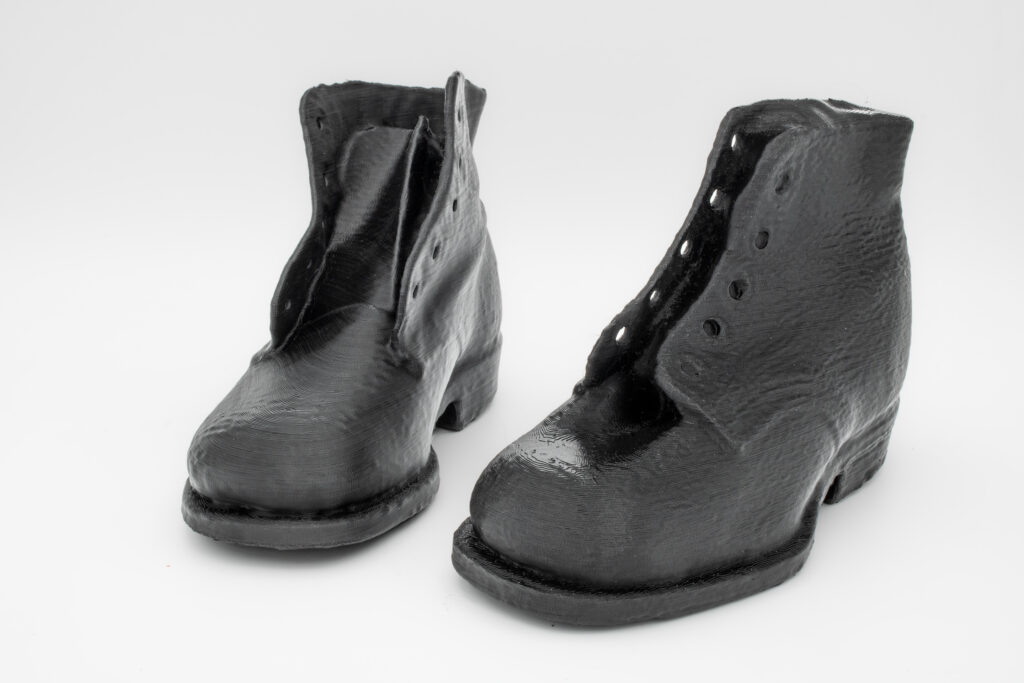
Besides the prosthetic arm and its eerie reproductions, there are other telling objects: a straitjacket, a hundred-year-old wickerwork wheelchair. Rosie, now in a wheelchair herself, remembers being a health worker in a former life, and cupboards being full of these kinds of artefacts, no longer used but not thrown away. There are small workhouse boots, a charity ‘poor box’, an invitation to a talk on eugenics, all of which have inspired narratives. There are also photographs, lent by various other institutions – disabled people’s demonstrations in 1985, for example – and a video of the group working with the Corali Dance Company, created by people with (mostly learning) disabilities.
The group also had training in disability history. There were 1880s photos by George Wood of disabled people on Victorian streets, some begging, some limping, some limbless, all abandoned. “We’ve always been part of history, and it’s not something new. Bad representation leads to horrible things – good representation leads to better understanding. We don’t know the names of the people in the pictures, but without proper documentation and thought, they disappear and we think they don’t have a history”. A bit like slaves, I remark. And there is a Disability Coat – this was a loan, and is a cloak of many colours with the relevant restrictive Acts of Parliament sewn into the sleeves and the fronts. “I felt that it was a perfect piece for the exhibition, which is about representation.”
So, requiring better understanding, here we are back where we started. While humans can journey to the moon, reproduce and insert a new hip joint as a matter of course, synthesise a baby, split the atom, reprint a lost antique sculpture, create moving holograms of 1970s megastars, or remodel faces and bodies, society as a whole still cannot properly accommodate difference, still cannot quite break the mould of hundreds of years of ingrained narrative which labels the disabled as incompetent, stupid, sociologically embarrassing. This small, beautiful exhibition does more than most to emphasise this cultural dissonance, is of enormous value, and is a huge credit to its creators, instigators, and participants.
Stored out of Sight is at Hastings Museum and Art Gallery, Bohemia Road, until 16 December 2023. Exhibition details: hmag.org.uk/see-and-do/exhibitions/stored-out-of-sight/
Frankie’s video: youtube.com/watch?v=X9L3lXXbysM&t=209s

We hope you have enjoyed reading this article. The future of our volunteer led, non-profit publication would be far more secure with the aid of a small donation. You can also support local journalism by becoming a friend of HIP. It only takes a minute and we would be very grateful.

Leave a Reply