
Quiet Realism Makes a Noise
HELEN MURPHY & NICK PELLING explore the David Tindle exhibition at the Kino Gallery.
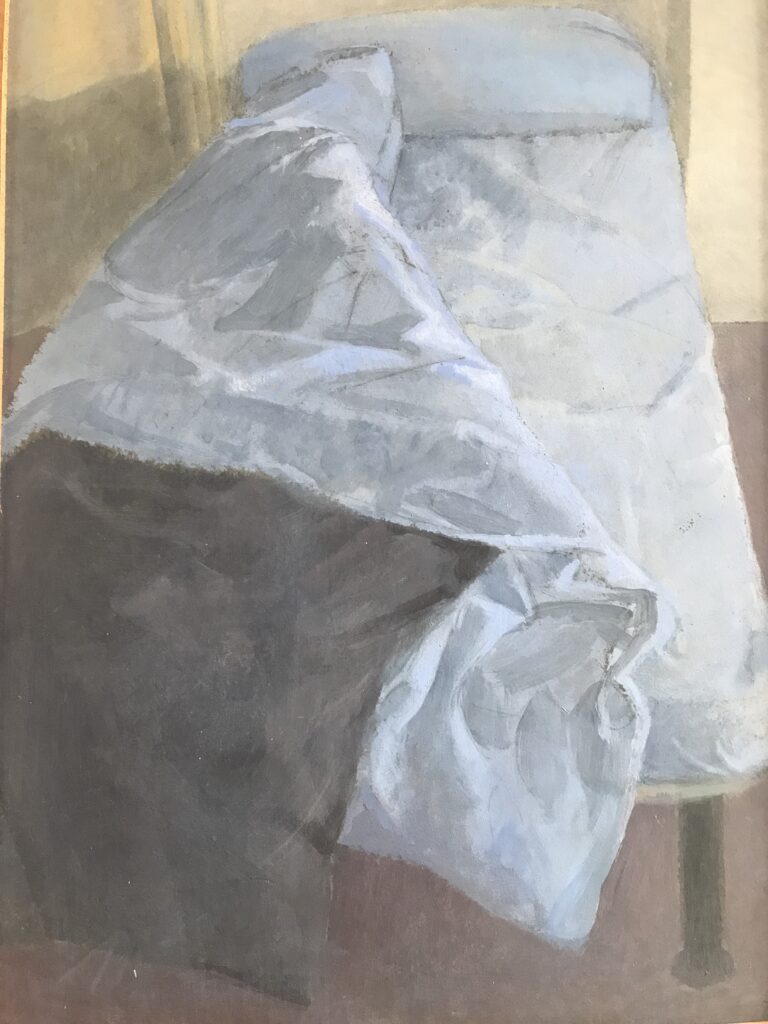
David Tindle: Blue Bed Sheets and Pillowcase (2006)
When you think of British painters of the 1950s and early 1960s, there is a tendency to think of the bohemian Soho crowd who swirled around Francis Bacon in what became known simply as Muriel’s Bar. The trail of great paintings, love triangles, alcoholism and suicides, of which their lives seem to consist, can make you think all of these painters are best defined by their commitment to carnality.
BAGGY JUMPERS
However, some of the painters of that era were not hanging out in paint-spattered baggy jumpers in a vortex of gay sex and bebop noise. In amongst this band of hedonists and self-destroyers, there were some painters who just quietly stuck to their craft. One such painter was David Tindle, an artist who – whilst strongly attracted to the magnetic personalities of Bacon, Lucien Freud, Keith Vaughan and John Minton – stayed true to his own vision. Russell Baker and Olga Mamonova have undeniably pulled off quite a coup in putting together a retrospective of the work of this important, but rather neglected, survivor of that volatile period.
Russell told us of the time when he spotted Tindle outside his Kino gallery in 2009 and invited him in; “as two northerners we immediately hit it off.” Russell remains a friend and has even visited him in his current home in Italy. Baker says that he feels “privileged” to hear David’s tales from the almost mythic Baconian world. Whilst myth and fact may not always coincide, it is certainly true that this friendship has brought us a remarkable show.
LEAVING THE PROVINCES
David Tindle was born in the very unbohemian town of Huddersfield. He later studied at the Coventry School of Art and might very well have remained a little-known provincial painter in such environs. But in 1951 at the age of 19 he took a gamble. He moved to London and found work as a set painter in West End theatres. He was quite well regarded as such but what seems to have changed his fortunes was an out-of-character decision to reach out to quite a well known London painter, John Minton. Minton was both a great painter and an aesthetic networker. For whatever reasons he took to Tindle.
Minton knew how to connect Tindle to the right people. In 1954 Tindle achieved his breakthrough exhibition at the Piccadilly Gallery. The gallery was run by the slightly snooty gentleman collector Godfrey Pilkington, scion of the great glass manufacturing family. Pilkington hated the fashion for abstract work that was seeping into London from New York. Tindle was a realist and one can only assume Pilkington welcomed him as a very British antidote to American splatter.

NOT WHAT IT SEEMS
Tindle is still painting today at the age of 91 and, inevitably, a retrospective that covers at least seven decades leaves a sense of shifting concerns. His work in the fifties displays the influence of early Lucien Freud. The deeply meditative Broken Egg Shell, painted in 1954, has the sharp kitchen-sink silent realism of Freud’s Girl with a White Dog, from 1952. But the kitchen is not quite what it seems. It comes freighted with a curious atmosphere. As in so much of his work, people are absent but feel just out of the painterly camera. Works such as Blue Bed Sheets and Pillowcase carry a sense of a human bed story just hanging in the air.
Rachel Cooke, in the Guardian, was also onto a truth about Tindle when she spoke of his tendency to “play with realism”. The scene of an unpeopled room, in the subdued style of a Gwen John, is familiar but almost too normal. Tindle himself felt that his work had a sense of a time half-remembered: of quiet moments slipping away.
AUTOBIOGRAPHY IN PAINT
The later work, such as Two Young Women and a Stray Dog, from 2017, have a feeling of distant viewing: like long swathes of contemplation on canvas. The painting style is somehow both thinner and deeper. No matter how one interprets the work, the wonderful exhibition brings you a kind of journey through a painter’s life. As you wander around Kino, upstairs and downstairs, you slowly realise that you are inside one man’s total commitment to painting. An autobiography in shades.
The exhibition continues at Kino in Norman Road until 28 January 2024
We hope you have enjoyed reading this article. The future of our volunteer led, non-profit publication would be far more secure with the aid of a small donation. You can also support local journalism by becoming a friend of HIP. It only takes a minute and we would be very grateful.

Leave a Reply