
Piper Hosts pip
BEN THOMPSON
Every now and again, you see something that’s different and special. At pip’s first gig – appropriately enough, at the Piper (supporting El Khat back in October) – Otti Albeitz’ fluid drums embraced the other three musicians on the stage like a loving octopus. Stuart Griffiths’ early career alto sax somehow managed to combine vulnerability with lethal menace, and the spectacle of jazz double bassist Andy Beresford dealing with the electric interventions of Khalil Patwa was a treat for the eyes as well as the ears.
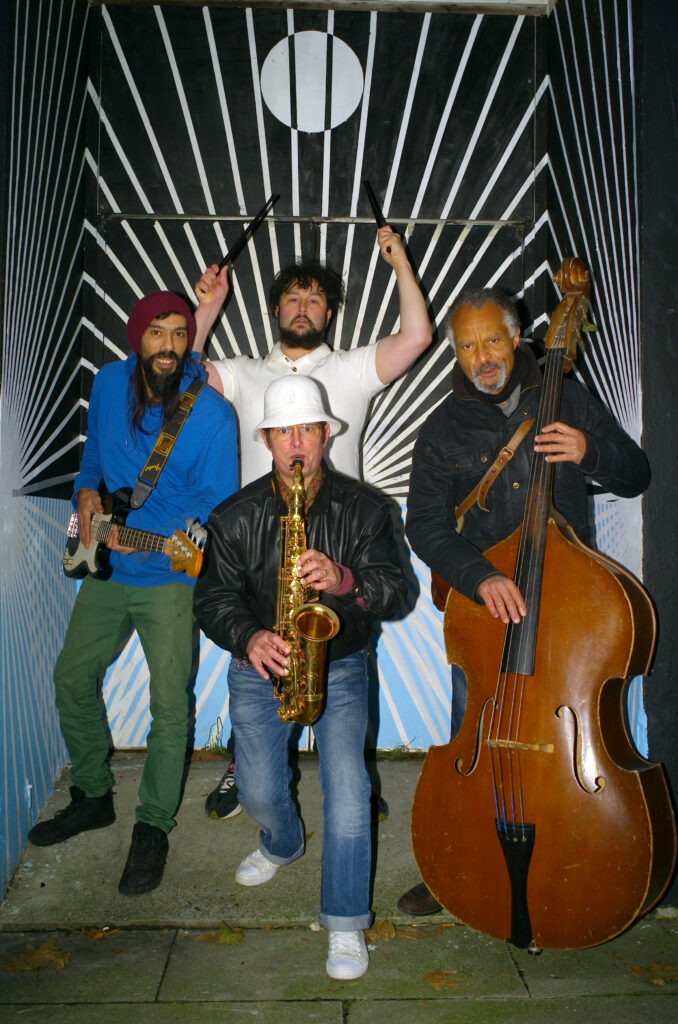
Left to Right: Khalil Patwa, Stuart Griffiths (on sax), Otti Albietz, Andy Beresford
In the run up to their eagerly awaited second show (in the White Rock Hotel Basement on 9 January) which will mark monthly jazz night Berth of the Cool’s transition from a vinyl-only dj event to a platform for some of the area’s more experimentally minded musicians, I asked each member of the group to explain their function in pip and how what they do there relates to music they have made previously.
“I’ve played double bass in mostly jazz/groove settings before,” notes Beresford, “So it’s quite a thing for me to create something coherent and then have the groove carpet pulled from under my feet by sudden anarchic interjections from my bandmates, but hopefully what comes out is a sound that’s fresh.” Patwa’s more poetic vision of what he brings to the table – “I use my bass guitar and effects box to add texture and rhythm, like a wind that’s now fragranced because of the flowers it’s blown” – gives you some idea of the contrasts in personality and musical provenance that make this group such an intriguing prospect.
“At the core is nothing but flow,” explains moonlighting BEAU frontman and solo artist Albietz. It’s clear that pip’s short name has some long stories behind it, not least in the raw melodic drift of paratrooper-turned-war-photographer Stuart Griffiths’ alto sax. His deconstructed military melodies are a way of channeling traumatic experiences in combat zones from Northern Ireland to the DR Congo. “I came back to the saxophone after many years in the wilderness and undergoing therapy for PTSD,” Griffiths explains; “and when I’m playing it all my problems seem to lift away.” He’d hoped to join the regimental band after the Thatcher government’s cuts put paid to his school music lessons. Things didn’t work out that way, but now he’s making up for lost time on an instrument bought for him by the Royal British Legion. If that’s not the circle of life, I don’t know what is.
We hope you have enjoyed reading this article. The future of our volunteer led, non-profit publication would be far more secure with the aid of a small donation. You can also support local journalism by becoming a friend of HIP. It only takes a minute and we would be very grateful.

Leave a Reply