
Musical Conversations on the Edge of Modernity
VICTORIA KINGHAM
Sonatas for violin and piano were never my thing, really. But I dare say I have watched and listened to more of these in the past four years in Hastings than at any other time in my life. And each time, the breadth and complexity, the intensity and originality of their structure has become clearer.
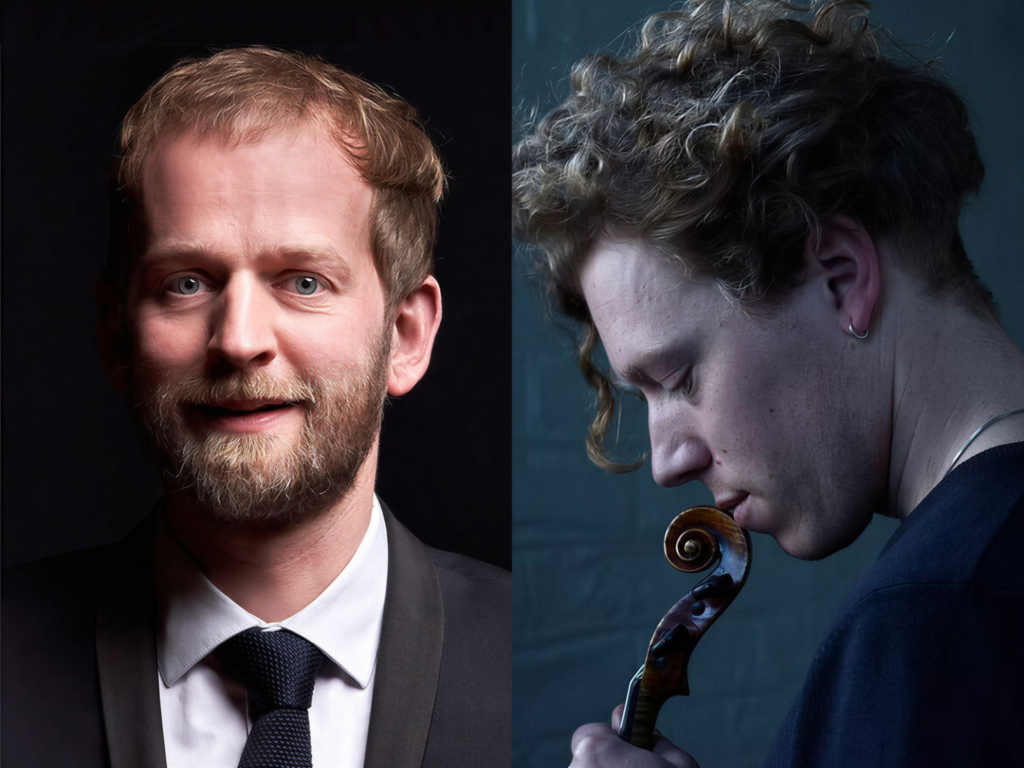
Alasdair Beatson (left) and Max Baillie
It hasn’t just been violin sonatas either. Starting with the Oxford Lieder sessions at Fairlight Hall, which were fascinating, and something I had enjoyed before, I began to appreciate the interaction, the conversation, between instruments. A friend who went with me to one of the piano concerto concerts recently – someone who had never been before, but is musical and listens – said: “I didn’t realise, till now, that it was all about questions and answers.”
So the Lieder series, which lays emphasis exactly on the questions and answers – the relation between the piano and the voice, the piano not only reflecting the melody but also the lyrics of the songs – was a revelation. Going back to the violin sonatas, watching string ensembles and quartets, I began to get a glimmer of why the string quartet is often held, in musical circles, to be one of the most difficult tests of a composer’s skill. It is often considered a composer’s highest achievement: to write an intelligible, complex, and emotional conversation between four stringed instruments, each with a similar timbre.
Watching Max Baillie and Alasdair Beatson play such demanding music showed me how the formal creation of a composer can be realised, in performance, through the deep understanding of two master musicians. They clearly admire each other’s musicianship, and the rapport between them was almost palpable. They were able to play the conversation: impeccable timing throughout, and each piano entry and each violin entry were positive, definitive, indicating firmly the trajectory of each following phrase.

MAKING IT NEW
“Make it New!” was the Modernist watchword of the years from approximately 1918 to 1930. It leaked across the Art world, in the visual arts, the literary, and the musical. “I am essentially a polyphonist and not a connector of pretty chords,” Enescu has been quoted as saying, though his sonata is intentionally reminiscent of the folk music of his native Romania. Kurtag, famous teacher and the composer of extremely short, intense pieces, is still alive at 100 years old.
Baillie and Beatson put together an erudite programme that reflected a progress in twentieth century music while saving Beethoven’s Kreuzer Sonata to the end. “Beethoven was a difficult man,” explained Beatson (rather laconically), and the bad-tempered, bad-mannered Ludwig dedicated this fast, intricate and impossibly difficult piece to a violinist who flatly refused to play it. Nevertheless, Beethoven, the ‘Magnificent Rebel’ wrote music that formed a point of departure for every other music for the next three hundred years, and he was not only the greatest rebel of his time but also the greatest genius. So the evening ended with a piece that contained, in its radical departures and endless invention, perhaps the origin of all the others.
Predictably, I loved it all. Some of it was unfamiliar to me, and I have listened to all the pieces again since. However wonderful the soloists on a recording though, for classical music you have to be there for the real thing, the micro-expressions on the faces of super-talented musicians, the exchanged nuances of mutual musical understanding, the shared lift at the start of a phrase, the obvious, beautiful, wordless conversation. There’s nothing like it.
Max Baillie and Alasdair Beatson played Enescu, Boulanger, Martinu, Kurtag, and Beethoven on 10 March at Christ Church. Details: stlconcerts.co.uk/event/max-baillie-alasdair-beatson
We hope you have enjoyed reading this article. The future of our volunteer led, non-profit publication would be far more secure with the aid of a small donation. You can also support local journalism by becoming a friend of HIP. It only takes a minute and we would be very grateful.

Leave a Reply