
Marine Lifein Hastings Contemporary
VICTORIA KINGHAM
Odd how music that was cult-radical in the 1960s and 70s has become today’s café muzak; the institutionalisation of the ex-radical. So, sitting in Hastings Contemporary’s new café, Coquina, I hear subdued rounded sounds that were once the drug-fuelled, outlandish dreams of Jefferson Airplane, Kevin Ayers, and Lou Reed.
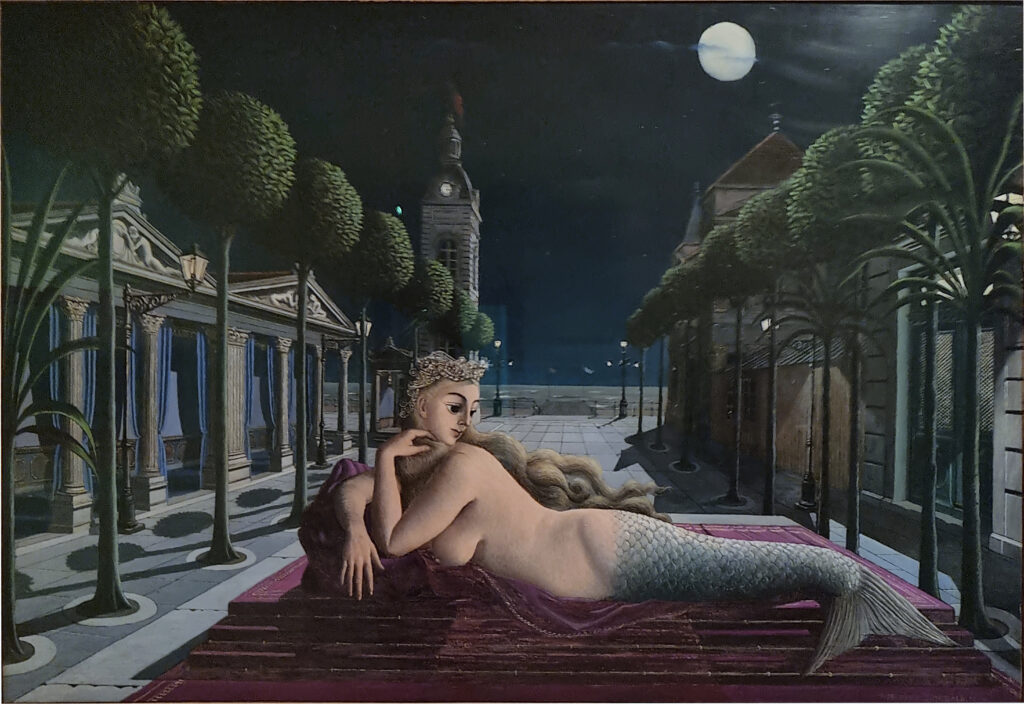
Paul Delvaux, Siren in the Moonlight, 1940. Oil on panel, 111.9×180. On loan from Southampton City Art Gallery

This demonstrates a process that I have always found very interesting, and sometimes a little bit sad. I rarely go to see re-formed bands that I revered years ago, for precisely that reason – a youth culture by definition wants to differentiate itself from its immediate ancestors’ generations, to go where they didn’t, to like the hitherto unlikeable, admit the hitherto inadmissible. An act defined in this way by my own generation’s youth culture has to search for a raison d’être in today’s world. Those irresistible searing singing voices have often degenerated into caricatures of themselves, some of the legendary guitar riffs are by now more than a little arthritic, and ‘sex, drugs, and rock ‘n roll’ is a granddad cliché. Does this happen with Art? There are visual artists who find one innovative style very lucrative and are condemned to repeat it to the point of moribundity.
THREE SHOWS
By contrast, there is nothing moribund about this art gallery. In spite of its 14-year existence Hastings Contemporary still doesn’t command quite the reputation that it deserves, but it’s getting there. It’s a unique building, designed beautifully to fit in with the surrounding black wooden fishing huts. It commands an excellent view of the beach, with the carefully maintained fishing boats (only about ten of them still go out to sea) aligned along the water’s margin. That view from the upstairs window is always surprising: it’s so pictorial that it inevitably becomes part of the show. The current show actually consists of three different exhibitions.
Hence The Sun Feeds the Wind, an exhibition curated by the Hastings Fishermen’s Protection Society, is a whole room devoted to moving images and reminiscing voices of Hastings fishermen, their past lives and hopes (if any) for the future. Art For Your Oceans is prompted by the use of Ocean Ink© – the first ever show of sustainable work made with a new, seaweed-based ink. The leading work for this is by Anthony Gormley–an ink wash of a body swirling under water.

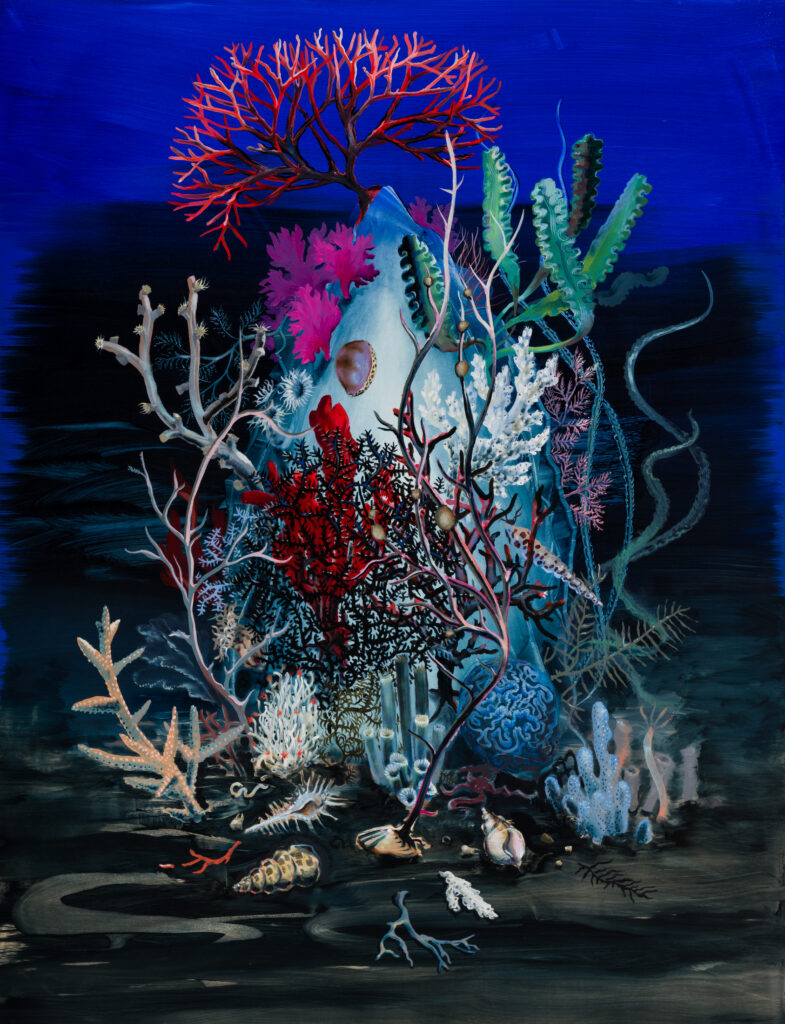
The excellent Undersea exhibition displays Delvaux’s magnificent Siren In Full Moonlight, amongst abundant world-wide representations (contemporary and ancient) of mermaids and mermen in all kinds of unusual situations, often mythological, sometimes dream-induced. Conversely, there is a vivid 300-year old painting of a reluctant-looking red lobster waiting to be eaten (on a Delft dish) by Charles Collins. Among a plethora of other sea creatures, there’s also a heartrendingly perfect little modernist Still Life by Edward Wadsworth, featuring a grainy wooden upturned boat and beautifully patterned, elegantly placed conch shells in harmonic design nearby. There are also many sometimes funny, but often beautiful and intricate, modern paintings: Nicola Bealing’s Cowrie Rock with Teeth is very special.
It’s hard to tell where one exhibition ends and the next begins, but as they’re all about the sea anyway that doesn’t seem to matter much. Outside the café, Laura Ford’s sculptural tribute to ocean wildlife – a big huggable velvet seal draped over an old velvet chaise longue – examines you dolefully as you pass by. And it’s Pirate Day too, so there are hundreds of families and dogs, wearing bandannas, tricorns and eye patches, milling about on the Stade, and they all crowd in when it starts to rain.
NEW DIRECTOR, NEW EXHIBITIONS
This current exhibition has involved input by the gallery’s new Director, Kathleen Soriano, though much of it was planned before her arrival. Her latest book is Madam & Eve: Women Portraying Women. Women artists, representing themselves or other women, often intentionally subvert our long, culturally-ingrained archetype of Woman as Object of the male gaze. Notably this copiously-illustrated and carefully produced book contains comparatively few works presenting women as beautiful, stylish, decorative or desirable in the expected sense.
I wondered if Soriano saw part of her role as promoting women’s art particularly. “I’m more interested in making sure that it’s [the Gallery’s] a more fully diversified offer,” she told me. “Always having the issue of representation in your head when you’re putting the programme together, rather than just the women versus men thing.” Nevertheless the proportion of work by women on the gallery walls is unusually high.
The next exhibition, which begins in September, is Soriano’s own initiative, featuring work by three very individual artists, two of whom are local residents. Sophie Barber makes work that uses text and painting to reflect the environment and its detritus; Isabel Rock’s work also demonstrates an intense interest in climate change. Soriano describes it as “highly colourful, surreally joyful, filled with giant wedding cakes and crocodiles in a swirling sea of spaghetti Bolognese…quite loud, provocative, disruptive.”
The third artist, Michael Landy, is famous for once disposing of his entire 7,227 possessions (including a flashy red Saab) over the course of two weeks, via a giant conveyor belt and dumpsters, in the window of the recently defunct C&A store in London’s Oxford Street. In contrast to this flamboyant performance, for this new exhibition Landy, a Royal Academician, has created a series of large, beautiful, quiet etchings of ordinary wild plants, called Nourishment.
COMMUNITY PLANS
Soriano already has extensive plans for the future of Hastings Contemporary. She is particularly keen on community involvement, and I asked her about the unique community of Hastings with its many Festivals.

“We’re busy trying to reimagine what a gallery can be. It’s partly being in Hastings and on the beach that allows us to do this,” she tells me. “We’ve got a mobile studio that looks like a fishing hut. It’s parked on the Stade but it will travel around Hastings and beyond to other communities and to festivals. Other Arts organisations can also borrow it. So we’re busy working out how we can use that with the festivals. I’ve also got way bigger ideas about what we could be doing outside of the Gallery building. As you can imagine there are lots of areas around us which we could activate beautifully, and powerfully, for the area. All the staff live in Hastings and are really embedded in the community, and know the festival organisers.”
She is extremely enthusiastic about her working environment. “It’s been so rewarding working with the team– it’s a really fabulous team of people at Hastings Contemporary, and I think we’re all really excited about the new vision. We’ve had a conversation this afternoon about how we would describe it, what the values are. I think it’s given all of us a big boost of energy and excitement.”
CONTINUAL GROWTH
Soriano has had years in her chosen field, and clearly her established reputation will have an effect on how the work of the gallery is able to develop. “The Art world is very small,” she says, “and when you’ve worked somewhere there’s always a bit of you that’s still connected with it.” She is involved in various large projects – programmes for Sky Arts, strategic involvement with various other galleries (the Royal Academy, for example) and museums and Arts organisations, and an organisation called the Touring Exhibitions Group. “I’ve been in the business for a long time. What that means is that I have a broad network. So I can text the Director of the British Museum and say how are we going to work together on the Bayeux Tapestry, for example. So it allows us to operate at a slightly different level.” This different level has prompted her to organise (with Jo Myles) the well-established Sussex Open, which for the first time will be shown, next year, here at Hastings Contemporary.
Every plan, of course, depends “a hundred per cent” on raising funds. “As a director of an organisation you need to show how you will pay for exhibitions – all the things need to be income generating. We’ve just launched a new patrons’ scheme called The 1066 Club, that will allow artists’ studio visits to its members. I have access to artists – these are opportunities that money can’t buy. So we have a mixed income model. And it’s one of the reasons we’re trying to work further in advance. It’s only by working long-term with various funding bodies that we can get these things into place.”
Although Soriano plans to move to Hastings to live, she currently lives a peripatetic life: “I’m down now for a six-week run, and then I’m back again for all of October/ November/December. Then in between I’m on Zoom.” she goes on. How does she have the energy? I wondered. “I have to say that this year has been absolutely crazy, and I feel great! I think it’s just my natural way.”
hastingscontemporary.org/events and for more information vist wikipedia.org/wiki/Kathleen_Soriano
We hope you have enjoyed reading this article. The future of our volunteer led, non-profit publication would be far more secure with the aid of a small donation. You can also support local journalism by becoming a friend of HIP. It only takes a minute and we would be very grateful.

Leave a Reply