
Jazz, Jamaica, Joy
VICTORIA KINGHAM talks to legendary jazz pianist Monty Alexander
Monty Alexander has lived and played in the US for more than sixty years, since being discovered as a young pianist in a bar. Despite this he has never lost the Jamaican lilt to his voice or his whimsical expression. His pianism, however, is pure jazz, hence one could say, pure American. Except, like all great jazz, its sources are universal.

Monty Alexander
That said, he was brought up in a Jamaica that was still under British rule. “I’m pleased to come to Rye” he says, “and I’d like to go to Hastings too.” He was sent to a boarding school. “The teachers made sure they would tell you British History, William the Conqueror and all of that. Some of the teachers were from England.”
He recalls that interacting with the instrument gave him joy. “I was able to pick out melodies from 3 and 4 years old, and just have fun. I stopped having fun when my mother tried to get me to go to a piano teacher. Fun has been part of my playing music. When Louis Armstrong came on to the stage, he brought enjoyment.” His family weren’t exceptionally musical – his mother sang in the church choir, had a yen to acquire an old piano, and took a few lessons. There were always popular songs on the radio. He doesn’t talk about his father.
“It wasn’t just – this kind of song, that kind of song. It was – I don’t know the word – a banquet. Country and Western or Mantovani or Rachmaninoff or Chopin, and the piano sounded heavenly, and I just loved the sound, and tried to emulate it. And the other thing was rhythm. Pulsating, swinging jazz – Armstrong and Nat King Cole. They came to Jamaica to perform. I saw Satchmo. I shook his hand. I was ten years old and I shook his hand! Then there was Jamaican folk music, calypso, mento.” [If you don’t know what mento is, try listening to Old Lady You Mash Me Toe, by Hubert Porter, and you’ll get the kind of thing].
He mentions hearing pianists Billy Kyle (who played early piano for Louis Armstrong’s vocals) and Eddie Heywood, who recorded with Billie Holiday, Ben Webster, many others. And listening to their piano styles, I can hear them now in Monty Alexander’s. Honed, adapted, overlaid, but there nevertheless. There’s an available track of Heywood playing a beautiful solo version of Hey There (You with the Stars in your Eyes). “Then I heard a lot of rhythm and blues – Louis Jordan, all this kind of music. But a big moment for me was hearing Errol Garner, and Ahmad Jamal, who later became my friend, and he recorded my song on his album.”

NO PREJUDICES
If you want to hear more of these classic jazz musicians there are countless on-line ways of listening. They were magnificent, and the point is, that Alexander absorbed them all. “Any time I saw somebody play the piano I was drawn to it. I loved to hear classical music that was so intricate, and passionate. I had no prejudices, I heard it all.”
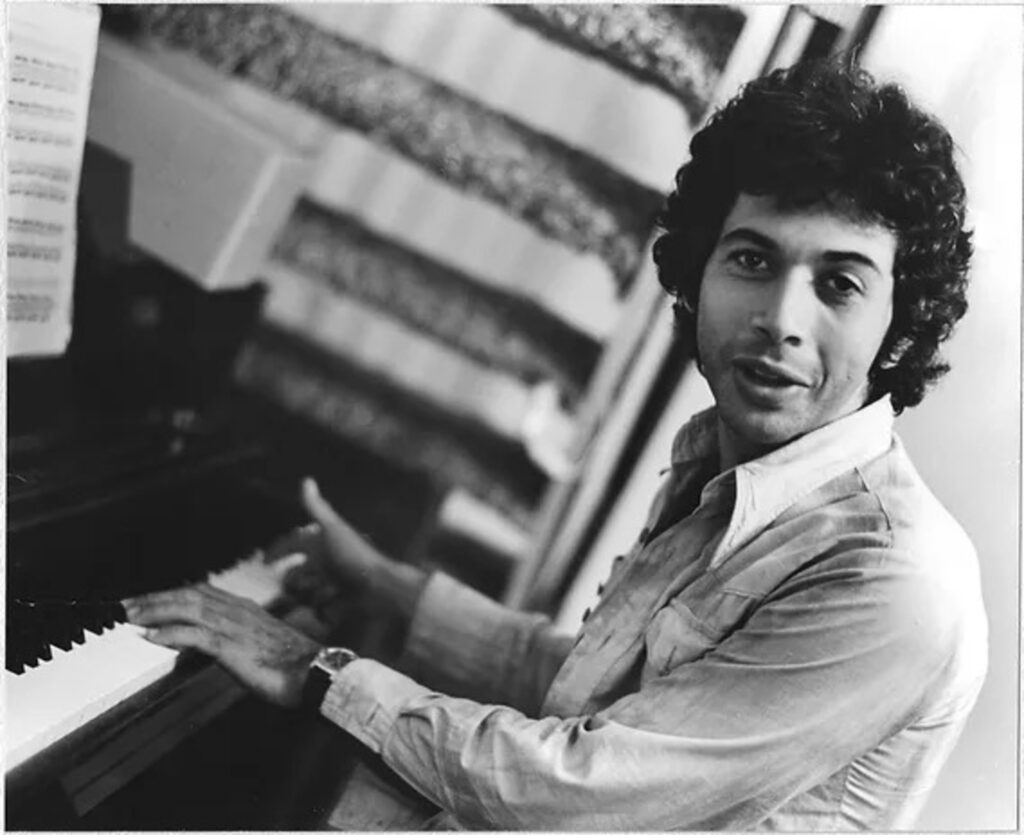
Monty Alexander in the 1970s
“I never write anything down. Just about everything I do with music is coming from the air, from the sky! I didn’t want instruction, because I was already enjoying it. Even with jazz, teachers were saying do it like this, do it like that. But I was in the company of the elders, and they would tell stories about the music. Forty years ago, Ella Fitzgerald’s manager (Norman Grant) asked me if I would work with her. But how could I work with somebody so incredible when I would have to struggle through a piece of paper? So I had to say, thank you for this honour, but I can’t do it. So I just kept on doing what I do – come to play a concert, come to Ronnie Scott’s – through time, one accident after another.”
What he plays is, I would say, jazz at its purest and most inventive. “Jazz musicians, we always want to play something different, something new.” He is bringing a drummer and bass player over with him, and I wonder how he approaches musical arrangements for the trio. “We don’t talk about it, we don’t rehearse” he laughs. I believe him. “Drummer Jason Brown, he’s been with me six, seven years, very open-minded. And another wonderful young man, [bass player] Luke Sellick. They just follow me, my music, whatever route I go down.”
His latest album, released a few months ago, is called D-Day. “The very day I was born. That’s why I’m Monty, Montgomery” named after the WW2 field-marshal. “On that album I describe the fear of war that’s about to happen, and say something about aggression and hatred. That’s what that album is about. There’s a story, a reason for doing it. Jazz musicians, that’s how we are as people.” In June, this became a new No. 1 on the JazzWeek charts.
NEW YORK, NEW YORK
He talks of his exposure to the New York scene. “I was this odd guy on the side, and they were all very kind to me. Frank Sinatra said something like, ‘you’re really swinging, you should come to New York’. So I started playing at this club Jilly’s, a night club. I was playing at the piano bar, and Judy Garland was sitting at the bar.” Did you play for her? “No – I hate to say this, but she had a little too much alcohol to be singing. But Sinatra would end up ordering more drinks at 3 in the morning, and I’d play till 5 a.m.”
The owner of Jilly’s was Jilly [Ermenegildo] Rizzo, long time very close friend of Sinatra. “A gangster bar, really. Jilly was a tough-guy type of guy. You learned to behave yourself, mind your business. Jilly Rizzo got killed in a horrible traffic collision in the early 90s. In my opinion that was the day that Sinatra started losing his love for the music of life. So I made the album (Echoes of Jilly’s) and I got back a letter from Frank Sinatra to say thanks for remembering my dear friend.”

CARIBBEAN ROOTS
In the early 90s Alexander became disenchanted with the music around him, “what musicians were thinking and feeling, the apathy. Some of my heroes were dying, too. So I went back to Jamaica where I grew up, to do human music. Hanging out with my Jamaican friends. They don’t know about Charlie Parker or John Coltrane. It’s a whole different, Afro-centric culture, with the ganja and everything, and Bob Marley was a great exponent of all of that. I started meeting younger people and playing with them, the reggae beat, and my homesickness was evident. So I simplified what I was doing. Jamaican music is not how much you know, but how you play.”
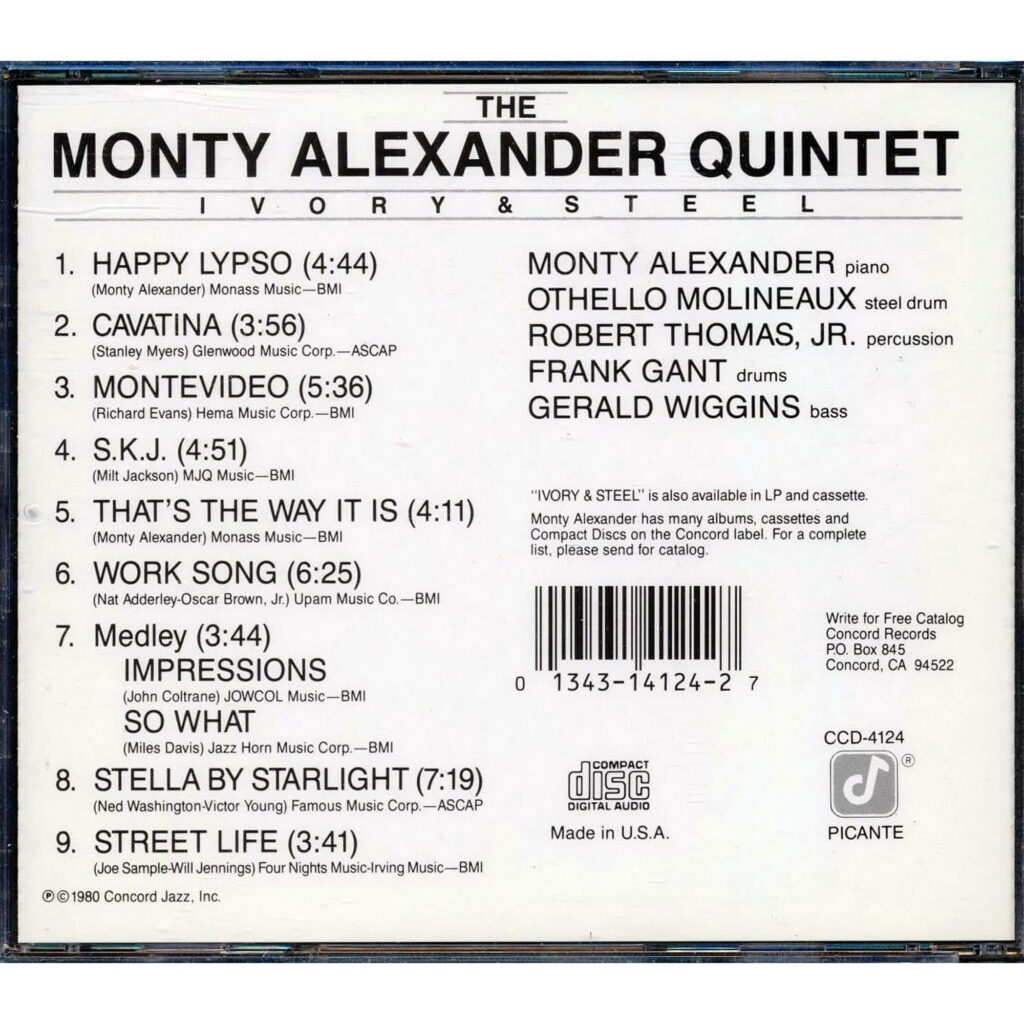
Characteristic of this period is Alexander’s discovery of how the sound of the steel drum resonated with the sound of the piano, to produce a “cathedral” effect. He had a significant association with the jazz steel pan player Othello Molineaux, a steel-pan genius who did know the music of Coltrane and Parker, who afterwards played for several years in a combo with gifted, troubled bass player Jaco Pastorius. Othello’s technical skill and invention contributed to the unique sound of that band of the 1980s, the Invitation line-up. But before that, Molineaux recorded with Monty Alexander, and also on two later albums after the death of Pastorius in 1987.
Monty’s story of that combo – and his store of musical anecdotes is endless – is that it was inspired by an album recorded in 1968 by the great Winifred Atwell called Ivory and Steel. Indeed, listening to her play Gershwin’s Rhapsody In Blue with the Pan Am North Stars Steel Orchestra is something to marvel at, the full ‘cathedral sound’. He loved it, so the band he formed with Molineaux, and their first album, was called Ivory & Steel in honour of Atwell.
THE CHARCOAL THAT BECAME A DIAMOND
Some of his best albums are the ones made at Montreux and in Tokyo. I ask him why he thinks so many great live jazz albums come out of those two places. “American people take jazz for granted, it gets labelled as ‘popular music.’ This great Art form happened in America, this charcoal from blues, from slaves, from Africa, that became a diamond. The Bible says, a prophet is without honour in his own country. But if you go to France or Japan or the UK there is a more passionate sense of appreciation. A musician feels that, and it encourages them to reach for a higher level.”
He has made 75 albums, featured on many more, and to each of them, he brings a characteristic joyful originality. A tune like Stevie Wonder’s Sunshine of My Life for example doesn’t necessarily have the kind of chords that make a classic jazz standard like, say, Tangerine. Stevie Wonder is a virtuoso, tireless activist and wonderful songwriter but not known on the whole as a jazz musician. Monty’s version takes Sunshine of My Life through a heavily romantic, near-schmaltzy, introduction into a brilliant double-time fantasy and back again, and I love it. Monty has to remind me, though, that we are talking about fifty years ago! One of the best things about Spotify is that finding tracks ignores time, and the best tracks don’t date.
And indeed, neither does Monty Alexander. The performance, in legendary St Mary’s at Rye, promises greatness. He will be flying in from the Nice Jazz Festival. Rye Festival is fortunate to have acquired an equally legendary, committed, lucid, endlessly inventive, joyous musician, considered by many to be one of the best jazz pianists in the world. It was a privilege to speak to him, and it will be an honour to see him play.
Monty Alexander will play at St. Mary’s Church, Rye, as part of the Rye Jazz and Blues Festival, on Sunday 25 August from 3-5 p.m. Full details of the Festival, which runs from 22-26 August, can be found at ryejazz.com where tickets can also be purchased.
Copious information about Alexander, his life, and his music at montyalexander.com.
We hope you have enjoyed reading this article. The future of our volunteer led, non-profit publication would be far more secure with the aid of a small donation. You can also support local journalism by becoming a friend of HIP. It only takes a minute and we would be very grateful.

Leave a Reply