
Iago Banet
Think Spain, think a black gaucho hat, think black jacket and jeans and guitar and you would be forgiven for thinking aha! Flamenco. Think again. As Banet, with the most engaging stage presence, explained, Galicia is separate from the rest of Spain and its native music has much more in common with Scottish and Irish Celtic music than with flamenco, indeed using a form of bagpipes.
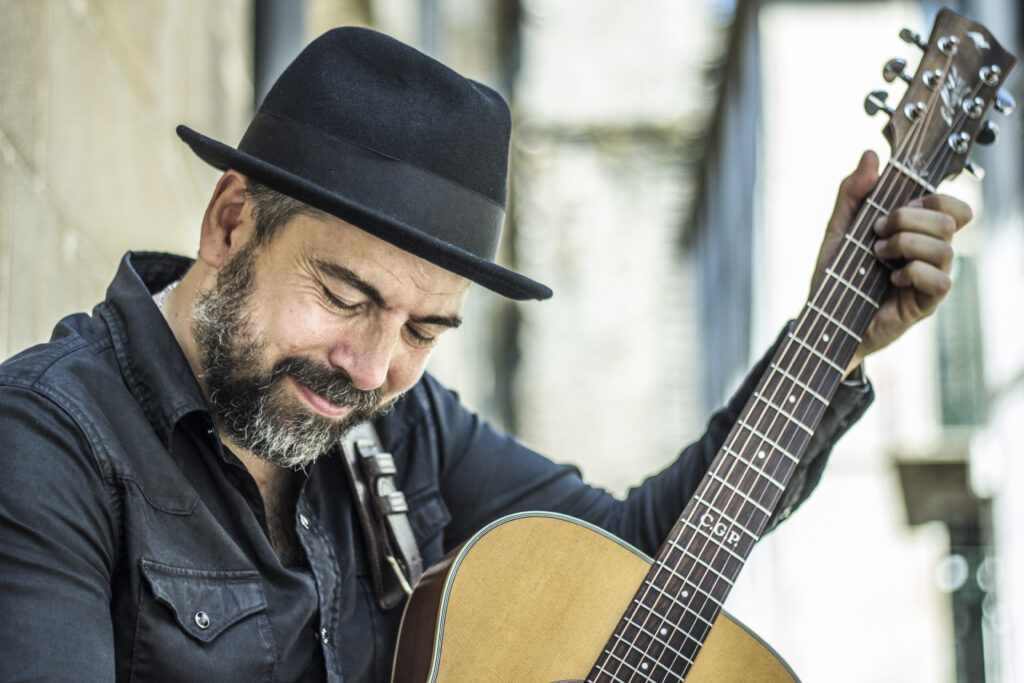
This is not to say that Banet plays Galician. Indeed, as a musician, like Xhosa Cole, he has absorbed and retained the best of every genre, and, like Cole, his gift enables him to reproduce, transform and transcend the original melody whilst still acknowledging it. He picked up the guitar comparatively late – 18 years old – and obsessed himself with it to such an extent that his mastery of his particular style now, after say twenty years, is unrivalled.
On first hearing, one could be forgiven for thinking that this was a reversion to the guitar finger-picking style of the 60s and 70s, when acoustic guitarists cut their teeth on the thumb-picking minor blues of Davy Graham’s Angie. Think John James, John Renbourn, John Fahey, then add in a bit of Henry Mancini and Duke Ellington and, yes, faint Galician-folk echoes, you have something like what Banet does, but update it and it ends up as unclassifiable. Perhaps beginning his instrument late enabled him to sponge up more notes. He tells me, surprisingly, that he grew up listening, like millions of teenagers, to Queen and Guns and Roses, and that the guitar he picked up happened to belong to his father, a non-serious guitarist whose band experience ended almost before it began.
He can be called virtuoso. Many of the songs he played were his own compositions – we bonded briefly over a common dislike of ‘tribute bands’. “Why would they do that?” he asks. He presented impeccably worked, intricate tunes, some extremely fast and showy, some like the lovely Purple Heather written for his partner (who is Scots), statelier and more contemplative, with a drone bass and definite echoes of the Highlands. Mancini’s Baby Elephant Walk, though, was a real surprise, especially given that it was a popular radio hit before I was even a teenager. Ellington’s It Don’t Mean a Thing, also, was a fabulous retake with so much packed into such a short time, his thumb working overtime on the bass riff, his other fingers working Reinhardt-style on the melody, with a tiny quote from Grieg. Enchanting, and like Xhosa Cole extending augmenting and renewing something already wonderful.
We hope you have enjoyed reading this article. The future of our volunteer led, non-profit publication would be far more secure with the aid of a small donation. You can also support local journalism by becoming a friend of HIP. It only takes a minute and we would be very grateful.

Leave a Reply