
Human Exploration: Grace Lau
HANNAH LOUISE SAMPSON
Grace Lau has had a unique and adventurous four decades working with portrait photography, and she doesn’t seem to be slowing down. Recently she exhibited her body of work, Adults in Wonderland, as part of The 80s:Photographing Britain at Tate Britain. I sat down with her to speak about her recent collection, Portraits in a Chinese Studio, which will be exhibited next Chinese New year in the Hastings Museum. It is likely to be her last showing of this project, which spans 20 years.
We settle at the sturdy dining room table, its homely, lived-in surface covered in letters and books. To our right, the wall is alive with memorabilia – old photographs and gilded picture frames, displaying a stranger’s family history. The air carries faint traces of freshly cut grass and coffee as the open door lets a breeze in. Lau moves with quiet assurance. Just over five feet tall, she stands with gentle composure, her calm presence radiating across the table. She offers tea with a delicate, reassuring smile.
As we sip our drinks, Lau explains the inspiration for her work, Portraits in a Chinese Studio. Her voice, measured and thoughtful, gathers intensity with each phrase. “I wanted to show that ‘exotic’ doesn’t only apply to one race,” she says, eyes glinting with conviction. “We are all exotic. It’s a uniqueness that each person has.”
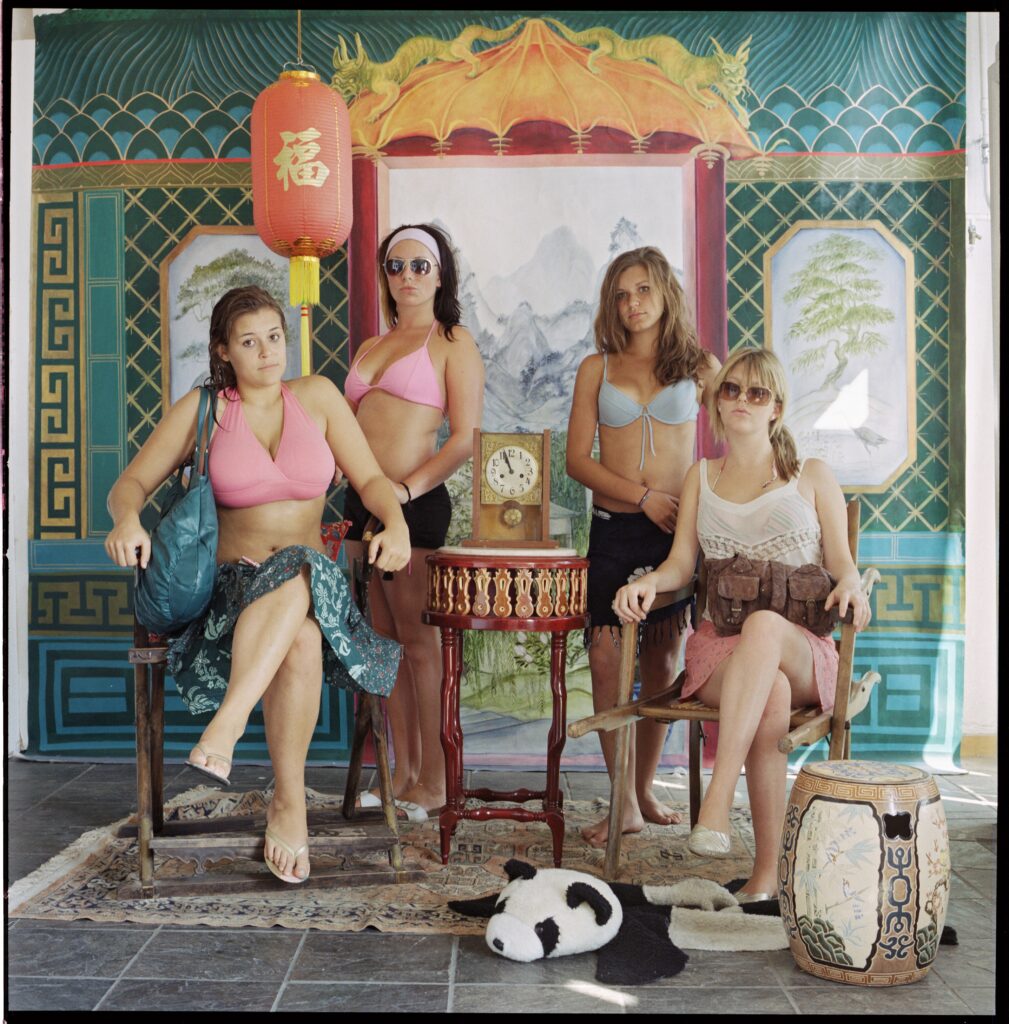
Born in London to Chinese parents, Grace is a photographer, artist, writer, and lecturer whose work has long explored identity, community and representation. She moved from London to Hastings in 1998, drawn to the idea of life by the coast. By the summer of 2005, she had set up a free portrait studio in the seafront building of St Mary-in-the-Castle. The project 21st Century Types acts as both a visual representation of the diversity of the British seaside town in the early 2000s, and a commentary on the traditions of portraiture itself.
At first, unsure how she would fit into the seaside community, Lau quickly discovered Hastings’ unique character: “It was very diverse…You’ve got the fishermen, you’ve got the artists, you’ve got all the tourists. And people like dressing up here,” she recalls. That diversity inspired her. In the easy, open atmosphere of summer, people were willing to perform for the camera in the formal setting of a portrait studio.

Situated among the town’s arcades and ice cream shops, the studio felt less like an interruption and more like another stop on the day’s entertainment – albeit one that left a lasting record. Her studio, with its glass frontage, was deliberately accessible – curious passers-by could see the process unfold before being invited to take part. “I just asked people who passed, ‘Would you like a free portrait?’” Grace says. Queues formed around the block, and in just six weeks, “We had over 600 portraits.” An Arts Council Diversity grant covered her costs, allowing the work to remain free of charge.
The project eventually produced an archive of 400 photographs, published as the book Portraits In a Chinese Studio, documenting ‘21st Century Types’. For the project, Lau created a Chinese-style backdrop painted by theatre designer, Robina Barson, and furnished the space with props sourced from local antique shops.
The use of natural daylight, and an old-fashioned Hasselblad camera, meant that everyone had to stay still and look at the camera. “That was the only thing I demanded of them,” Grace remarks. It was also reflective of the Victorian-style portraits made in China (and here, in actual Victorian times) where subjects were asked to look still and emotionless. She also asked sitters to retain their contemporary accessories – collapsing past and present into a single frame.
Grace’s inspiration for the portrait studio arose from her research into 19th-century photographs of China, often produced through what she calls “the colonial gaze.” Lau wrote recently, “I am making an oblique comment on Imperialist visions of ‘exotic’ Chinese. By reversing roles, I have become the Imperialist photographer documenting my exotic subjects in the ‘Port’ of Hastings.” She continues: “’Types’ were recorded by Western missionaries who outraged beggars, blind orphans and scenes of poverty, to raise money back home for their cause, and to ‘convert the heathens from their backward ways.’”
For Lau, portraiture is always collaborative. She talks with her sitters, makes small requests, and invites them to play with roles and costumes. She is drawn to portrait photography because it allows her to explore multiple layers of identity and self-expression, capturing the ways that people reveal different sides of themselves. “I like people that role-play, that dress up…the people that show different aspects of themselves,” she says. Her approach produces portraits that are both humorous and serious: humorous in their playful theatricality, serious in their challenge to stereotypes and conventions. “It’s about understanding cultural diversity, but also unity – the fact that people can live together still,” Lau says of her project.
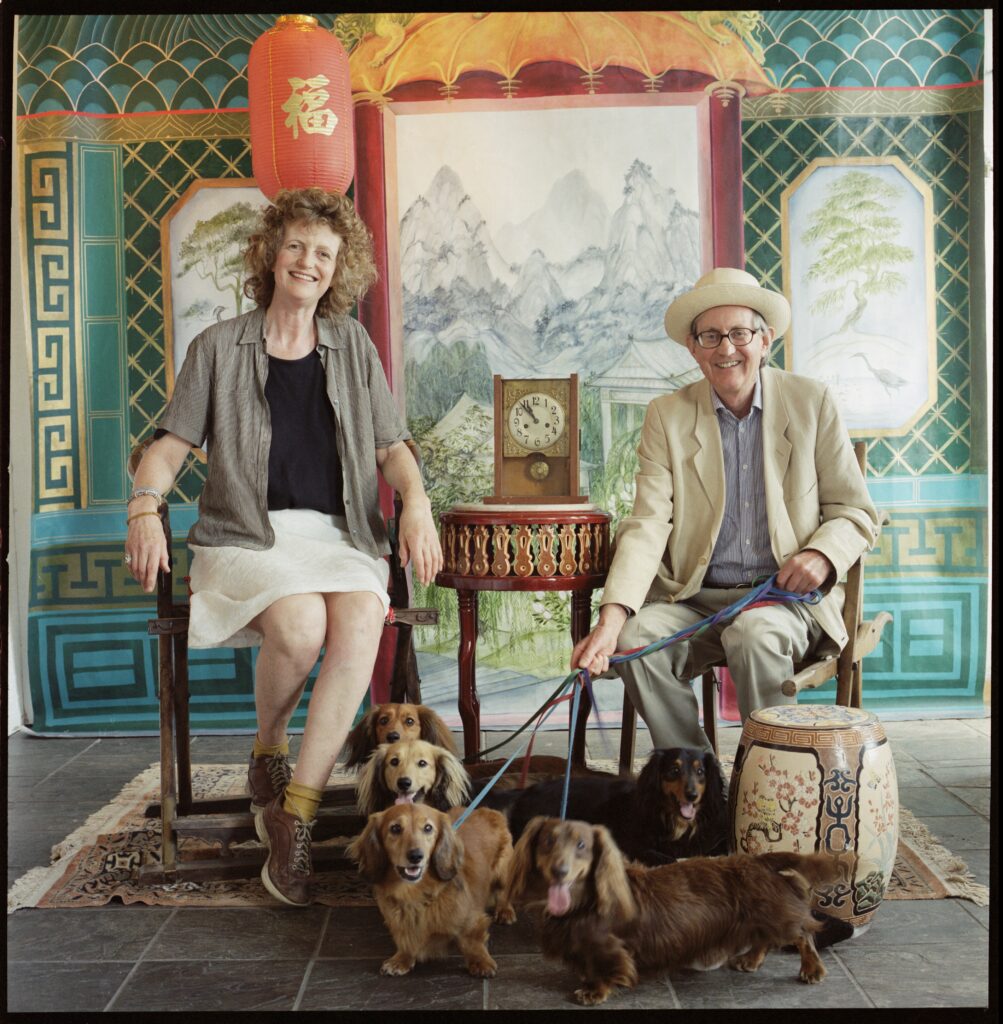
Her archive is filled with stories: a couple, married for 20 years, posed with their five dachshunds. The dogs ran wild around the studio, until Lau discovered what would make them stay still: barking at them! “I got really fed up” Grace laughed. “The dogs were running around like mad…and they wanted to pee on the panda rug, so I had to drag it out of the studio” she says.

While she finally got the dogs’ attention, she lost that of the subjects, who both burst into laughter. The photograph captured both comedy and intimacy, and years later, when Lau encountered the woman again, the portrait had taken on a new poignancy – her husband and all five dogs had since died. Her work continues to resonate: the Portraits were exhibited at the John Hansard Gallery in Southampton in 2018.
Asking her about the role of portrait photography in today’s age of social media, we agree that most things seem to follow what’s trending rather than individual creativity. “You still get some good portraits. Every year at the National Portrait Gallery in Leicester Square, they have an annual portraiture exhibition.” Yet, the threat of AI is looming as Lau notes how the criteria of portraiture with the growing use of AI to create images. “It will be interesting to see the show in November at the National Portrait Gallery” Lau says. “And to see how many AI images are accepted.” “I think people still kind of have respect to the manual camera,” she says with a smile.
Lau also remains active locally, as a founding member of the PhotoHastings festival, where she helps broaden its reach and diversity. “I’m still exploring the art side of the town. There’s lots going on,” Lau says. During the last two decades, Hastings has developed and become more ‘fashionable’ for holiday makers and people wanting to remove themselves from the pressure of living in London. Lau takes an optimistic view of gentrification. “I think it brings more ideas and diversity. It broadens out the local people’s minds, because I think you can become a bit too ‘localised’ … you just do art for your own sake and for people in Hastings…[but] you need to have ideas from all over the place.”
Her portraits are more than mere images. They are invitations to see the threads woven into every face and every story. They act as records of the present and echoes of the past. Lau’s artistic journey has been one of human exploration, and one can hope there will be more to come.
Grace Lau’s Portraits in a Chinese Studio will be shown at Hastings Museum & Art Gallery from 10 January to 29 March 2026. Private view: 10 January, 2 pm. The museum will also be holding a Chinese calligraphy workshop with a teacher from China, Yutong Zhang, on 28 February over the Chinese New Year. Next summer the Solaris Gallery in St. Leonards will also be exhibiting Lau’s subversive fetish scene images from the 1980s, some of which were shown at Tate Britain’s major exhibition, ‘The ‘80’s’ earlier this year.
Portraits in a Chinese Studio: gracelau.co.uk/project/portraits-in-a-chinese-studio
Hastings Museum and Art Gallery: hmag.org.uk
Prints on Sale at Solaris Gallery
St Leonards: solarisprint.co.uk/exhibitions
We hope you have enjoyed reading this article. The future of our volunteer led, non-profit publication would be far more secure with the aid of a small donation. You can also support local journalism by becoming a friend of HIP. It only takes a minute and we would be very grateful.

Leave a Reply