
Focus on Folk
VICTORIA KINGHAM explores the folk scene, local and visiting
Bill and Steve’s Excellent Adventure: A celebration of fifty years of the Hayloft Folk Club
Two stalwarts of the original British folk music revival will celebrate, in August, the return of folk to the Cove at Fairlight. The Cove was once The Hayloft, a noted and celebrated venue for folk musicians during the 1970s and 80s.
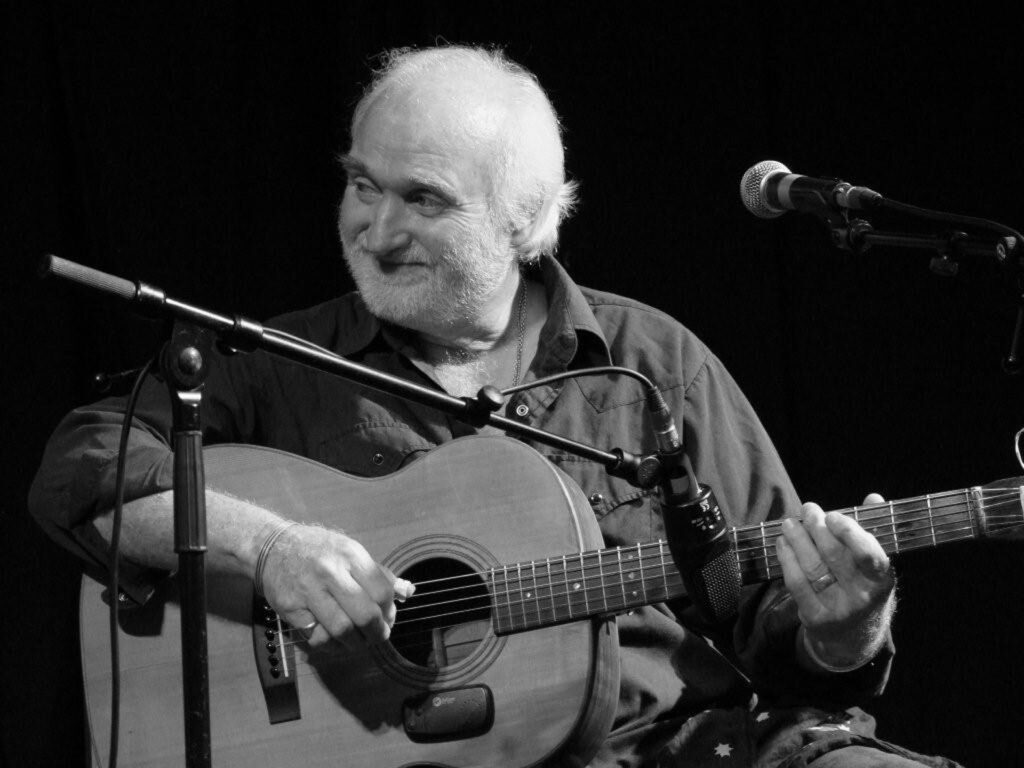
In those days you could see renowned stalwarts: The Taverners, Shirley Collins and Ashley Hutchings, Finbar and Eddie Furey, Bob Davenport, Ewan McColl and Peggy Seeger, Cyril Tawney (to name but a few), all in the space of a year or two. The 80s attracted, among many others, Brian Boru, Dave Swarbrick, Martin Carthy. Many of these, now celebrated veterans, continue to make wonderful music.
In fact, though the Hayloft was certainly a well-known venue among afficionados, the seventies was the tail end of the folk revival here and indeed everywhere. In the days of the American hippie dream, American folk artists (Joan Baez, Pete Seeger, Arlo Guthrie, Bob Dylan) extended the definition of folk to include political protest. What happened? Street protest in America became hip-hop; in the UK (and Europe) it became the anarchy of punk. Some of this change must be attributed to the marketing strategies of the big music companies, some perhaps to the changes in the global political situation.
Beautiful, melodic folk-rock bands (Steeleye Span, Fairport Convention, Pentangle, Jethro Tull et al) and enormously talented finger-style guitarists (John James, Gordon Giltrap, Bert Jansch, Davy Graham) are perennially admired, but have perhaps faded into the realm of cult-following. Yet all of these developments stemmed from the original idea that the sterling 20th-century folk music collectors had – of preserving and improving music and lyrics handed down by indigenous members of ordinary society. Life maybe doesn’t have so much room for folk, or folk, now. There’s always too much else going on.
But at Fairlight in August and September, you can see two of the original performers, who have been persuaded by local historians Bill Pocock and Steve Green to grace a nostalgic occasion – an anniversary celebration and reconvention of the Hayloft of fifty years ago. Paul Downes and Martyn Wyndham-Read, two of the original performers, will appear. Both Sunday evenings promise to be a unique opportunity to appreciate excellent musicianship in the immediate present. New interest will be formed for those unfamiliar with the genre, and a forgotten interest recreated for those of you who remember earlier days.
Folk Returns to Fairlight will be two evenings at The Cove (formerly The Hayloft) 53 Waites Lane, Fairlight TN35 4AX:
Sunday 25 August, 6pm, Paul Downes, folk legend from Devon, has worked with Pete Seeger
Sunday 1 September, 6pm, Martyn Wyndham-Read, accompanied by Iris Bishop, has worked with Shirley Collins
Jason McNiff – The Coffee House Sessions
McNiff is a devotee of the playing of Bert Jansch. With good reason. Unique guitar style, clear, rhythmically perfect, no frills. And immaculately pitched. So at his gig I expected a nostalgic sixties fingerstyle tribute. Instead there were songs by McNiff himself (from his new album Everything’s A Song) Bob Dylan, Johnny Cash, Paul Simon, and J. J. Cale. Why not, indeed?

McNiff’s own guitar style is reminiscent of Jansch’s, and his eclectic choice of numbers suggests an encyclopaedic repertoire. In fact he sings Dylan sometimes better than Dylan himself, and articulates the lyrics with meaning – even Blowin’ in the Wind didn’t sound like the cliché that it has inevitably become.
A highlight was an accomplished version of a song by Jason C. Frank, called My Name is Carnival. I hadn’t heard of Frank, but having looked up his biography, I can see where McNiff is coming from. Frank has been called ‘one of the best forgotten songwriters of the 1960s’ but his style and his guitar playing have been cited as influences by, yes, Bert Jansch, also the late, tragic Sandy Denny and Nick Drake. It has beautiful, sad, off-the-wall lyrics and a great guitar accompaniment with a classic alternating fingered bass. I love it.
One thing: if, for example, there had been a couple of solo performances, a couple of slower numbers, more pronounced changes in mood, that would have varied the set a bit. But hey, I don’t think that was the purpose of it – we all enjoyed it, Hanushka did a roaring trade, and McNiff, stick-thin with an old trilby and a traditionally hung guitar, looks really sexy. He is doing a great deal to make his audiences aware of remarkable and lovely songs; he also hosts a regular ‘Folk Sundowner’ at the Jenny Lind. Go and see him; you won’t be disappointed.
Jason McNiff performs at Hanushka’s, Robertson Street, every Saturday, 5.30-7.30
Tarren
Local music promoters Sounds St Leonards are bringing a Bristol-based folk group, Tarren, to Hastings in September. They will be playing at St John’s Church, St Leonards, as the last stop of an extensive UK tour which coincides with the release of their second album, Outside Time.
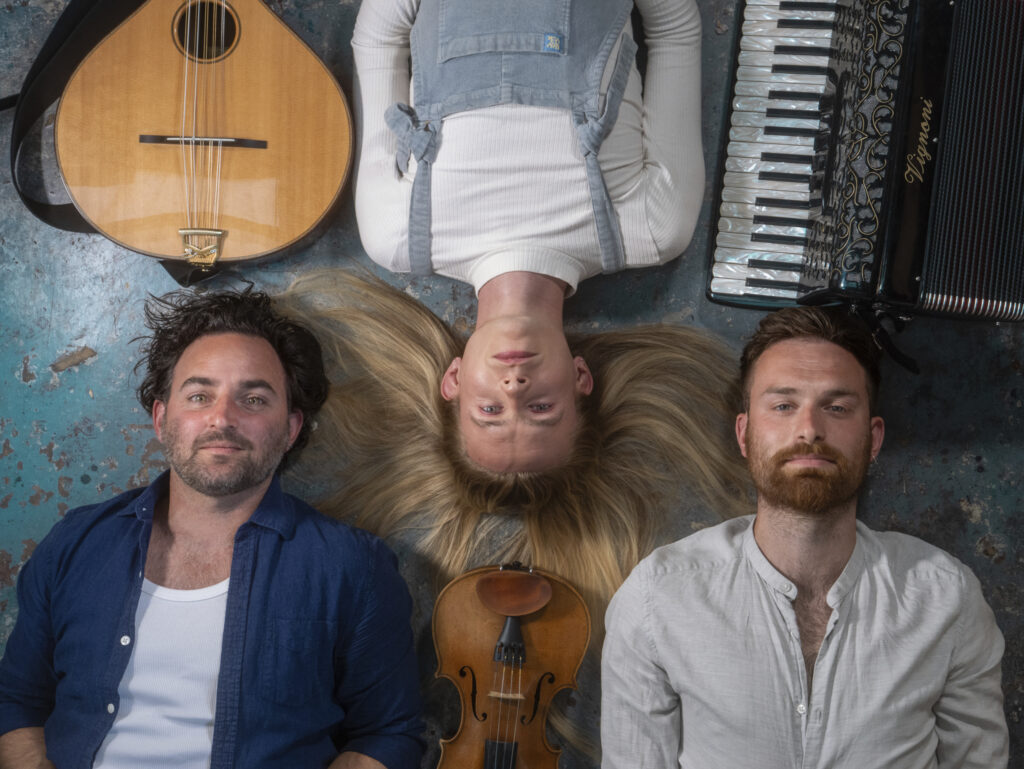
Tarren: Left to right: Sid Goldsmith, Alex Garden, Danny Pedler
Musically Tarren are impressive. There are just three of them: Sid Goldsmith, Danny Pedler, and Alex Garden, all experienced musicians. Their sound is insistent, unusual enough on the folk circuit in having no guitar or rhythm instrument more modern than the cittern, a kind of poor man’s mandolin dating back to the Middle Ages. The total effect is redolent of those small Elizabethan bands that often accompany productions of Shakespeare. Combined, the instruments (played as they are by Tarren with extraordinary accuracy of rhythm, purity of tone, and melodic variety) sustain audience interest, building up a high level of intensity which makes for compulsive listening.
Their debut album, Revel, gives us tunes written in complex modern time signatures with occasional socio-political lyrics – “Come all you good people/I must bring you in/to hear a few words about swindles and stings” and “Honesty’s all out of fashion” state the subject matter of their composition Hardwood. There are various tunes on Revel which are traditional but highly unconventionally reworked. Searching for Lambs, for example, can be found in all good folk collections: it has been recorded countless times since it was discovered and collected by Cecil Sharp early in the twentieth century. Tarren make it sound almost menacing: there’s a kind of minor drone to it that undermines its gay May-morning-proposal message, perhaps because we are now so far from the time when immediate sexual attraction largely assumed the necessity for immediate marriage. Tarren are very aware of the dissociation between that tradition and our own, in a band that includes one stated non-binary member. Embracing this theme, they have more recently released a single, Neither Maid Nor Man, which is a compilation of three traditional cross-dressing songs with added modern lyrics, and also appears on their new album.
For their gig at St Leonards the trio will perform from that album. The evening promises to be excellent, and Tarren continue the practice of making the traditional relevant in words, melody, and style.
Tarren will play at St John’s Church, Pevensey Road, St Leonards, on Friday 20 September at 7pm. Tickets at Eventbrite, tinyurl.com/5hyyckd3
We hope you have enjoyed reading this article. The future of our volunteer led, non-profit publication would be far more secure with the aid of a small donation. You can also support local journalism by becoming a friend of HIP. It only takes a minute and we would be very grateful.

Leave a Reply