
Father, Forgive Us
VICTORIA KINGHAM
It’s always a joy to remember that the first person recorded as having written music down systematically, was a woman. Hildegard of Bingen was a highly-regarded, highly devout Catholic Abbess, a woman polymath whose ‘sacred monophony’ spawned a whole universe within the musical art form. In between casual jottings such as treatises on theology, botany, and medicine, she invented a way of writing down holy songs for nuns to sing. That was in about the 12th century – but apparently (and I’ve just learned this) God tells Job somewhere in the Old Testament that during the act of Creation the morning stars all sang together and the Angels shouted for joy, so he made music at the same time as he made everything else, but actually (he continued to tell Job) Jubal, the son of Lamech and Adah, was the first to make a musical instrument and sing to it – and now I’ve realised why we call happy musical expression, jubilation. Musicologists’ theories are slightly more prosaic: Charles Darwin thought that music developed as a form of sexual selection, from the mating calls of animals. Purely from Wikipedia, and very little prior knowledge, I understand that the oldest object thought to be an instrument, a nose flute carved from the thigh bone of a bear, is about 40,000 years old. The Ancient Egyptians also had stringed instruments, which you can see in their ancient drawings on papyri.
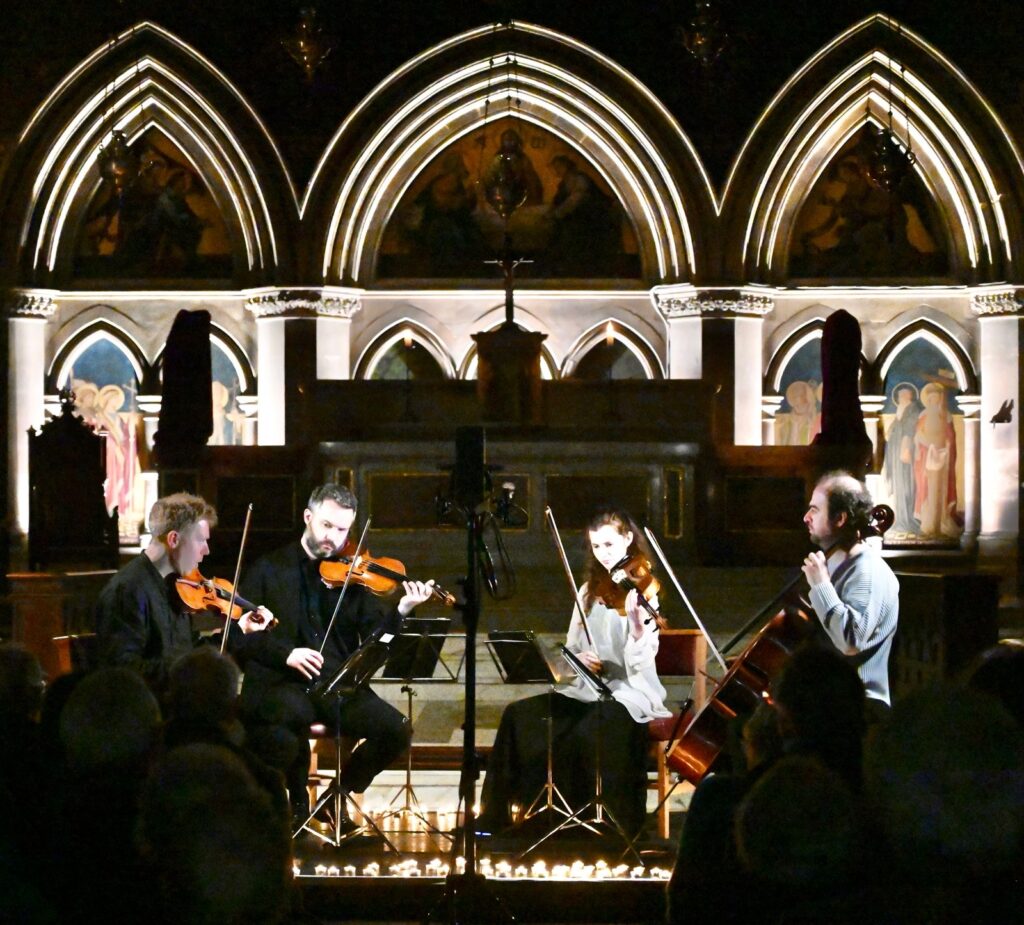
Max Baillie and Magnus Johnston (violins), Ann Beilby (viola), and Joseph Pritchard (cello) perform at Christ Church St Leonards
SEVEN
It’s quite a stretch from the harps and lyres of antiquity to the modern violin and viola, but working from the general to the particular, I need to ignore the countless stages in between. So on Good Friday last I attended what was probably the nearest I would nowadays get to a church service, a performance (in an Anglican church) of Haydn’s The Seven Last Words of Our Saviour on the Cross. Diligently counting words in my head (none of them added up to seven), I realised it actually means seven last expressions, and a vicar read from the pulpit the phrase that inspired each movement.
Father, forgive them; for they know not what they do/To day shalt thou be with me in paradise. … /Woman, behold, thy son! … /My God, my God, why hast thou forsaken me? … /I thirst. … /It is finished. … /Father, into thy hands I commend my spirit.
Of course it was a sublime performance of one of Haydn’s more celebrated works, worthy of any international concert hall, but happening here in a church in St Leonards on an occasion which (if you were so inclined) you might say was blessed. We are certainly blessed, to see this quality of performance here.
The church was subdued on Good Friday – the main icons were neatly covered in made-to-measure shrouds, and the lights dimmed. It was a ‘candlelit’ occasion, and the four musicians were illuminated at floor level with an elegantly-arranged grouping of tealights. Very atmospheric: it caused me to wonder what it is about the long endurance of candles, as symbols, in this case in an Anglo-Catholic church. After all, since about the 1890s candles have been pretty redundant as light givers (except among the very poor), since many homes already had gas lights which were more efficient and effective. Candles are still retained to create ‘atmosphere’ and a ‘softer light’ at supper, for example.
The musical occasion was pretty, and indeed soft and atmospheric, but what is it that continues to retain the candle so strongly as a cultural symbol, in our language and in the customs of many faiths, while their daily use is virtually redundant? Of course they were always a Christian symbol, the light under the bushel, the Light of the World, I am the Way, the Truth and the Light, and are massively symbolic in other religions – Judaism, Buddhism, Hindu, Taoism, Kwanzaa, Islam, Paganism all use the symbolism of the candle to mark certain occasions. Please, I don’t scoff, it was beautiful, but it’s still a mystery. Maybe that’s the point, the Mystery.
LAST WORDS
Sometimes referred to as the Father of the String Quartet, Haydn was born a musical genius. His impoverished parents, realising that they could not afford to nurture this, apprenticed him to a well-to-do local musical family, and he never lived in his parents’ home after he was six. He had a terrible childhood with the Frankhs, often in filthy clothes and with not enough to eat, which facts, some say, accounted for his parsimony in business dealings in later life. But he learned and studied enough and had enough genius to gain all kinds of exalted royal and religious residencies later. He always remained a devout Catholic, so this most stately series of pieces was commissioned by a leading Spanish church for Good Friday so that the priest could deliver a little sermon on each of the seven phrases, with the music immediately following. The priest paid Haydn by sending him a cake filled with gold coins. They knew how to live in those days.
Taken together, there was something in the music, the musical heritage, and the church setting that made it a religious occasion even for non-believers, if religion is to be interpreted broadly as a set of rules to live by. The seven phrases undoubtedly epitomise an enduring message, expressing central catholic tenets: forgiveness, eternal life, sanctity of motherhood, betrayal and doubt, supplication, acceptance, and the submission of the Spirit. There was a reverence about the whole occasion that transcended the mere playing of music – though that may have just been the effect of the candles. It’s a pity therefore that even the most basic idea of universal forgiveness does not translate, in the real world, or even in most religions, to action.
We hope you have enjoyed reading this article. The future of our volunteer led, non-profit publication would be far more secure with the aid of a small donation. You can also support local journalism by becoming a friend of HIP. It only takes a minute and we would be very grateful.

Leave a Reply