
Ever Fallen in Love with Something?
By Helen Murphy and Nick Pelling
Have you ever been seduced by the look of something? Felt the strange, secret thrill of optical desire? Not the yearning to buy, just the strange sense when your eyes tell you are in the presence of something quietly, delectably perfect. The Boutique show at Solaris Gallery, in Norman Road, brings you works that play around with that subtle, but very real, mixture of seeing stuff and feeling other stuff.
The artist Alessandro Raho’s works are very hard to categorise precisely because they seem to exist in deliberately ambiguous terrain. They seem a bit like paintings. They are not paintings. And yet, they were. They are kind of like Pop Art in that they enjoy the superficial, repetitive commercial look of a thing, but then they are also about unique, understated beauty. Unlike Pop Art, it is not about the loud crassness, or amusing nihilism, of capitalist consumer imagery. It is more about ordinary small ecstasies and, above all I think, exquisite colour harmony. As if fairground jewellery were made by Fabergé.


Still Life with Chocolate by Raho; Oberon by Raho
One of the intriguing contradictions of Raho is that although he chooses to work in part with infinitely reproducible imagery – he admits to being much influenced by Warhol – he is also akin to a medieval craftsman in his obsession with materials and craft skills. He told us that he frets about the material he may use for a canvas “to the point of madness”. And similarly, he says that preparing the right colour harmonies in physical paint, is “almost everything I do”. And yet he then subjects these meticulously crafted paintings to machine reproduction. This struck us as counter-intuitive. As if Monet might think his water lilies would be better presented by Snappy Snaps.
We spoke to him at the gallery to try to make sense of his approach. He explained that the works on the wall were giclée prints of his initial paintings. The paintings he explained, become like printer’s plates. From this “painted plate” another layer of process becomes possible. A layer that sort of returns the object to its origins as product.

A giclée print is an extremely high-resolution image, produced by a machine that can exactly replicate the colours and tonality of an image to an almost perfect degree. And the pigment remains high on the surface, not lost and distorted, as in ordinary reproductions. But, as Raho says, importantly, what you end up with is “something else”.
And, the giclée process opened up enormous possibilities. Particularly in terms of scale. A small still life of a seventeenth century figurine is what it is. A five-foot image of a cavorting figurine of Oberon, glossily pretty in pink, can really mess with your head. The modern nature of the print forces the viewer to try to locate this in time. To feel the odd sense that the image in front of you is both then and now.
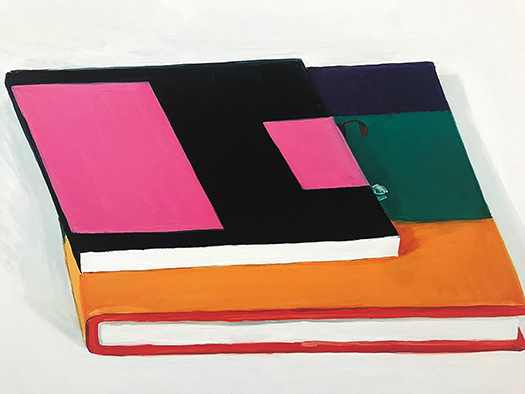
Mary Heilmann by Raho
A perfectly magnified print shows you the painting in an entirely different way. The little swishes of tiny brushwork and patterning, swerve up into almost abstractions. The normal scale of the figurines rises up to become uncanny and unsettling: a still life becomes a weird life.
But Raho is not, like much modern art, about controversial game-playing. What he gives us in many ways is his joy at feeling human optical pleasure, refracted through a gently commodifying process. Just as so much all around us is here by mass production but can still be faintly freighted with warmth. His picture of a toy horse and a chocolate bar has all the delight a child might feel in bright alluring colours. Pinks in particular seem to hold something for Raho; and the endless loveliness of whites as they fade to grey. His Mondrian-esque picture (Mary Heilmann) of a simple pile of books could easily be thought of just as a perfect exercise in colour harmonies. But, in Raho’s image, there is the hint, or faint promise, of picking up a desirable book.
We asked him if the six pieces on the wall were selected specifically to be in the overall show or were just distinct pieces. He was very definite. “I wanted these six pieces, in this street in this town.” There was a pause. He added, “in this particular part of this road, in this window.” Hastings means much to Raho. And he feels that the art scene and art patronage – in terms of the politics and the money within art circles – is now moving away from London. He welcomes this, although it should be added that he has very definitely established himself in the capital’s art world: not everyone has a portrait of Judi Dench literally unveiled at the National Portrait Gallery.
The exhibition at Solaris is very definitely worth a visit. The gallery owner, curator and working artist is Alex Drawbridge. She is the creative brains behind this gallery. And Alessandro admits that in many ways the show is born of a sort of joint vision. It is an understated space. The work may be in some ways, subtle and quietly beautiful and, again, understated. And even minimal. But don’t let all that pianissimo stuff fool you. In terms of art, on the heavy-metal art scale, this goes all the way to eleven.

• The exhibition, Boutique, is on at Solaris, 76 Norman Road, until May 14.
We hope you have enjoyed reading this article. The future of our volunteer led, non-profit publication would be far more secure with the aid of a small donation. You can also support local journalism by becoming a friend of HIP. It only takes a minute and we would be very grateful.

Leave a Reply