
Easter Music for Grown-Ups
TOM BLASS, author, journalist, publisher and local resident, recreates a transcendent musical experience.
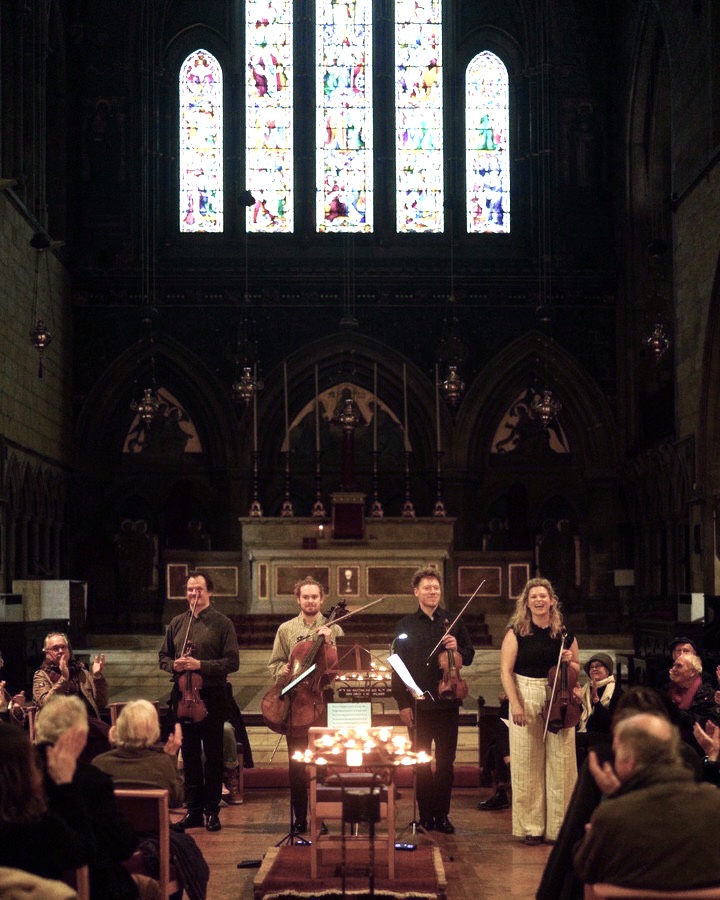
The Seven Last Words of Christ was originally composed by Joseph Haydn in orchestral form and had its first airing in Cadiz in 1786. Haydn himself described how the setting “enhanced” the music:
“The walls, windows and pillars of the church were hung with black cloth, and only one large lamp hanging from the centre of the roof broke the solemn darkness. At midday, the doors were closed, and the ceremony began…”
The backdrop to the performance that Max Baillie and friends gave of the version for string quartet 237 years later was perhaps not quite as shrouded and crepuscular; but the candlelit, high Church Gothic interior ensured that the distinction was one of degree, and the whiff of incense, lingering from the day’s service, blurred it further.
And while we’ll never know for sure what its first audience made of the piece, one can only imagine that they were similarly provoked to reflect – by the nine dark musical gems of which the piece, composed of seven individual sonatas (the Last Words), prefixed with an introduzione and suffixed with a terremoto (earthquake), that by turns confront and console, promise and perplex.
Taut, plangent and articulate, neither Haydn nor Baillie stooped to offer trite, facile tropes about rebirth, bunnies and the promise of hope in-a-ho-hum, here-we-go again sort of a way. This was Easter music for grown-ups, with long, thoughtful passages where the melody could sometimes be almost repetitive, but subtly changing, coaxing along difficult and sometimes obstinate ideas. But then astounding with a collective celebration of pizzicato notes, each like a little cracker. Or a sweet but sad conversation between long notes and short.

At 70 minutes without an interval (the collective urge to applaud after each section was palpable) to listen without tiring demanded a kind of immersion in the music that would have been impossible were it not executed with such finesse and integrity. Indeed, at some point toward the end of the penultimate sonata (Consummatum est – ‘It is finished’), I stirred from thought-induced semi-consciousness to take stock of the brilliance of Baillie’s tone and playing. Just remarkable.
Something also about the setting helped here too. The quartet members were tightly grouped, arranged, to the extent that four things can be, in a small circle around which we, the audience, radiated, but facing inward, and with intent, not quite as an act of worship, but certainly of deep, and deserved, admiration.
Amen.
We hope you have enjoyed reading this article. The future of our volunteer led, non-profit publication would be far more secure with the aid of a small donation. You can also support local journalism by becoming a friend of HIP. It only takes a minute and we would be very grateful.

Leave a Reply