
Crown House and the Meeting Tree
VICTORIA KINGHAM
The revival of Folk Music began in the UK with musicians and musicologists like Cecil Sharp, Vaughan Williams and Ewan McColl, who faithfully collected, wrote down, unearthed broadside ballads, or recorded songs in the oral tradition all over the country. In the USA, people like Alan Lomax and Pete Seeger did the same, and the musical style developed and expanded to become protest and poetry, with Bob Dylan upsetting many purists by bringing on a band with electric instruments.
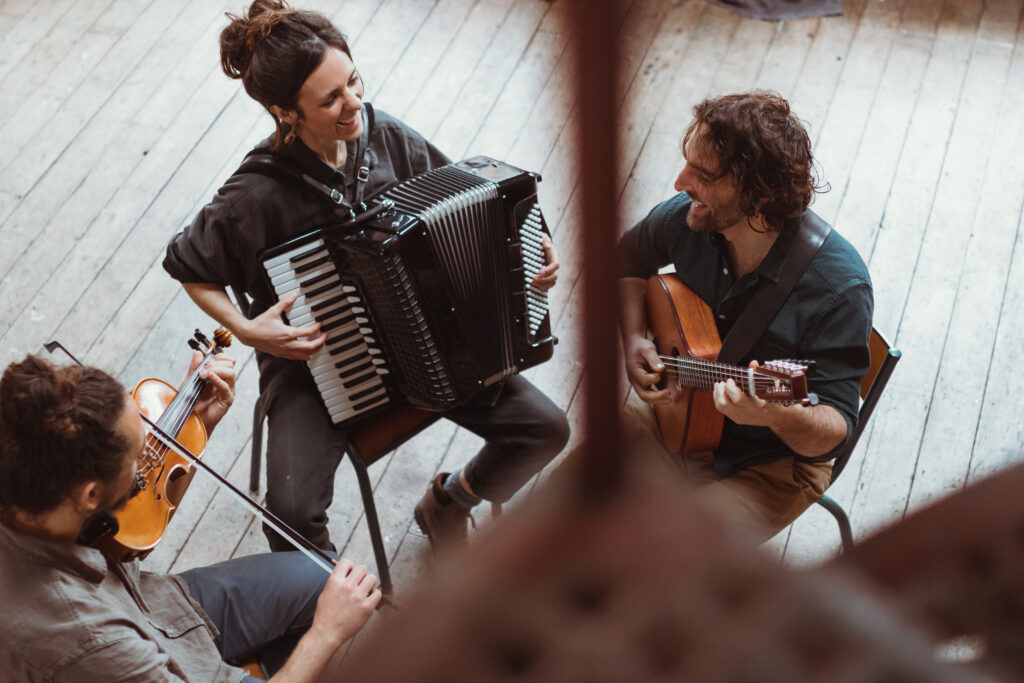
Left to right: Rowan Elliott, Tamsin Elliott, Sid Goldsmith
In the UK, bands like Steeleye Span and Fairport Convention, while true to the folk tradition, expanded the musical arrangements and the electric sound; instrumentalists like Bert Jansch, John Renbourn, John James, Gordon Giltrap, added a blues dimension and a finger-style guitar brilliance.
Now, there is ‘modern folk’ which incorporates that mid-century revival and all the developments in between. Typically it’s played on traditional instruments and pays homage to the folk style, the intent and the institution. Tamsin Elliott’s trio, which performed at Crown House last week, is an excellent example of the movement, skilled and committed. Multi-instrumentalist Elliott plays a small lever harp, an accordion and a traditional tin flute. Rowan Elliott plays fiddle, and Sid Goldsmith a traditional cittern. While the instruments may be traditional, the numbers are modern, individual and largely written by Tamsin herself. There were no vocals (at least on that evening) though one tune (Lullaby) incorporated wordless humming.
JOYFUL COHESION
This is a fine, accomplished trio with an unusual, joyful level of cohesion and interplay. The sound amplification is modern, as are Elliott’s personal dedications and inspirations. But her musicality comes from everywhere – there’s a definite Middle-Eastern-modal sound to some of the tunes (Minuett), and while her roots remain in the English tradition, Elliott has collaborated extensively with celebrated Egyptian oud player Tarek Elazhary. Their album So Far We Have Come is a testament to the way folk-inspired music can cross both geographical and harmonic boundaries.
Some of the numbers were from past albums; about half were from Elliott’s latest, The Meeting Tree, which, she writes, is “a collection of social tunes, celebrating connection, dance, nature and the joy of sharing music with friends.”

Like the band Tarren, who came to St Leonards last year, and in which the cittern player Sid Goldsmith also plays, the trio is Bristol-based.This performance was part of an extensive tour covering England and Wales during November. Crown House is the obvious venue for a band like this – private, relaxed, intimate, it brings listeners and musicians together.
There’s a lovely familiarity about music audiences round here, and a marked collective appreciation of how fortunate we are to have exceptional organisers and promoters who bring to the South Coast some of the best music in the UK.
The Tamsin Elliott Trio is promoted by Holly Harman of Sounds St Leonards. Tracks from The Meeting Tree can be found or bought on Bandcamp, at tamsinelliott.bandcamp.com/album/the-meeting-tree, or on Tidal (not Spotify) and other streaming platforms.
We hope you have enjoyed reading this article. The future of our volunteer led, non-profit publication would be far more secure with the aid of a small donation. You can also support local journalism by becoming a friend of HIP. It only takes a minute and we would be very grateful.

Leave a Reply