
Contemporary People Power?
Kent Barker worries that Council ownership of the Hastings Contemporary could be a retrograde step
for local people.
Is Hastings Borough Council about to become the owner of the Jerwood/Hastings Contemporary gallery on the Stade? The Jerwood foundation has offered to give the building to the local authority, and the issue is to be decided at a full council meeting this month. If HBC does take back the lease, and with it the ownership of the building, it is probable that Hastings Contemporary management will continue to run the gallery. But is that what we really want? Indeed, should a local authority have such direct control of its arts venues?
The history of the art gallery is far from straightforward. Residents and visitors around 2010 will recall the vociferous “Say No to Jerwood on the Stade” campaign. Objectors argued that the foundation was being given large tax breaks and that millions of pounds of public money would be poured into ‘gentrifying’ the former coach park while pushing out local traders. Jerwood and the council claimed it would be a catalyst for regeneration.
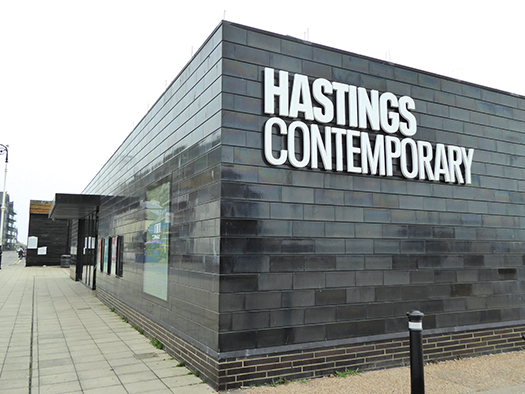
Anyway, the gallery was built, won architectural awards and, arguably, was a considerable improvement on what went before. Jerwood invested £4 million which fully-funded the cost of the building which they then owned. However, the council retained freehold of the site and invested £1.7 million of council tax payer’s money. This, along with grants from the Sea Change Fund, East Sussex County Council and the South East Development Agency paid for the Stade Hall, Stade café, Stade open space and highways improvements.
THE BIG EXIT
But then, five years later, as you may recall, The Jerwood foundation fell out with the management of its Gallery, packed up their paintings – which formed the permanent exhibition for which the gallery had been intended – and walked away. It was renamed the Hastings Contemporary and managed by a ‘National Portfolio Organisation’ – an independent not-for-profit set-up that is largely funded by the Arts Council.

There are differing opinions of how well they have operated the gallery since. There have been some notable exhibitions including last summer’s ‘Seaside Modern – Art and Life on the Beach’ but some others have underwhelmed. There seems to have been no great move to replace the permanent collection that disappeared with the Jerwood, and local artists complain that they don’t get much of a look in. Nor do residents. As one put it: “I used to take our granddaughter to the baby sensory mornings there, but I don’t think they have much community-friendly stuff nowadays compared to the De La Warr or, best of all, the Towner.”
ELITIST AND EXPENSIVE?
And the Contemporary is relatively expensive at almost £10 a ticket (cheaper with concessions and annual membership) which mitigates against the less affluent or indeed casual visitors just popping in for a quick shufti. Local artist Lone Ormond told HIP she was a member and a great supporter of the gallery: “I agree the gallery is quite expensive to visit and that most likely put a lot of people off. It would be great if there was free entry for the locals.” Others argue that it is simply not a public space, and you can’t even have a coffee at the café without paying full gallery admission.
The question is, will any of this be likely to improve under the auspices of the council? HBC also owns the Hastings Museum and the White Rock Theatre. The latter is operated by a manage-ment company – Trafalgar Entertainment. Hastings’ theatre creatives – playwrights, actors and directors – have complained in the past that the theatre has virtually no local productions or input. Rather it is known for national touring companies who import pantos, tribute bands, re-hashed musicals and stand-up comedians. Fine for tourists but perhaps thin artistic gruel or opportunities for residents.
Hastings Museum is not only owned, but is also run, by the council. Opinions differ as to how successfully. One Hastings local said: “I’m very fond of it! We’ve seen a couple of good exhibitions there recently – I think it’s really starting to improve and up its game since receiving more funding in lockdown. There are some good activity days for children too, and they are planning a big extension/revamp.” Others, though, find the permanent exhibits ‘dusty and tired’ with none of the pizzazz that more imaginative modern curators can bring to bear.
TO OWN OR NOT TO OWN?

But the dilemma remains: is it the function of a local authority to control their local arts venues? In Bexhill, ownership of the De La Warr Pavilion was transferred from Rother District Council to a charitable trust in 2004. Few have anything bad to say since about its free exhibitions or accessibility. You view the art as you walk through the building to the public café upstairs.
In Eastbourne, ownership of the Towner was transferred from the borough council to an independent charitable trust chaired by David Dimbleby in 2014. The local authority still supports it financially (along with the Arts Council) but has no say in its running. They only charge for one exhibition a year otherwise it’s free. So, are these not models that Hastings Borough Council could and should adopt for the Contemporary?
Experience suggests it is unlikely to do so. The council has a quite extraordinarily extensive property portfolio of some 800 holdings (look up HBCAssets Jan2022) and would seem extremely reluctant to divest itself of them. It also maintains other assets by retaining full control via a charitable trust. There’s been a long and controversial history of the council acting as sole trustee of the Foreshore Trust. The Charity Commission dislikes such arrangements arguing that they can easily give rise to conflicts of interest. If, for instance, the Foreshore Trust wanted a building on the beach, its own trustees – the council – would determine the planning application.
So assuming that the ownership of the Jerwood/Hastings Contemporary does revert to HBC, councillors might like to consider some ideas for its future. First, would it not be best to divest ownership immediately to a fully Independent charitable trust? Second, should not ALL council spaces be open to the public in some form or another? After all, it’s not really the council who owns them but us, the council-tax payers. For the Hastings Contemporary this could be achieved by allowing public access to the café through part of the gallery. Thirdly,
that part could house a permanent exhibition of genuinely ‘contemporary’ works by local artists – thus directly supporting Hastings talent. Ideally, of course, all exhibitions would be free as at the De La Warr and the Towner. By the people and for the people of Hastings might be the Gallery’s new mantra.
We hope you have enjoyed reading this article. The future of our volunteer led, non-profit publication would be far more secure with the aid of a small donation. You can also support local journalism by becoming a friend of HIP. It only takes a minute and we would be very grateful.

Leave a Reply