
Contemporary at Ten
2022 is the ten-year anniversary of the gallery that is now Hastings Contemporary. To mark the event, they are currently hosting three major exhibitions each of which, says Gareth Stevens, has much to offer.
To celebrate its tenth anniversary, Hastings Contemporary presents Making Waves, a special alumni exhibition appropriately bringing ten artworks by ten artists, all of whom have exhibited in the gallery over the last decade. This includes Chantal Joffe, Rose Wylie, Maggi Hambling and Sir Quentin Blake. Other major artists also featured in the exhibition are: Anselm Krut, Rachel Howard, Jeffrey Camp, Stephen Chambers, Anne Ryan and Gillian Ayres.
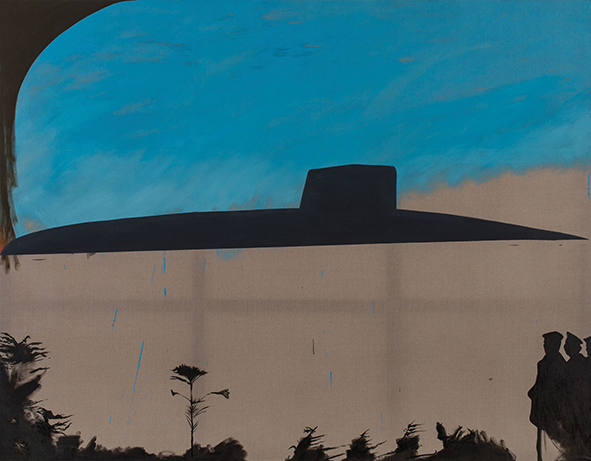
The Silent Service by Caragh Thuring
Each of the exhibiting artists has kindly donated an artwork to be sold by Hastings Contemporary. All proceeds will go towards the gallery’s future work. The exhibition itself is a veritable mixed bag. John Bratby’s Jennifer Mallam Twice stands out as a great example of the artist’s inimitable painterly style. Intensely expressive, the double portrait taunts the viewer to speculate on the sitter’s inner life. Bagatelle by Gillian Ayres is a joyous example of British abstraction. Full of riotous colour and interlaced forms, this piece takes its lead from Matisse’s ‘Cut-Outs’ and is, in my opinion, the highlight of the exhibition.
Announcing the show, Hastings Contemporary Director Liz Gilmore says: “Over the last ten years the response to the art we have shown has been phenomenal. We have been constantly punching well above our weight, with alumni artists to be proud of, all whilst receiving awards and positive reviews. Over 400,000 people have visited our exhibitions, with many more engaging in our learning and participation programmes”.

Nature and the Manufactured World
The second exhibition is by painter Caragh Thuring. Although born in Belgium in 1972, Thuring grew up in Scotland surrounded by the landscape and human activity which forged the themes central to her work. She lived on the shores of the Holy Loch and would observe huge nuclear submarines breaking the surface as they returned to their US base. She became absorbed by the Glasgow docklands and, more generally with the relationship between nature and the manufactured world. Thurung recurrently uses the motif of the brick to connote the coming together of the natural world and human industry. At the same time brick walls obscure our view and, like submarines, contribute to the existence of an unseen world. It follows then, that she is also fascinated by volcanoes. Like submarines their activities lie beyond sight and only intermittently erupt through to our conscious experience.
The large canvas August 1779 recalls the painting The Eruption of Mount Vesuvius on the Night of 8 August 1779 by Pietro Fabris. It depicts a volcano violently discharging lava whose plume is interlaced with delicately painted lightning bolts against a sullen and increasingly ash-filled sky. Across the foreground a rather crudely painted red wall reminds me of Phillip Guston’s work, and defiantly tells us that we will never truly know what goes on deep beneath this eruption – or its subterranean causes.
Silk Weavers in Suffolk
For her more recent works, Thuring uses bespoke cloth from silk weavers in Suffolk as her canvas. The work starts to take shape before any paint is applied. Digital versions of previous paintings, photographs or found images are woven into the very surface of the ‘canvas’. “I want to build imagery into the surface that I was then painting onto,” she says. This, she explains, enables her to continue work she has already begun previously in other media. It also breaks up the picture plane to provide layered veils of meaning, partial views of things and unusual juxtapositions.


Left to right: Self Portrait with Esme on the Promenade by Chantal Joffe; Cloud falls in love with mortal by Penny McCarthy
For me one of the most enthralling works in the show is Heatwave which combines the use of road-line marking paint, screen printing with woven linen and cotton. A photograph of an arid landscape has been subtly printed onto the picture’s surface before being over-painted with semi abstract forms that occasionally echo features of the digital image, but at times disrupt one’s ability to read the image as merely a ‘landscape’. The element that really lifts this work is the luminous organic forms that hover above the ground in a spectral cloud. Although slightly menacing, this work, for me, has such a convincing and sensitive use of colour and most successfully expresses the tension between objectivity and more plastic formal elements.

This is Thuring’s first UK exhibition in six years and she says she is looking forward to seeing her works – created at different points through her career- together for the first time.
Cloud falls in love with mortal
The third exhibition, from Penny McCarthy, consists of an extensive series of her graphite drawings made between 2019 and 2022, mostly during lockdown. She received the biennial Evelyn Williams Drawing Award in 2019.
For McCarthy, drawing is both exacting and deeply contemplative. “Drawing is slow and it is presencing. It’s almost as if it asks the viewer to pause, to think, to breathe. I think of the combination of time, breath and elongated thinking as drawing”, she explains. On working exclusively with graphite on paper McCarthy says that medium allows easy reversal of decisions and, “is so light and so portable. There is always the possibility that a single piece of paper may be the compression of a year’s worth of looking and thinking – yet it is essentially almost weightless.”
McCarthy claims that, when drawing, her attention isn’t focussed fixedly on looking – she qualifies this by stating that, “my gaze is turned inwards”. She is energised by the challenge of representing something, “as elusive as a cloud, a vapour or a fog”.
Re-imagined Star Trek
The exhibition spans a range of dreamlike themes that interweave and overlap to the point where there is a completeness to one’s experience when viewing the work. Bound together by a single medium and way of working, I found myself more open to explore that which was being depicted. A drawing of a cat (Bandit) in the artist’s studio; a re-worked drawing of a statue seen in Rome tells, in a calm detached way, of a rather gruesome Greek myth; a drawing of the sea from memory; a re-imagined episode from
Star Trek in which a cloud falls desperately in love with a human. Each work takes us beyond quotidian experience into a fabulous, almost surreal, yet fastidiously rendered reality.
• All three exhibitions run until 12 March 2023. www.hastingscontemporary.org

We hope you have enjoyed reading this article. The future of our volunteer led, non-profit publication would be far more secure with the aid of a small donation. You can also support local journalism by becoming a friend of HIP. It only takes a minute and we would be very grateful.

Leave a Reply