
BOOKBUTER REVIEW
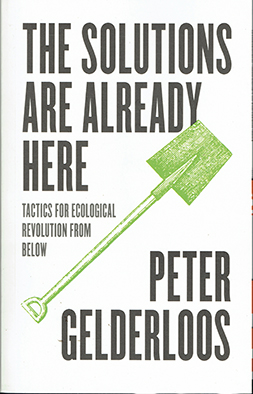
The Solutions Are Already Here
By Peter Gelderloos
Published by Pluto Press, at £16.99, available at Bookbuster
Review by Tim Barton
Gelderloos has published a few books. Tellingly, one was called How Nonviolence Protects the State. Andrea Chalupa, in her podcast for Gaslit Nation, Rattled, says that ‘Once you’re in an autocracy, it takes human sacrifice to get out.” Currently, the UK is run by extremist neoliberal idealogues and, in apparent contradiction, fundie nationalists. Strikes are rife, despite having been rendered almost illegal, as has ‘peaceful protest’. The new campaign group ‘Enough is Enough’ has declared a National Day of Action on October 1st against the fossil-fuel industry and their lobbyists, who buy off our ‘representatives’. Alan Moore’s ‘V’ says, quite rightly, “People should not be afraid of their governments. Governments should be afraid of their people.” Gelderloos’s book has a raised spade on the cover: both a digging implement and a weapon.
His subtitle is Strategies for ecological revolution from below, and he has written this book to highlight solutions. Nevertheless, his first two chapters look at the wider context from government and corporate murder, through the failures of ‘market solutions’, to ecological connectedness, as “taking in the scope of the problem is necessary for looking at the solutions”. He is quite right, as too many in despair accept ‘solutions’ that are not remotely up to solving the problems in order to sleep better at night. Sadly, this understandable tendency is itself a large part of the problem.

GOVERNMENT AND CORPORATE COMPLACENCY
Much of the catastrophic damage we have done to the biosphere, which is clearly harming us all, is deemed by governments, NGOs, corporations, and scientific institutions as ‘an acceptable level of collateral damage’. Gelderloos points out that the nihilistic fall-back position, that ‘humans are the bad guys’, needs to be resisted, although it is a view too often expressed even by those who stand for the environment (our home). The tendency to ‘eco-fascism’ is rightly derided as no solution at all. The ‘human nature’ cartoon is overly simple, and leads to a view that ‘there is something inevitable about what is going on’. This book resists both government and corporate complacency (and worse), plus green movement nihilists.
One of the key debates here is around ‘the commons’ and our view of it – whose it is, who controls it, who profits from it. Taking back the land we live on is a necessary part of the solution. In my view this goes beyond the country park, our town squares, and land set aside for grouse shoots. Currently, the Crown Estate gets over £100 million per year from leasing the seabed (the Treasury gets £300 million, so at least some gets back into ‘the public purse’). But our government views its mandate as to starve the people of the benefits of taxation by demolishing welfare provision, privatising what’s left of the NHS, and, topically, not reining in energy companies, whilst talking of ‘temporary nationalisation’ to mend broken industry with our money before handing it back to private owners, most of whom extract much needed money from the UK economy as they are either registered in tax havens or under foreign ownership.
FOXES BUILDING HENHOUSES
The Crown Estate is not the only large establishment entity stealing, over centuries, common land, but is near the top of the list for expropriation if ‘the people’ ever get to take the power back. As must be the ‘free ports’ the government is allowing on our soil, an infraction on our rights that should result in riots amongst those who spent the last several years claiming they are ‘getting their country back’.
‘Entrenched hierarchies inside and outside states often encourage ecocidal behaviours and prevent adaptation. […] If we do not revolt in the face of ecocide, the likely result is that states will increase their power and intensify their exploitative practices’, until a synergy between multiple tipping points simply removes billions from the equation – tipping points, I’d argue, many of which we are passing right now.
“…growth by any means necessary’ is the capitalist motto. When states do acknowledge issues, they are unable and unwilling to see solutions beyond ‘more state’, just as corporate globalised capital insists on ‘more freedom for capital’ to magically ‘fix things’: naturally, this is foxes building henhouses”.

Despite my review so far concentrating on ‘the problem’, the bulk of Gelderloos’s book is about community resistance, past and present, and tactics going forward. One clear point is that ‘single-issue’ resistance alone is no solution at all. Thus, organisations such as XR get a bit of criticism, as ‘the climate crisis’ is far from alone as one of the major issues facing us. Gelderloos suggests they would do well to widen their focus to include, for example, ‘environmental racism and the marginalization of racialized people and struggles’. Here in Hastings, and I suspect throughout XR elsewhere, there are of course many who see such contexts clearly, and it is to be hoped that they can influence policy sufficiently to head off ecofascist and depopulationist agendas within the green movement.
HAVE YOU LOOKED AT THE WORLD AROUND YOU YET?
As you may infer, a globalised but bottom-up human community is here seen as key to successful change. The bulk of the book is given over to a review of actions already underway, some successful, though always challenged by state-sponsored terror. These ‘stories of resistance’ include victories in halting ‘pipelines, airports, highways, and mines’, and the majority of solutions offered are illustrated with examples of ‘on the ground’ activity already underway. These look at, for example, food sovereignty, and the growing movement to de-urbanise cities, making them greener and more human-scale habitats. The last two chapters look at strategies, settling on ‘ecological revolution’ and embrace diversity as against the ‘false pragmatisms’ born of desperation; at justice and reconciliation; at the ‘networking of local and global space’; and an ecologically imagined, and necessary, paradigm shift, a ‘total transformation of human existence’. Read the book to flesh this all out!
“One thing that I think is true wherever we are is that we can get to know the earth beneath our feet, the history that towers behind us, the overlapping communities that surround us. Wherever we live, there we can find life, and with
life, struggle. […] there is another world right here, it has been with us the whole time’. Have you looked at the world around you yet?
We hope you have enjoyed reading this article. The future of our volunteer led, non-profit publication would be far more secure with the aid of a small donation. You can also support local journalism by becoming a friend of HIP. It only takes a minute and we would be very grateful.

Leave a Reply