
BOOKBUSTER REVIEW
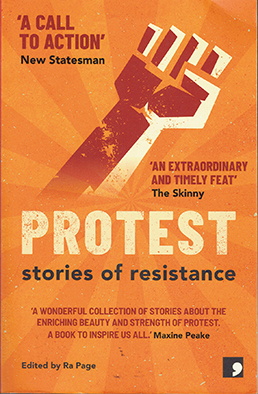
Protest: Stories of Resistance
Edited by Ra Page
Published by Comma Press, at £12.99
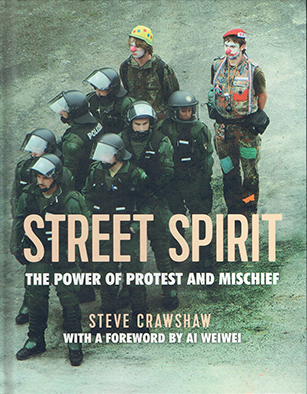
Street Spirit: the Power of Protest and Mischief
By Steve Crawshaw
Published by LOM Art, rrp £16.99, available at Bookbuster at £6.99
Review By Tim Barton
Protest. Often this has taken the form of populist witch-hunts, or of riot. Usually, riot is unintended by those lobbying a public to turn out. But most protest is tagged to specific grievances, often around workers’ and tenants’ rights. And most violence, whether ‘started’ by some of those protesting, or by the authorities (or by the latter in the guise of the former), is not caused or joined in with by the majority of protestors, though it is hard to tell, given the nature of our nation’s press.
Fifth columnists or no, violence is a good way to take public sympathy away from protestors. If clearly started by police or mercenary action it can help the cause, but even when that is the case the Press tend to twist the truth. I learnt long ago that if I wanted a fair idea of how many people attended a demonstration, I should look to a figure midway between that quoted by police or other state sources, and, say, the SWP’s estimate.

Historically, protest is usually not looked on at all favourably by the state. Although we talk of the ‘right to protest’, such a right has rarely existed de jure, even if we make it true de facto. Organisations such as Liberty and Amnesty
have their work cut out trying to lobby for censure of heavy-handed state response to protest. Steve Crawshaw’s Street Spirit is a celebration, in words and pictures, of ‘creative protests’, even under strict and authoritarian regimes, from Pussy Riot in Russia, through anti-G8 ‘clowns’, to human chains. It emphasises the power of mischief and the power of laughter, as well as more serious scenarios. Mark Twain said that ‘irreverence is the champion of liberty, and its only sure defence’. Current examples inevitably missing from the book would be the methods Extinction Rebellion has employed.
IN HASTINGS IT IS RARE NOT TO SEE SMALL GROUPS PROTESTING
But protest is often clamped down upon very hard indeed. Ra Page has edited a wonderful selection of 20 ‘stories of resistance’ by contemporary authors imagining or recreating protests, chronologically, from the Peasants’ Revolt of 1381, through the Suffragettes, Aldermaston, Vietnam, and Orgreave, up to the anti-Iraq War demo of 2003. The 20 authors include Alexei Sayle, Maggie Gee, Sara Maitland, and Kit de Waal. Although presented as fictionalised accounts, whether from the perspective of bit-part players or from a wider context, each story is followed by (mostly) academic essays on the events portrayed in the story: these are authored by historians and activists, and include Laleh Khalili and Michael Randle, author of
Civil Resistance.
Mass protest has been a popular way of demonstrating public dissatisfaction. Many groups organise small regular protests throughout the country. In Hastings, it is rare not to see small groups protesting for Palestinian rights, or the environment, on a Saturday afternoon. From 2011 Occupy started a new wave of broadly anti-capitalist protests around the country. Here in Hastings ‘rain stopped play’, quite literally. In London and Brighton the Occupy protests continued a little longer.
In the US, some Occupy groups are still going strong despite state resistance, for example in Oakland where they fill a community role similar to that filled for black Americans by the Panthers. Lockdown resulted in new constellations of protest, bringing together groups of people with a great deal dividing them, but unified over perceived threats to our freedoms. And the current energy crisis has seen the rise of Enough is Enough, with a series of mass demonstrations across the UK. The momentum may have been taken from the latter by the death of the Queen and by Truss’s proposed flaky and, in the long-term, terribly costly quick-fix, but we will see.
FREE REIN TO PREVENT PEOPLE DOING ALMOST ANYTHING IN THE STREET OF WHICH THEY DISAPPROVE
As well as all this, the government have been slowly throttling the circumstances under which demonstrations may occur, in a process not dissimilar to the police tactics of ‘kettling’ protestors (which, as the name suggests, intends to raise tempers to boiling point, thus ‘justifying’ a heavy-handed response – to our response). In 2011 the tellingly named Police Reform and Social Responsibility Act introduced a ‘controlled area’ around Parliament, extended by the even more tellingly monikered 2014 Anti-social Behaviour, Crime and Policing Act. These were not the first, the last, or the most vindictive changes. We need to be ever vigilant if we wish to retain our basic freedoms, that of protest being the tip of the iceberg.
Ferdinand Mount, in Shades of Peterloo (7 July London Review of Books) roundly condemns Johnson’s Police, Crime, Sentencing and Courts Act thus: ‘The meat of the Act is the power that it gives police to shut down and criminalise public demonstrations for being too noisy, including even a protest by a single individual. The police are of course to be their own judges in the matter of what qualifies as excessively noisy. Along with extending powers of stop and search without any visible cause for suspicion, the Act gives an ill-disposed police commander free rein to prevent people doing almost anything in the street of which they disapprove.
To fill in the gaps in the new Act inflicted by the House of Lords, the government is now bringing forward yet another Public Order Bill, further extending stop-and-search powers and imposing fresh penalties for protesters who ‘lock on’ to immovable structures.’
Alongside this is a considerable planned expansion of our ‘prison-industrial complex’. The race is on. Can we protect ourselves through protest? Will we see the emergence of a privatised prison system like in America, that needs to
be constantly fed and profits from the unpaid work of the interred? Will restrictions on protest be a feedstock for these prisons? Will they evolve into even more sinister camps, as they are in China? Protest is never ‘safe’, and is only occasionally effective, but it is nonetheless a foundational strategy for pushing a reform agenda. And, ironically, it is a safety valve to protect the state itself, something the elites appear to have forgotten along the way.
We hope you have enjoyed reading this article. The future of our volunteer led, non-profit publication would be far more secure with the aid of a small donation. You can also support local journalism by becoming a friend of HIP. It only takes a minute and we would be very grateful.

Leave a Reply