
Black History Month
Race or Racist Card?
A St Leonards exhibition prompted Kent Barker to consider what progress race relations have made in Britain over the past half century.
There have been, please take my word for it, some disadvantages being born white in 1950s Britain. I’m not after sympathy, and I can see how even this statement could be seen as offensive. But a key problem I feel is an inability to fully appreciate the depth of the black experience.
The thought occurred while looking round the excellent Playing the Race Card exhibition at the Greenhalf Studio in St Leonards. We can respond to what the 26 artists are showing us, but white people can never know what it is really like to be black in Britain.
Shaun Campbell’s Never Shall They Hold the Whip Hand takes my generation straight back to Enoch Powell and his 1968 ‘Rivers of Blood’ speech. Even though he never used those actual words – he was quoting Virgil’s River Tiber ‘foaming with much blood’. But he also quoted a constituent who supposedly told him; “In this country, in 15 or 20 years’ time, the black man will have the whip hand over the white man.”
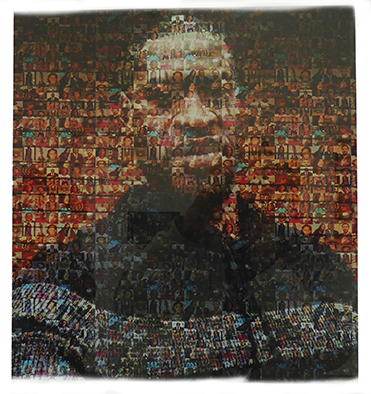
Black Lives Matters by Fatima Esayli
A more incendiary phrase – referencing the slave-owner’s whip – is hard to imagine in immediately post-Windrush Britain when, let us not forget, the government had invited West Indians to come to fill vacant jobs in the public service sector. And what has changed in my lifetime? We still do our utmost to keep immigrants (and particularly non-white immigrants) out. Or, if they manage the incredibly difficult and dangerous journey to get here, we inter them in camps, hostels and dingy hotels and threaten to deport them to Rwanda. And this while post-Brexit Britain faces critical labour shortages.
Like Shaun Campbell, artist Nicole Thornton was also brought up in South London. Her painting, The Game is Rigged echoes my experience of living around Lewisham and Deptford and New Cross before she was even born. The National Front marches; the New Cross fire in which 13 young black partygoers died; the racist murder of Stephen Lawrence in nearby Eltham; the constant harassment of anyone not gleaming white by the police who disproportionately used stop and search, and the notorious ‘sus’ laws that led to the 1981 Brixton riots (cf Chris Udenze’s black brick, Brickbat or Bookend? in the exhibition). As a young radio reporter, I was sent to Brixton the following day and was, frankly, embarrassed by the colour of my skin. Nicole is right. The game is rigged and has been all along.
And not just in Britain. Fatima Esayli’s intricate photomontage Black Lives Matters portrays another black person – George Floyd – murdered by Minneapolis police. When I first went to the States in 1969 – the year after the assassination of Martin Luther King – the Civil Rights movement was in full swing and the more militant Black Panther movement gaining momentum. Half a century later there may have been a black president but there’s still pervasive, institutionalised racism in the police and many echelons of society.
Shemelle Soyebo’s background and her painting Tick Box widens the discussion of race to Africa, reminding us it was the vortex of the slave trade and the unwilling recipient of Europe’s religious, economic and cultural imperialism. In the four decades since Brixton and Toxteth, Britain has become a much richer racial and cultural melting pot and although some things may have improved for people of colour, an awful lot of old attitudes persist. For some to occasionally ‘play the race card’ would be understandable but is, in my experience, rare. Playing the racist card, sadly, is not.
We hope you have enjoyed reading this article. The future of our volunteer led, non-profit publication would be far more secure with the aid of a small donation. You can also support local journalism by becoming a friend of HIP. It only takes a minute and we would be very grateful.

Black British citizens living in the Commonwealth were coming to Britan long before they were ‘invited’! Soldiers were demobbed after World War II and put on ships to go ‘home’ but realised they could pay their fares to return to the uk. That’s why when the Windrush tried to land it was held overnight by Ministers who thought they could divert it to Africa for people to pick nuts!
https://www.theguardian.com/commentisfree/2018/apr/22/windrush-story-not-a-rosy-one-even-before-ship-arrived