
Anthropop Art
DAVID MILTON
Having comprehensively plumbed the theme with Seaside Modern (2021), Seafaring (2022), Undersea (2025), and this year’s C-list celebrity co-curated The Open: Odyssey, Hastings Contemporary now presents two more meditations on the inexhaustible ocean. Behind this is not a lack of curatorial imagination, apparently, but a redefinition of the institution’s mission in terms of sustainability. Let’s give them the benefit of the doubt and dismiss as fanciful any fears that we might therefore soon be seeing the best of Jack Vettriano’s baleful beach scenes in a soggy retrospective.
Argentinian-born Miguel Rothschild’s Undercurrents is the work of a technocrat with pretensions to religiosity. The main piece is From the Depths of the Sea, an ingenious cross-section of waves in motion made from a photographic print on fabric suspended from 400 lengths of fishing line. 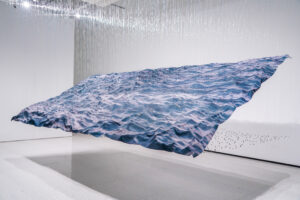 Its gentle undulations are quietly impressive, but a little cramped in the gallery space. It’s a cleverish miniature, on the scale of a model village, and the novelty soon wears off. More striking are a series of photographs. Undercurrents itself is a fiendish trompe l’oeil – quite impossible to photograph – that at times has the appearance of brushed steel and at others seems like a broiling oil slick. Ocean Crack and Black Sea II use broken glass to add vicious fault lines to images of waves, providing a clear sense of human scale and a wry but unironic commentary on human intervention. It’s all very cool, even cold.
Brazilian-German artist Janaina Tschäpe is in tenacious Canute-like Conversations with the Sea – the individual against and inside of the eternal, philosophically facing down the forces of the natural world and anticipating the dissolution of the self in its endless waves. In Meeresatem (Breathing the shore) Tschäpe’s sea is an International Klein Blue primordial soup, the waves of which appear as the bold brush strokes of a revolutionary Maoist calligraphy cut and pasted to achieve some bombastic emotional sloganeering. Here people appear like the ghosts of the timeless drowned; or the sardine-can-squashed, small-boat-bound fugitives, fate uncertain as they head to the south coast’s unfriendly shore. 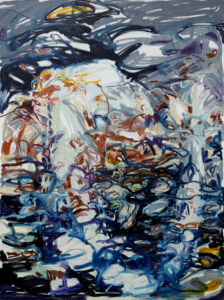 These are haggard, hurriedly rendered faces stylistically reminiscent of the 1950s’ German politically radical Gruppe SPUR, whose visceral, convoluted gestures are repurposed as a Greek chorus to the monologue of an energised and gritty Nature. It’s okay (and fun) for the viewer to play spot-the-reference here: Tschäpe’s appetite has been described as that of a Latin American “aesthetic anthropophagite,” a post-modern cannibal swallowing a pick ’n’ mix selection of European ideas, then sardonically spitting them out like a ruminative tobacco or khat chew. The show is a nervy distillation of a myriad of complex ideas issued with knowing self-poise and kinetic brio. A metempsychotic mermaid is the subject of both the tangled Sereias and the video He drowned in her eyes as she called him to follow, a jerkily shot home movie the siren call of which escaped me. The Conversations themselves are 15 new works in response to Hastings, depicting what might be a high-speed swimmer, a flash of mackerel skin, a storm-tossed inflatable in sore need of rescue. They’re colourful, sometimes happily slapdash, and at times wasabi sharp. Go for the colours and their blue heavens high.
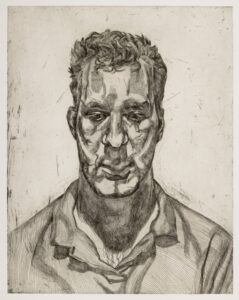
Back on dry land the big guns are rolled out as Moore/Freud pits Henry against Lucian, the latter recently recast with lofty disdain as “a minor British artist” by The Guardian. It’s a modest exhibition with a handful of minor works by each artist. The central conceit is not persuasive and hangs by a thread on a silly photograph by the bulldog-like Bruce Bernard of Freud posing as a Moore sculpture. An attempt to bind the artists together via their interest in family is undercut by an explanatory panel which tells us Freud “is known to have had 14 children by 6 women.” Many of them sat for him as adults, eliciting the bizarre remark that “It’s nice when you breed your own models.” Thinking of his subjects first and foremost as animals, Lucian himself was simply an old goat. With a gimlet eye for the grotesque, the German-Jewish immigrant Freud slipped neatly into the slipstream of a quintessentially British sensibility. One might readily place him in a long if wavering line which starts with William Blake’s motley Swedenborgian doughboys and ripped, starkers Pentateuchal prophets, digresses as it ticks off the soulless scarecrows of the execrable Glasgow Boys and the overdressed waxen undead of the Pre-Raphaelites, plods onwards to Stanley Spencer’s liverish, boneless, bendy action figures, thence to the Atrocity Exhibition contortionists of Francis Bacon, all the way to Jenny Saville’s CSI-core punch-drunk, impact-play palookas. Doleful faces loom out of necks like oxen led to an abbatoir. It’s ugly, deadly stuff, dark and unsubtle and utterly studio-bound. Freud’s portraits give off shrill parochialist vibes, a small dick energy which enacts a performative Britishness, insistently offering the bread and dripping cold comfort of baroque art world gesture in an attempt to evoke the existential. He can’t do hands. But The Guardian is surely mistaken: it’s hard to imagine the reputation of this flâneur of flabby flesh diminishing very much. He’ll always appeal to the bovine reactionaries and confused #whome? misogynists. Sale room prices actually indicate an ascendancy.
Henry Moore’s work, even in this dreary company, seems transparently forward-looking, rather than looking back to Spencer or Rembrandt. By turns sensitive, provocative and disturbing, his familial groups are placed inside claustrophobic interiors in a way which suggests they are part of the very fabric. Two Women in an Interior is exemplary, with a woman apparently knitting herself: It’s a depiction of metempsychosis of a kind that lies at the heart of modernism, suggestive of the despair and wit and tenderness of Samuel Beckett, a 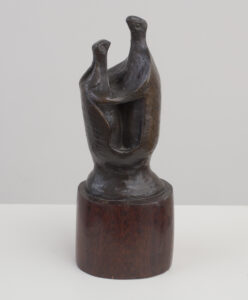 poetic gag piece which confounds and alarms. Moore’s sculptures – here only a few small maquettes – are instantly recognisable and as instantly pleasing to the eye, the hand and the intellect as a chess piece. He moves beyond gesture – the explicatory actions of the body – to affirm the relation of things in general, the interdependency of objects and people, of shapes wrapped around other shapes. Of everything. If he seems to allude to Dada’s fascination with dolls and automata (De Chirico is surely a touchstone but Moore swaps dusty, empty sunlit streets for dim, cramped candlelit bomb shelters), he rapidly and elegantly transcends it so that his hollow men and women are forms which resound with meaning, singing of a vibrant interior life far removed from the lardy surface schtick of Freud’s gluttonous gurners. The absence of any three-dimensional work beyond the very few tiny models might make the show seem simply tokenistic, alluding to a mere idea. But it’s a great idea. One to carry into the town.
Exhibitions run till 13 September 2026, Wednesday to Sunday and Bank Holidays, 11 am to 5 pm. Hastings Contemporary, Rock-a-Nore Road, Hastings TN34 3DW.
We hope you have enjoyed reading this article. The future of our volunteer led, non-profit publication would be far more secure with the aid of a small donation. You can also support local journalism by becoming a friend of HIP. It only takes a minute and we would be very grateful.

Leave a Reply