
All us Women 2026
VICTORIA KINGHAM
Tucked away in the Rooftop Gallery of De La Warr Pavilion is a small but intriguing exhibition underlining societally-nurtured patterns of violence, emotional imbalance and trauma against women. Curated and co-ordinated by Veronique LePlat, it is a set of striking textile-based and annotated montages with accompanying disturbing stories from the lives of the all-female artists.
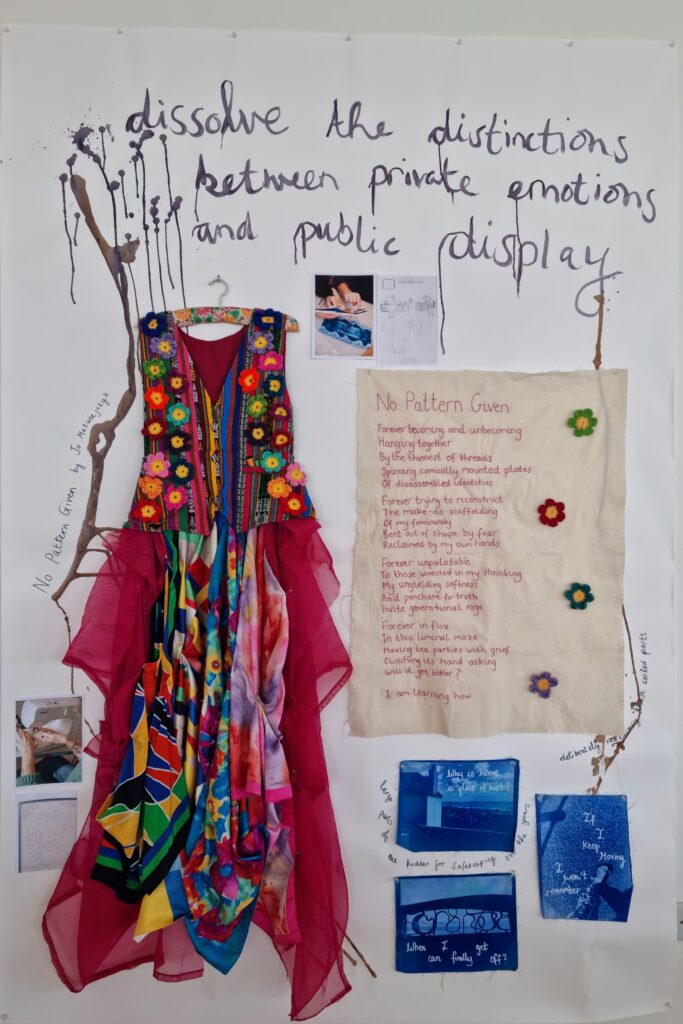
There’s a scarf that tells of intractable male prejudice against female-to-female relationships and some embroidery embodying love and forgiveness. A patchworked dress and a childlike desire to always wear dresses and to drink out of dainty china is contrasted with the surrounding terrors of war. Then there’s a story of ‘Violet’s Hat’, a memoir of the injustice of century-old ‘treatment’ for postpartum depression. “How much do we really understand,” asks maker Yvie Andrews, “what women go through, what they willingly try to manage, and how much still remains invisible and undervalued?”
There is an interesting piece of embroidery by Patricia Scanlan, the unfinished threads hanging down: she calls it Home. Emma Paige has produced a patchworked, caged matryoshka, as a symbol of cultural friction: “Beyond the surface of shared value lies a complex network of enforced behaviours, roles … that dictate how we should move, feel and exist within the domestic sphere.”
There’s a journey over an apron, a patchwork banner, and a textile piece called No Pattern which started out as a waistcoat and became, through time, something else more global and symbolic. It highlights a “broken relationship with femininity, something constrained by parental coercion and control”. Curator LePlat’s own piece is a denim jacket, also emphasising that as children we face embedded patterns of control and implied violence.

It’s a huge range of explosive topics to address in quite a small space, but worth going up to have a look and certainly to read the very illuminating accompanying texts.
You can also visit the website at alluswomen.weebly.com to see the history of the project and also to take part.
We hope you have enjoyed reading this article. The future of our volunteer led, non-profit publication would be far more secure with the aid of a small donation. You can also support local journalism by becoming a friend of HIP. It only takes a minute and we would be very grateful.

Hello, this was a very poignant and moving exhibition. Janey Moffat is not mentioned in the article above; she is an organiser, educator, curator, and mentor for the AUW project. I hope that this can be amended to reflect the efforts of all the artists.