
What’s Wrong with me?
A question most girls ask themselves sometime in their lives
Finley de Witt, local writer and body therapist, felt compelled to write Lovebroken (pub 2024) about their tumultuous journey through life. Written with comic wit, surprising twists and philosophic reflection, they finally find self-discovery and understanding. WoH interviews them.
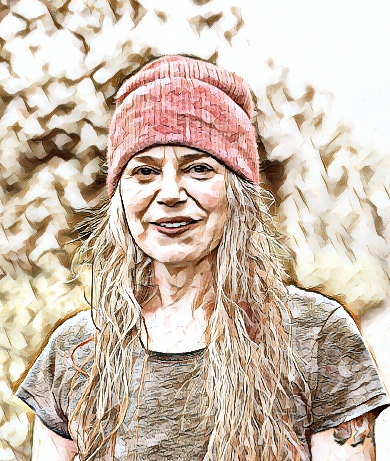
WoH: Tell me about the drive to write this memoir.
FdW: I was in a very deep trauma healing process, and realised there was a defining event in my childhood which had pretty much informed everything in my life. The question I had was: “What’s wrong with me?” This became the motivation, because everything I’d struggled with suddenly made sense.
WoH: That question is such a common experience of women and girls who don’t feel OK or can’t fit in.
FdW: Right, and then we self-criticise and think it’s our fault, and that’s exactly why I wanted to write, to offer hope. No matter how bad it’s been, you can find meaning and you can heal. I realised I had a powerful story – with a reveal at the end. The second motivation was that, as a trauma practitioner, I understood the dangers of ill-informed treatment. We don’t need to be pushed. We never know what might come up. I wanted to be unapologetic and encouraging to others about whatever feelings, thoughts or behaviours they have experienced in trauma.

WoH: So, acting as a support in dissolving shame for readers who might have similar experiences.
FdW: Yes, to normalise it: to say “you are not alone”. The amazing feedback I’ve had from people who’ve been sectioned or had breakdowns has been very humbling, much more than I expected.
WoH: I’m interested in the effect of the way you use humour to expose certain characters and situations in a very familiar, compassionate way. Did you have to be quick-witted to survive as a child?
FdW: I wasn’t witty as a child. I was silent. But that northern working-class bluntness is in my DNA. I think about how people laugh when there is pain – you can say very subversive things with humour. Laughter helps the release of pain. Also, I didn’t want a misery novel.
WoH: Yes, the blatant flaws in the characters are so funny; the reader quickly bonds with them. And that ‘get on with it and stop moaning’ aspect is funny but also shows the harsh side of northern culture that can bury uncomfortable secrets.
FdW: Exactly, and in storytelling we want contrasts. With the reveal, we see the taboo, which is still not talked about today. As children, we have to help our parents survive, even if they are not competent. We will always try to resource them so they can look after us.
WoH: How did university influence you?
FdW: University broadened what I was reading but it really gave me confidence in not taking things at face value. Just because it’s written down, it doesn’t mean it’s true. That was liberating. But it was Centerprise in Hackney – a community centre and bookshop – where I learnt the craft. I met so many writers and poets, and Jacob Ross [poet, playwright and novelist] was keen for writers to learn the craft. I was in a group called Anything for a Free Lunch – experienced writers, giving each other feedback. That was more informative and useful than doing an MA. It was a special time for women writers.
WoH: Do you think there is a feeling now not to speak out, that there is no need to write about trauma, or social control?
FdW: There aren’t the resources there were, with Outwrite, Spare Rib. It was new and exciting. We had a lot to say. There’s nothing that beats having your writing as a practice. I don’t write every day, but I trust things are composting and they will come out when ready.
WoH: Has it always been words?
FdW: I used to draw, but with words, you speak the unspeakable – which takes the power out of it. Secrets have to be spoken: once you say them, you see the world doesn’t explode.
WoH: Where do young women need support today? Is there a new repression of girls and their inner worlds?
FdW: As a trauma practitioner, I really encourage anyone to embrace their multiplicity. Part of me wants to go out, part wants to stay in; I feel despair, and happiness. We have opposite feelings. To get to open spacious curiosity, explore all our dimensions. Be open and curious about ourselves.
WoH: And the book shows how curiosity leads to discovery. You could say, it’s a great book – but why did you have to put that bombshell at the end?

FdW: [laughs] Yes, it was the thing that makes sense of everything that goes before, so it can’t be left out.
WoH: Well, lots of writers would leave that out. Keeping the story safe, avoiding the taboo. It’s a role model of a book.
FdW: The more we do it, the more it can be said. Taking risks is so important.
WoH: And, of course, this all ends up in a special town: Tastings.
FdW: [laughs] Yes, they will recognise the location. And the very colourful and wonderful characters who end up here.
WoH: Yes, in the melting pot of community healing. Thank you so much for talking to us and best wishes for the next chapters.
We hope you have enjoyed reading this article. The future of our volunteer led, non-profit publication would be far more secure with the aid of a small donation. You can also support local journalism by becoming a friend of HIP. It only takes a minute and we would be very grateful.

Leave a Reply