
Interesting People #4
Dr Ralitsa Hiteva
We often associate Interesting People with the bohemian lifestyle
of Hastings’ creative community. But creativity comes in many forms: following HIP’s collaboration with Dr Ralitsa Hiteva on the Hastings NetZero Supplement that came with Issue 174, HIP talks to her to find out how her fascination with infrastructure has led
to her own interesting life.
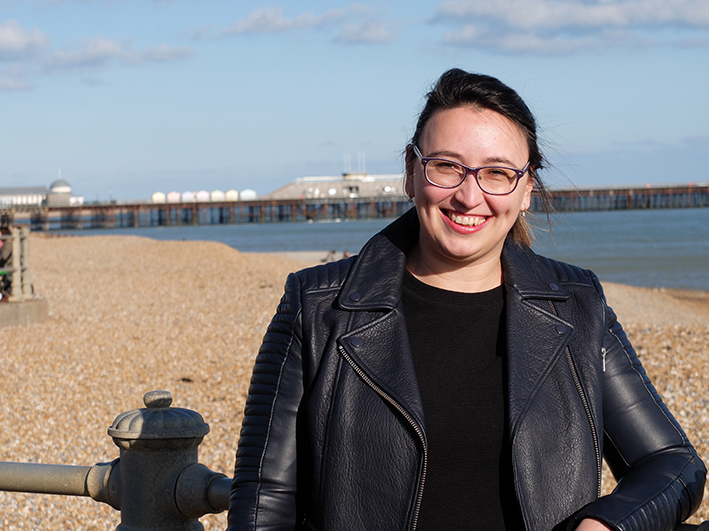
PICTURE: Dave Young
How long have you lived in St Leonards and what do you think of the place?
I first visited St Leonards at the end of 2016 and immediately fell in love with it. I moved here the following year and have now bought a house. I love the beautiful open space along the beach and the history of the place.
From the NetZero Hastings Competition and Supplement, I’m aware of your interest in infrastructure. How did that start?
I got interested in infrastructure while working at the Economic Commission for Europe at the UN in Geneva. I noticed how discussions on infrastructure always had full rooms of delegates – and everyone was paying attention. Infrastructure is where the money is! But it’s also one of the most powerful levers of change, as it is responsible for most carbon emissions. Infrastructure is a fascinating topic. The hard bit about working in this area is being young and female and wanting to talk about how infrastructure can be changed.
The biggest changes and social movements about environmental change are yet to come
As you just indicated, this might be seen as a male dominated area. Is this true or just a perception?
Yes, and it’s really hard to open up a productive space for change in infrastructure investment and policy and decision making, particularly when you don’t quite fit in. From creating platforms for new voices to involving the public and people from different backgrounds: social scientists, artists, users, there is always an element of having to convince and prove that these agendas are important and that these different voices need to be heard and considered on a par with those who traditionally work in this space. Infrastructure is not only male dominated, it’s a space dominated by certain professions, ways of seeing things, experiences and levels of income. That is one of the reasons why infrastructure often fails to support and work for those who are vulnerable and struggling. All these things go hand in hand, but it’s difficult to accept that diverse voices and experiences can lead to better outcomes for everyone.
You were born in Bulgaria. How did you end up in the UK?
I came to the UK to begin my undergraduate degree at the University of Edinburgh in 2003. After completing my MA in Economics and Politics,
I moved to Geneva and worked for a charity and the UN. I came back to the UK in 2009 to complete another Masters in Environmental Governance and at the end of the programme I was offered a full scholarship to do a PhD in Low Carbon Infrastructure. I was recruited to work for the Science Policy Research Unit (SPRU) at the University of Sussex even before I completed my PhD, and the work I have been doing since then is so interesting, I can’t imagine working on anything else. I feel very fortunate to be living in these times of change and to be working on something which is deeply meaningful to me and in which I believe.

Do you feel your childhood in Bulgaria shaped your current interests in any way?
My childhood was spent in different countries in Europe and has helped me to develop a strong European identity. I don’t see myself as being Bulgarian and living in the UK or being a foreigner. My identity is built around experiences which are not limited to one place or way of living. A lot of my colleagues have quite similar backgrounds, so I believe there is a whole generation of people who don’t fit labels based on places of birth. I grew up in a society which was undergoing fundamental change to its infrastructure, culture and political regime. Maybe that’s why I’m not afraid of change and actively lobby for it.
You have been working in environmental sciences for some time. Does the work you do give you hope for the future?
I believe that environmental change is one of the grand challenges of our time and one where we can’t afford NOT TO throw everything that we have at. Working on environmental change, whether we call it NetZero, low carbon or sustainability is more of a calling than a job. I’m far from being an exception, or part of a minority.
Working on environmental change … is more of a calling than a job
So you’re optimistic about the future?
My conviction has grown with time and I see this with others too. The biggest changes and social movements about environmental change are yet to come. I am optimistic about the future and our ability to effect change as a society.
You are currently a Research Fellow in Infrastructure Governance at the Science Policy Research Unit (SPRU) at the University of Sussex. What does that involve?
My role is mostly research and often involves examining in detail different aspects of the role infrastructure plays in everyday life. I have worked on many topics, from how urban gardening helps people living in fuel poverty, to classifying the different levels of business model innovations enabled by digital technologies. This usually involves getting to know about specific types of infrastructure and the people who are involved in developing them. I do a lot of interviews, focus groups and observations. I have to spend a lot of time reading policy documents and reports, and writing. It might sound odd to non-academics, but writing is how I think.
I am optimistic about the future and our ability to affect change as a society
Does this mean you have to be organised?
My house is littered with floating pieces of paper on which I scribble down thoughts. I sometimes do it absent-mindedly and it has created some comical situations. My mother held on to something I’d scribbled on for months because I‘d written down a bold statement about the biggest problem of society and how it could be solved; on another occasion I went into my favourite coffee shop and was questioned by the owner about what I’d scribbled on the back of a receipt a few days before. They initially thought that it was a message or complaint, but then decided to hold on to it in case it was important – in case you are wondering, it wasn’t; I was trying to figure out what rhymes with ‘infrastructure’!
What do you like to do to unwind after a day at work?
Since March 2020 boundaries between work and home have been blurred with working from home full-time. There isn’t a mental dropping down of laptops and workbags by the door anymore. Instead I have learned to enjoy and appreciate lunch breaks. I look forward to the middle of the day when we take our dog out for a walk and get to play with balls and run through puddles of mud.


We hope you have enjoyed reading this article. The future of our volunteer led, non-profit publication would be far more secure with the aid of a small donation. You can also support local journalism by becoming a friend of HIP. It only takes a minute and we would be very grateful.

Leave a Reply