
Hastings Assembles in St Leonards
ROD WEBB
The first town meeting of Hastings Assembles was held at the Stade in June this year, prompted by a generalised dissatisfaction with the lack of political choice in elections (see HIP Issue 254 Taking Power Back through Community Conversation). It was set up as a self-organising body under a set of general principles, among them for “everyone taking part to listen and speak respectfully even if they strongly disagree”.
One of the key decisions of Hastings Assembles was to have regular local assemblies. This came from the realisation that the people most needing a voice were often too busy dealing with the practical problems of life in what looks to be continued austerity: finding a place to live and balancing the weekly budget. So, to generate greater participation, assemblies need to focus on issues of direct concern that can be addressed in practical ways at a community level.
Last week I attended the second Assembly for the local council wards of Central St Leonards, Gensing and Maze Hill. Seeing barely eight people assembled at the allotted time of 5.30pm in St John’s Church Hall was a reminder that the local community would need ‘galvanising’. But within ten minutes, there was a more encouraging group of 20 people sitting in a circle and introducing themselves – not so bad for a miserable winter evening on a Sunday.
What was definitely encouraging was that there were a few new faces, not just those who doggedly attend so many of the volunteering/activist events. And it was a varied group – inevitably with diverse views on how to proceed.

Grace Lally, one of the original people behind the initiative, found herself having to take the role of facilitator. She’d hoped that many more of the 40 people attending the first meeting – who had enthusiastically come up with relevant topics – would attend. The idea was that participants would divide into like-minded discussion groups, not only coming up with plans, but also self-organising for practical implementation.
Instead, there was a loose conversation about some of the topics. But out of this, some kind of consensus seemed to emerge: one function of the assembly could be to serve as a hub which could harness existing volunteer groups to tackle specific local issues.
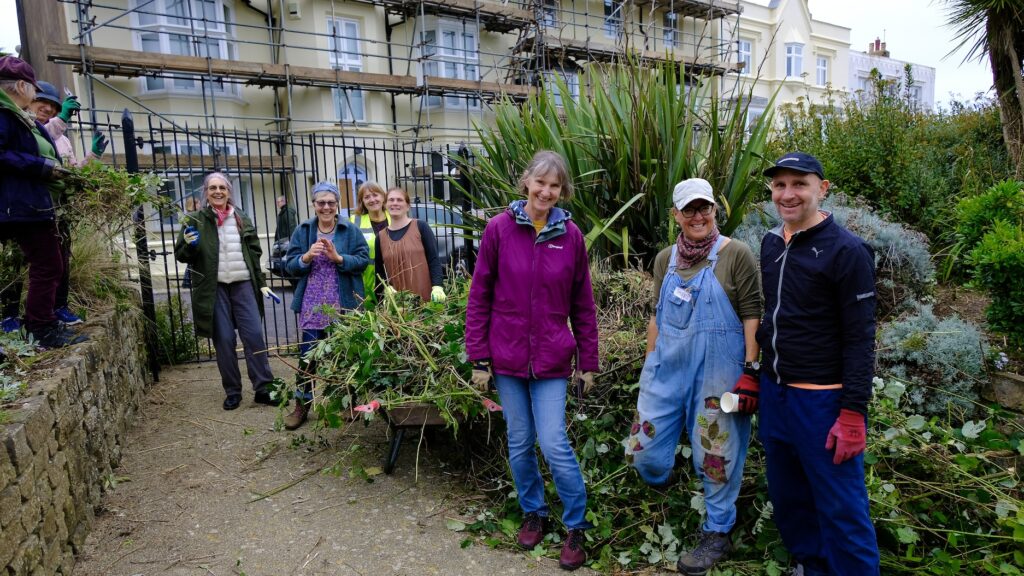
An example of this is the recent mass tidy-up of St Leonards Gardens, involving Transition Town Hastings, Tidy Up St Leonards, the Hastings Borough Council and about 35 volunteers – a project that will continue in 2025.
And within this ‘hub’, a genuine community could emerge, inclusive and supporting and willing to tackle local issues both big and small. Rather than placing political action as the driving force, this could emerge through discussion and practical community solutions over time – perhaps to be discussed at a town assembly.
I, for one, went away from the assembly quite excited about possibilities, particularly now that there is agreement to meet on a monthly basis on the last Sunday of each month. Roll on 26 January!
Since the meeting at the Stade, there have been local meetings in Ore and Braybrook Wards, and it is hoped that others will emerge in 2025. See hastingsassembles.org for more information or follow on Facebook @hastings.assembles.
We hope you have enjoyed reading this article. The future of our volunteer led, non-profit publication would be far more secure with the aid of a small donation. You can also support local journalism by becoming a friend of HIP. It only takes a minute and we would be very grateful.


Leave a Reply