
All Refugees Welcome
By Sarah Milne
Over recent months, we have seen the conflict in Ukraine unfolding in real time before our eyes on our TV screens and social media. At the same time, we continue to see the more familiar images of refugees from other areas of war arriving in the UK from their journey across the channel on small boats.
I wrote about the experiences of Ukrainian refugees in our town, and those of us who have opened our homes as sponsors in the June 17 issue of the Hastings Independent (no 203). I included a quote from Jane Grimshaw, Convener of Hastings Supports Refugees and Co-Chair of Hastings Community of Sanctuary who said she believes we are now, “creating a two-tier system of people deemed worthy refugees and those deemed unworthy”. In the same issue, Alex Kempton, the Refugee Buddy Project’s Operations and Campaigns Manager outlined how divisive media narratives around refugees have been responsible for directing sympathy and empathy towards different groups of people.
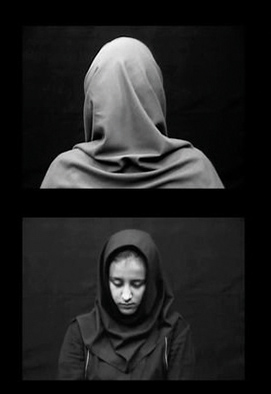
Video still from the project Dastan, 2010 by Amak Mahmoodian
This year’s annual refugee week, 18-26 June, was organised around the theme ‘Healing Through Creativity and Conversation.’ In Hastings we were treated to a vibrant program of creative actions and events, organised by the Refugee Buddy Project in collaboration with over 18 local artists and 15 organisations. At the centre was a panel discussion held at the De La Warr Pavilion on Wednesday 22 June. All Refugees Welcome was organised and hosted by the Buddy Project, in partnership with Shannon Ghannam of Magnum Photos. It was a fascinating, powerful, and challenging call to examine the role images play in the in our understanding, attitudes and behaviour around migration and asylum seeking in the UK and the impact dominant narratives have on individuals, families and communities settling in our communities.
Journalist and author Daniel Trilling gave a moving reflection on his many years reporting on refugee news stories. He explained how important it is for us to look behind the statistics and political slogans presented to us to find the individual human stories and discussed his experiences travelling with people from country to country while writing his book Lights in the Distance (2018). Daniel’s presentation showed how terms commonly used by the media to define individuals ‘refugee’ or ‘economic migrant, ‘legal’ or ‘illegal’, ‘deserving’ or ‘undeserving’, fall woefully short of capturing the complex realities of their lives and stories.

This idea was developed further by Jess Crombie, a researcher and consultant for the development and humanitarian sector, including organisations such as the Red Cross, Save the Children and the DEC. Jess discussed how stereotypes evolve when the media shows just part of an individual’s story, such as a man’s arrival on a beach in England wrapped in a blanket with no shoes, or a child looking dirty and destitute in a refugee camp. These images capture just a moment in those complex realities Daniel Trilling describes in his writing, yet we use them to form wider attitudes and opinions on the individual as a whole and can even extend these beliefs to everyone else we associate with the image before us.
Through presenting her People in the Picture research project with Save the Children, Jess urged us to let individuals express themselves and tell their own stories. She explained how many of those who contribute to professional visual campaigns have given consent to work with photographers and videographers. They understand that images capturing desperation help agencies to collect the funds and support that enable them to do their work. But these images should be accompanied with a balanced story about the people involved and the lives they lead. Of course, many of the images we see every day are taken without the consent of the individuals involved and with no opportunity to give their own explanations.
The activist and campaigner, Maz Saleem, gave us a passionate and emotionally charged reminder of what can happen as a result of media stereotyping in recounting her memories of the day her father, Mohammad Saleem, was stabbed and murdered in an Islamophobic attack in April 2013. Maz reminded us “tomorrow it could be someone else’s father, mother, brother or sister who is murdered or attacked for simply looking visibly Muslim”.
The panel discussion was closed by the Iranian photographer Amak Mahmoodian. Amak, now living in Bristol, showed us a selection of beautiful and powerful images exploring the impact of being of displaced and exiled from home.
The discussion left lots to think about, but it’s clear we can all help by challenging the stereotypes, or incomplete ideas about people we have formed through the terms and images served to us by the media. The best way of doing this is to give those refugees living among us in Hastings the time and space to share their own, complete, human stories.
• Check out the Refugee Buddy Project for more information about the All Refugees Welcome discussion and the panellists. www.therefugeebuddyproject.org
We hope you have enjoyed reading this article. The future of our volunteer led, non-profit publication would be far more secure with the aid of a small donation. You can also support local journalism by becoming a friend of HIP. It only takes a minute and we would be very grateful.

Leave a Reply