
Death to Doom Scrolling
As the government considers outlawing algorithms which addict people to social media, and schools increasingly ban mobile phones, Hastings teacher CHRIS WATKINS explains why he has taken his own self-denying ordinance
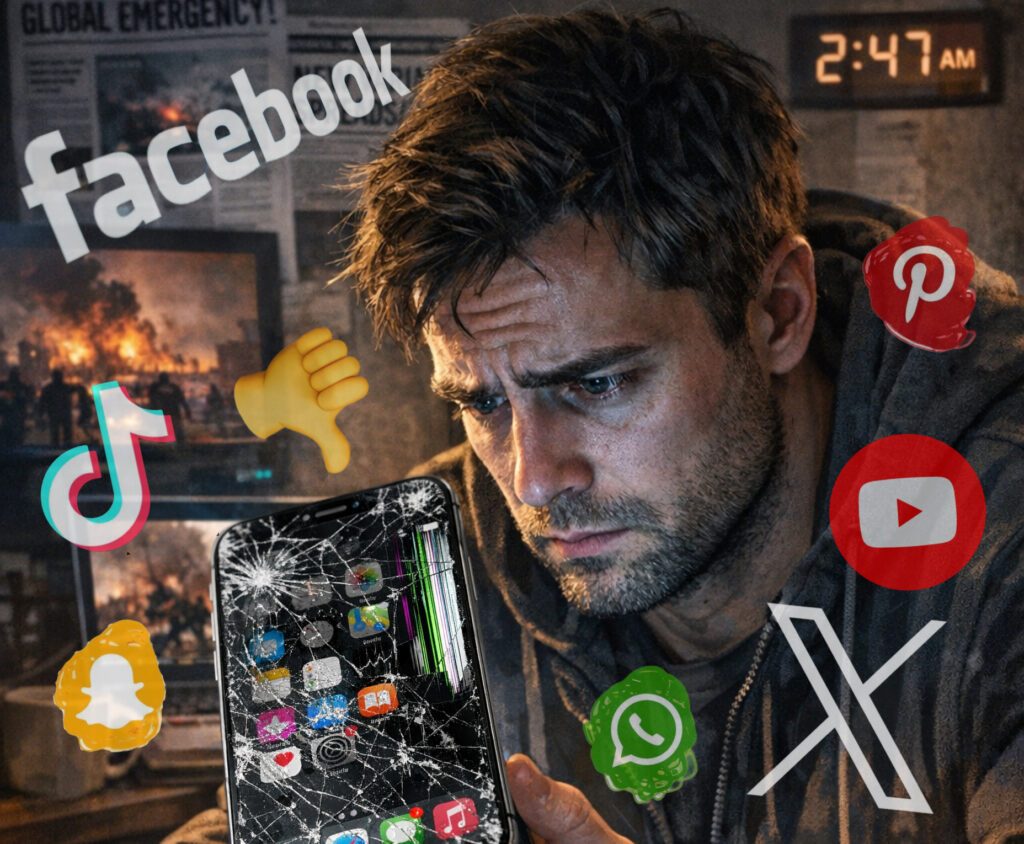
I guess I’m thinking about this now because I finally got around to deleting my social media accounts. They don’t make it easy. Who can remember the password to that long-forgotten email address? It’s like burning two decades of diaries, address books and letters, but my days are immediately transformed. Yes, I still pick up my phone several times an hour to be reminded it isn’t saying anything, but I’m sure that will pass. And I understand – and welcome – that soon I will be out of touch and uninformed. Perhaps older people should start passing over their ‘authority’ sooner?
The kids at school don’t like it when we talk about taking their phones away, but mostly they just don’t like being told what to do. When you go a little deeper, maybe you ask “How would you feel if you didn’t have a phone?” Some of them might pause and answer, “Happier.” There are a lot of questions we need to answer about phones and social media, but maybe we should start with “If we aren’t sure whether they are harmful or not, why are we giving them to children?” As far as I can see, the honest answer is “Because they were invented.” Everyone got very excited and pretty seriously addicted quite quickly, but it was only recently anyone started asking if it was a good idea.
Seriously Addictive
As parents, it is probably time to pose questions. Very soon after it was invented, the internet became a public space, and parents, in particular, started wondering who was making sure it was a safe place for their children. When you think about it, that is an odd way of going about the problem. As parents, we say to our children, “Here’s your phone. You’ve got to have one. Yes it’s pretty expensive, and I am worried it might be bad for you, but we don’t have any choice. Do be careful; billions of dollars have been spent making sure it’s seriously addictive and anxiety-inducing. It might have weird stuff on it, maybe some predators, people might use it to bully you, and I can’t really keep track of those things, but here you are. Happy Christmas.” The kids in school say “Well, I need to be able to contact my parents; it’s dangerous out there,” and I tell them, “Actually, violent crime has dropped substantially in the last few decades, but also do you need a smartphone to contact your parents? Wouldn’t a dumb phone do that job?” It’s not a very positive debate.
Being of an age, I didn’t even have much to turn off – in truth, I never made it past Facebook, but I did do a lot of that. It would have been unkind not to share my clearly excellent tastes. My ideas were obviously profound, and the world had to be told, despite those regular Saturday mornings spent in hungover deletion. I even prided myself that the ever-diminishing number of responses or pixelated thumbs-up only indicated I was too radical and unsettling. I shared my musical ventures, photography, and creative expressions – my feed was a careful curation of my presented self. Then, a few months ago, like a clumsy evangelist, I fell among the commentariat hell-bent on conversion. I spent hours each day making it my second job to cajole and convert. No matter that half the voices were probably artificial, I was saving the algorithm itself.
Class Actions
We have seen a slew of countries banning social media for young people and class actions successfully prosecuting social media companies for harm to children. And in return, those companies sue for damage where governments restrict their unfettered access to populations. Suddenly, it feels like one of the functions of government is to protect us from international corporations attempting to control our attention for profit. Is that normal?

It is very easy to find convincing evidence that social media, particularly on handheld portable devices, is injuring us all. And I indulge scepticism about the effect of banning particular platforms to children, given how little heed is paid to existing rules – hands up who knew you need to be thirteen to use Whatsapp? There remains a lot of hoping that the law will make it all safe for us. It is also obvious who most wants these systems to continue, and, oh look, it’s the people who provide us with our opinions. I ask the kids at school, “You know it costs energy and thus money to keep your thousands of online pictures on a server? Why do you think Instagram does that for free? Because they like you?”
I probably hadn’t noticed how much time I was spending in fruitless argument with strangers, but after a few weeks my feed was broken, and everything was another bot-made fanpage for Rupert Lowe – the multi-millionaire Restore Britain politician. Then maybe the sun came out or something, and now it was a good time to stop for good. This far down and no further.
I couldn’t remember when I last felt bored, and that is the first thing that returns. It’s not like I even started reading more books or took up a new activity. I expect that will come, but for now, I am very happy to sit in silence and look at nothing. I’m wondering what is the validation that online provides – does writing in those allegedly public spaces allow us the misapprehension that we can be seen? Does sharing our opinions about politics and power online allow us to feel just heard enough to avoid actual action? Most of all, as I use my phone to write these words, I wonder what shall I do with these newly spare hours?
We hope you have enjoyed reading this article. The future of our volunteer led, non-profit publication would be far more secure with the aid of a small donation. You can also support local journalism by becoming a friend of HIP. It only takes a minute and we would be very grateful.

Leave a Reply