
HYP: Josie Barnes
Women in the Hastings Fishing Industry Today
Women in Hastings’ 1,000 year old fishing industry have always supported the men by selling the fish whilst the men went to sea, doing the laundry and hop picking during the summer months to earn extra income. Occasionally they had to pawn their clothing or jewellery when extra work was hard to come by. During the war, while men went to serve, the women were left to support their families; some volunteered for the RNLI and did a lot of the jobs that the men traditionally had done.
Fishermen have always socialised together, which mainly revolved around drinking at venues such as the Winkle Club. Women struggled with this because they were expected to look after the children, undertake domestic tasks such as working in the communal laundry whilst their partners were often out and sometimes drinking to excess.
The fishing industry in the 21th century has changed in some ways; women have more control over their businesses, jobs and relationships, and some women now participate in commercial fishing. They are paving the way in the industry, with a few women challenging traditional seafaring superstitions. They are inspirational in many ways.
I decided to find out for myself what life is like for local women involved in the industry, as the main focus has been on the men until fairly recently. I felt it was important to document the culture and changes in their lives and was surprised to be told how much trauma has been so deeply felt within the fishing community.
I was told several times about the forcible repatriation from the old town to Ore to build the ring road and clear the “slums”, an experience from 50 years ago which is still talked about with bitterness today. People say that the council back then thought that the fishing industry was unglamorous, messy and gritty; possibly putting tourists off visiting the town. In one discussion I had with a local woman, she felt like the council still weren’t prioritising their needs given the fact that tourists now come to Hastings to eat fish and chips and visit Europe’s biggest beach-launched fishing fleet.
The fishing industry is dangerous. In one group discussion, women said that they had known of three people either going missing or who had died within the last year due to machinery launching the boats or whilst out at sea; in fact, one person, a teenager, went missing at sea. I was told that this case apparently hasn’t been properly investigated by the council or the police. One woman I spoke to said that she wasn’t sure if she wanted her children to carry on doing commercial fishing given how hazardous it is.
Sadly the cost of living crisis has affected the fishing community, and they have had to raise the price of the fish they sell. The diesel to run the boats has increased significantly in the last year which is another contributing factor to prices going up. One woman interviewee said that she had to lay off her own son (who had just become a parent) because of how precarious the industry has become.
Brexit has clearly had an impact, despite some local people supporting it, as it has increased barriers to trade and introduced new restrictions. Several people interviewed felt that they were lied to about the benefits of Brexit and now have to trade via Brixham in Devon.
Despite all the hardships the women in the fishing industry face, they all stated that there is a real sense of comradeship, solidarity and community spirit, which is much needed in the current climate.
My work featuring Hastings is very much informed by my love for the place where I was born. My photos and interviews were created in partnership with the families, and their consent and collaboration was crucial to this project. I decided to take photos of my interviewees with objects that are important to them, so that I could give something back to the families that can be remembered for future generations, perhaps still working in Hastings’ fishing industry.
INTERVIEWS
Polly Drummond & Gail White run the Rock-a-Nore Fisheries; Charlotte Swann from the NetShop Jellied Eel Bar is part of the community; and Lucy Phillips is part of the crew at sea.
Polly Drummond & Gail White: Rock-a-Nore Fisheries

Rock-A-Nore Fisheries has been running since 1804. Sonny Elliott, his brother and his sister Polly Drummond took over the shop in the 90s when their grandparents passed away. Currently Sonny and his family run the shop with all of the fish sourced locally and with a smokery on site.

P.D: My name is Polly Drummond, I started down here when I was 13. My nan and grandad owned the shop, so I used to come down after school and do a bit of washing up and work at the weekends. I left school at sixteen and ended up working here. Other than a few years out when I went to have my children, that’s where I’ve been ever since.
G.W: My name’s Gail White, I’m a family friend and I’ve been here for years. I started working here when Polly went on maternity leave.
J.B: What changes haveyou seen in your lifetime?
P.G: I suppose the type of fish people are used to seeing is changing. In the past it used to be plaice and herring. Now it’s a lot more fish/seafood like sea bass and scallops. People’s tastes have changed; People want everything prepared.
P.D: My grandmothers on both sides are part of the fishing industry. It goes back hundreds of years in my family. Both my nans grew up in this town, their parents used to do it. So it’s always been work for my family. Obviously, my partner works in a different industry. I mean you’re probably not going to get rich from it, but it’s a way of life. It’s not always easy but you can make a living if you work hard.

J.B: Would you want this way of life for your children?
P.D: Possibly not. It’s not easy. It’s very cold down here. Bitterly, bitterly cold when you’re in the fridge for nine hours, hands in ice. So it’s not an easy job. I wouldn’t necessarily push them into it, but if they really wanted to I wouldn’t dissuade them either. But it’s hard work, You have to be quite tough to put up with the cold.
J.B: Tell me about your object?


P.G: Well, Nan was amazing down here. She was brilliant with customers. You know it was her baby, this shop. She was the one who started it, so she’s really a big part of this place. Her urn is upstairs so she can always be remembered.
J.B: I heard Holly used to wheel fish to sell in Bexhill everyday back then – is that true?
P.D: That’s Lily’s mum, Holly, my great-grandmother. That’s what she used to do. She used to push the wheelbarrow the fish to Bexhill to sell and come back again.
P.D: Yeah, she was one tough cookie.
J.B: So how do you see things progressing in the next twenty years?
P.D: I think things are changing. What people are wanting is changing. You have to adapt to that. People want things like lobsters. They want more luxurious things now. So I think you’ve got to adapt to what people are wanting. There’s a lot more people from London living here now, it’s different to what we used to do.
G.W: A lady actually came in today and she had said it’s taken about ten months to find us. She’s only from Mountville, which is Battle way, but she’s been trying to find us for months. It’s because people say go there, go there. It’s a real destination point for locally sourced fish.
Charlotte Swann at the Netshop Jellied Eel Bar
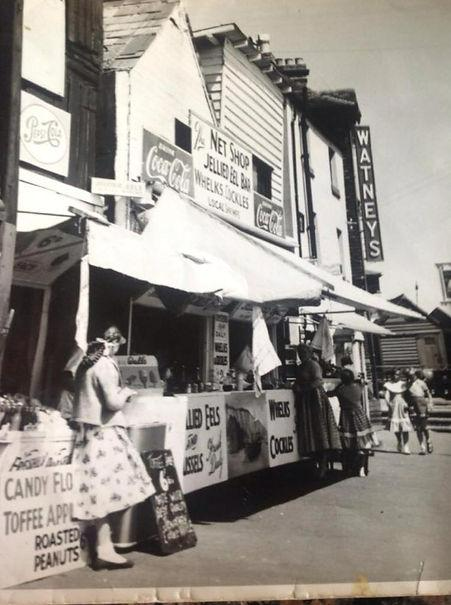
The netshop dates back to the 1940s when the family business began trading from a stall on the beach. Soon after, the building in Rock-a-Nore Road was purchased and passed down from generation to generation, starting with Reggie Lee, then Johnny Swann Snr, and followed by Johnny Swann Jnr, who has run the business for over 30 years.

C.S: I’m Charlotte Swann. I’ve been working here since I was a teenager- it’s my parents’ shop. My dad’s owned it probably for about 40 years now and his grandparents had it before him.
J.B: What are the work hours like?
C.S: I get up at about 4.00am, but in the summer it varies. Some Saturdays you can be here until like 7.00pm some nights, I guess it depends on how busy it is.
J.B: What do you think is the hardest thing about being in the industry?
C.S: A lot of the time it’s actually getting the fish to sell at the moment and the cost. The price is really expensive; it keeps increasing.
J.B: Why is that?
C.S: If there’s a lack of fish, it increases the price and if they’re not catching it, you have to pay a premium.
J.B: Do you think Brexit has made it harder for the fishing community to catch fish or is there no correlation to it at all?
C.S: Yeah, I think it’s related to it. It’s made it harder because there’s more fishing rules. I’m sure there is, however because I’m not catching it, I don’t know the ins and outs of the regulations put in place. They have quotas now, which I think they never used to. They could catch what they wanted and now things have got to be a certain size. If not, they need to be thrown back, so I’ve heard.
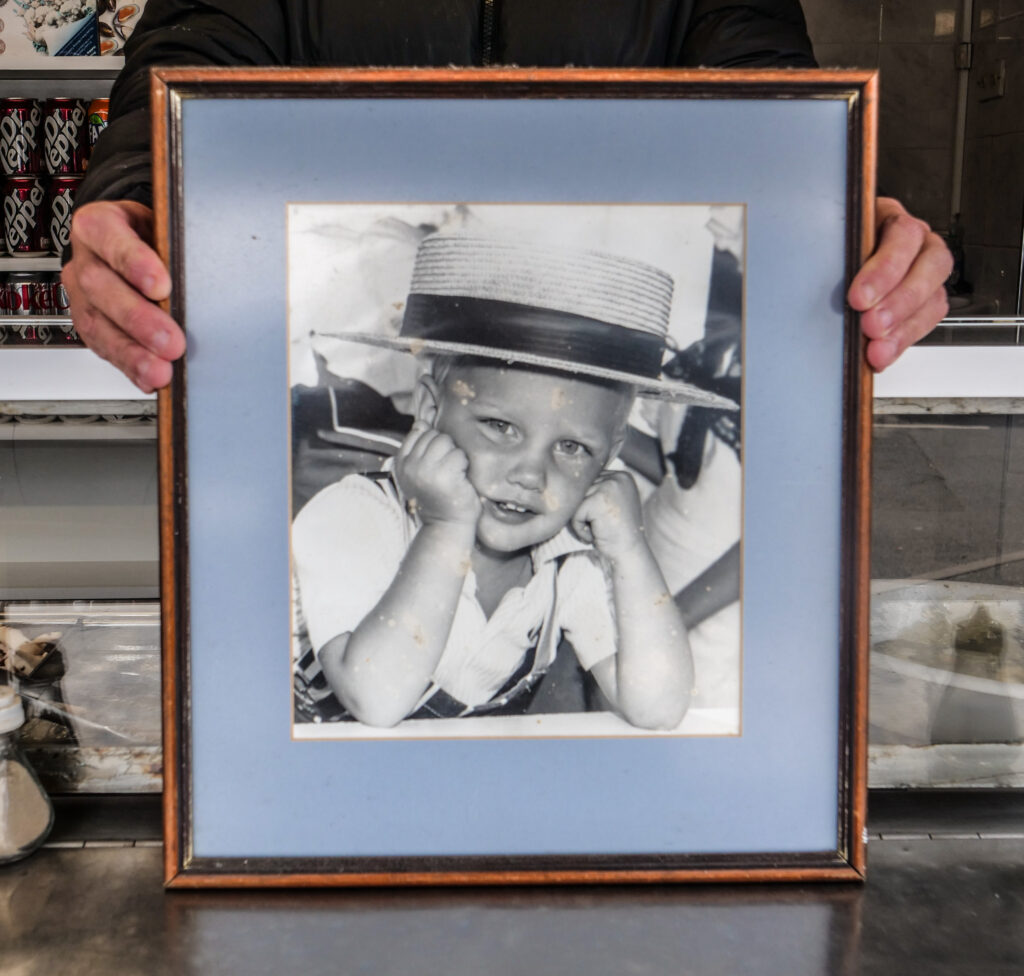
C.S: It’s a picture of my brother; I think he must have been about three or four maybe. We were in the Hastings Carnival and the float was the shop and the picture’s been up for years.
J.B: What do you think is the nicest thing about being in the industry?
C.S: Everyone knows each other, and people are really friendly. It’s just a really nice community to be involved with.
Lucy Phillips: Out At Sea
Lucy Phillips and Paul Stanley run Mick’s Fish at the fish market behind Hastings Contemporary Gallery. Paul used to go and work with his dad (Mick Stanley) from the age of about seven, and later on in life named the fish shop after his dad.
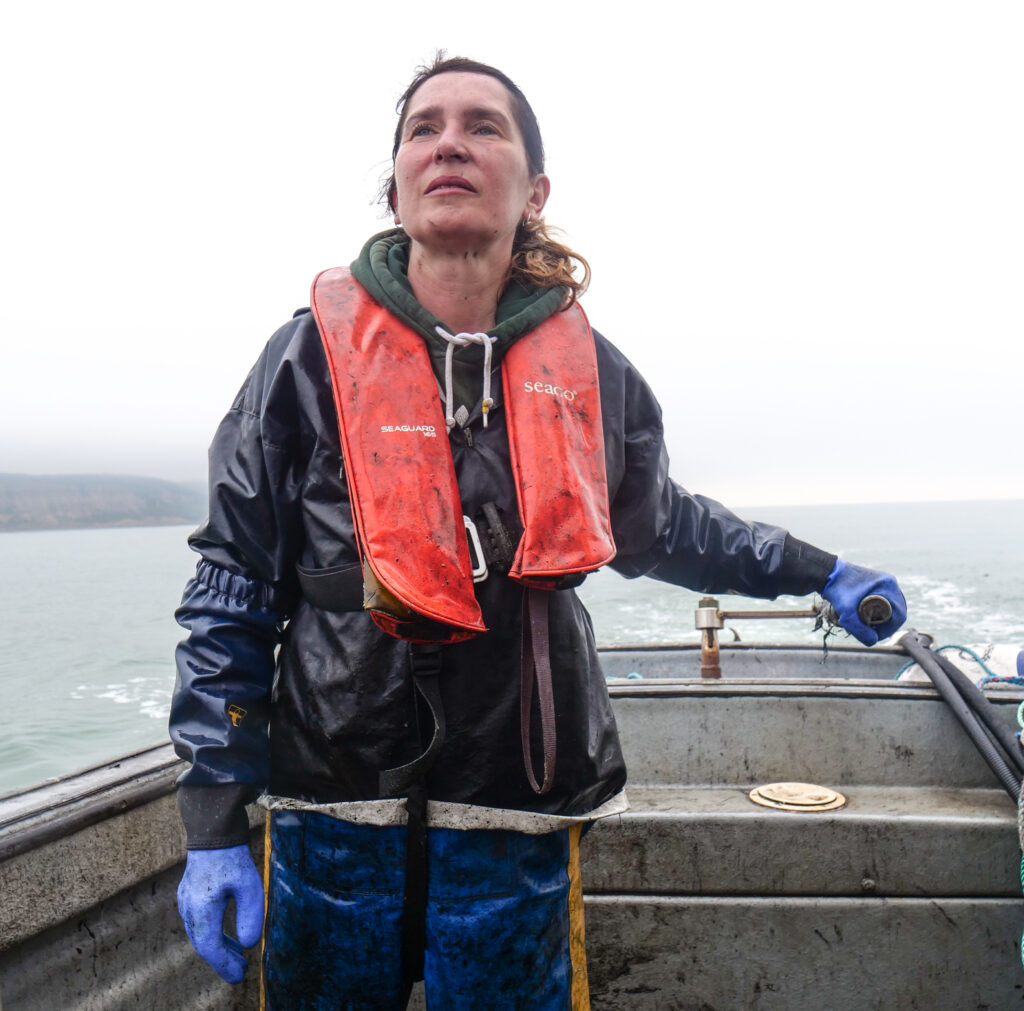
L.P: My name’s Lucy. I’m 52 years old, I’ve lived in Sussex all my life really, and I moved to Hastings from Brighton 20 years ago.. I’ve got a daughter who’s 18 and I’ve done lots of different jobs over the years, and while my daughter was growing up. I worked as a translator and then I’ve been working with all selling fish for the last six or so years.
Initially I was a customer of course, and one day he just asked me for help. Then I ended up helping Paul out and have been full-time crew plus selling fish for the last year. And I have my own little boat as well, a little rowboat. I had that for a couple of years before doing this.
J.B: Have you seen any change in your lifetime?
L.P: Well my lifetime in fishing is very, very short. But I would say even in the last few years I’ve been working with Paul and seeing what the boats land and seeing the fish that we sell and what people catch, I would say that a lot of things are getting much, much harder because of industrial fishing, so there seems to be a lot less fish around, especially if you speak to older fishermen who’ve been doing it their whole lives. And when they talk about the catches of fish they used to catch, nobody catches like that anymore around here. So I would say even the five or six years I’ve been working here, it’s obviously become more difficult for people.
J.B: Do you think that’s partially to do with Brexit?
L.P: So most countries, if you’re close together, like France and Britain, we would have a limit down the middle and France has a 12 mile limit, and fishermen were promised that the limit would be extended to 12 miles from six miles and it wasn’t. And the effect of that on us is the bigger boats from say Belgium or Holland and potentially France, but it seems to be mostly big boats from Holland, come up and down the six mile limit, which isn’t very far. And we are in a narrow stretch of water, so it would’ve made a big difference for fishermen to have that extra. Because things have been so hard, particularly for a small-scale fleet, like the one in Hastings, very traditional and people are obviously going to want something that’s promised to improve things.
So, you know, people are pretty fed up with the way that they’ve been treated and were offered, something that potentially could have improved the situation … So I guess we’ve got none of the advantages of being in Europe and all the disadvantages of not .
So, in terms of the market and everything, I don’t know what Brexit has done, I would say it hasn’t improved. It clearly hasn’t improved in the way that was promised. And I voted to remain in Europe. I wasn’t a fisherman at the time, I voted to remain, but having become involved in fishing, I do understand why fishermen voted to leave and it’s clear that they’ve been let down in terms of being promised things. So it’s not as simple as people think. People voted to leave Europe for a good reason that was offered to them and it didn’t happen.
J.B: What’s it like being a woman in the industry?
L.P: I feel very much accepted and I’ve never felt that being a woman has been anything that anyone has regarded as a problem. I’ve been treated well, People down here seemed to have accepted me, which I feel grateful for. People don’t go on about being a woman doing the job because I’ve been doing it for a little while and stuck at it. I’m a bit of a tomboy so I don’t mind.
J.B: The fishing industry has a reputation for being dangerous. Is this true in your experience?
L.P: Of course it is. You’re dealing with unpredictable factors the whole time and you’re doing a job that involves machinery, anchors, knives, ropes… of course it is. We can take measures to be safe, but there’s no question it’s a dangerous job.
J.B: What’s the hardest thing?
L.P: I would say probably the hardest thing is the fact that it’s becoming more and more difficult for people to earn a living doing something that’s a good way of feeding people. Whether that’s regulations, restrictions, paperwork, lots of regulations come, restrictions come in.
J.B: Tell me about your object.
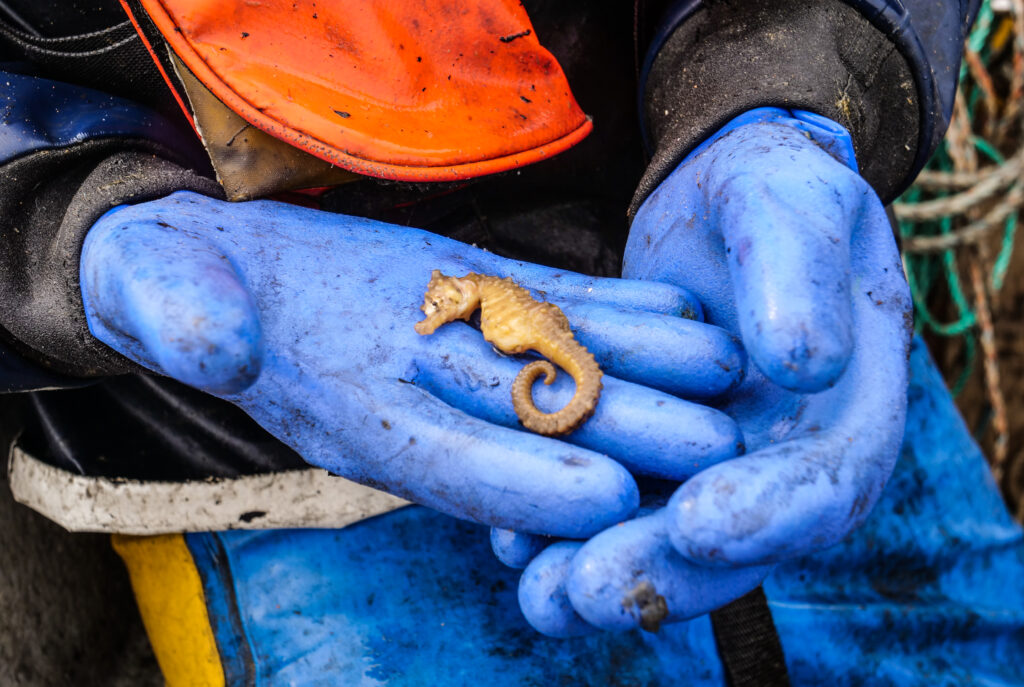
L.P: The seahorse is quite rare now, so, I guess it’s like a bit of a personal symbol for me. I never get bored of seeing what comes up in the nets or pots, and I know that quite a lot of people who’ve been doing it for years feel the same way. If there’s something different or interesting, people get excited by it. I know that some of the older fishermen, like Doug for example, he still gets excited by everything that comes up. I guess it is a bit of a personal symbol.
I personally, and I think quite a lot of people probably, make an effort to put things back alive as well. So if I find a seahorse in there, I put it in some water or put it back over the side.
I guess one of the other things is because of the way that people fish here, which is quite small scale, if you’re doing netting you have time to sort through your catch and keep stuff and you can get rid of the stuff that you don’t want to catch, they can still go back in the water. Obviously with a great big industrial boat that’s not going to happen. So I guess it’s a bit of a symbol of that as well. The fact that we are still fishing in a way that makes it possible to see little things like that.
J.B: What’s the nicest thing about being in the industry?
L.P: It’s just exciting every time you go to sea. So even when the weather’s horrible, sometimes it’s a bit scary, but everything is always different. It’s not a routine. You’re watching the weather; you’re watching the tides. We do different kinds of fishing at different times of year. It’s the freedom to be doing something that I love doing. So the best thing is seeing the dawn, seeing the sun come up, seeing parts of the town from a different place that lots of people don’t see. Everything else seems quite small when you’re at a sea, you’re concentrating on one thing. Your mind’s not wandering, you’re concentrating on what you’re doing and staying safe. What you’re catching, whether you’re making money.
I know that most people in Hastings do, but I think it’s really important for everyone to recognise what a special thing we’ve got here and to fight for it to carry on existing. So whether that’s buying fish locally from the fleet, understanding what’s going on here, understanding the problems that we face and celebrating that and knowing everyone is doing their best to ensure that this can continue. I think it’s a massive part of this town’s identity, but also, the industry itself is part of people’s income and families, traditions and generations and all that. We should do everything we can to ensure that it continues, but things are getting harder and harder. So people should realise that it won’t just carry on as it is because it does need support in all sorts of ways. So if that’s coming down and buying fish locally for fishermen and making sure that you buy Hastings fish whenever you can, that will be a great thing to do.
We hope you have enjoyed reading this article. The future of our volunteer led, non-profit publication would be far more secure with the aid of a small donation. You can also support local journalism by becoming a friend of HIP. It only takes a minute and we would be very grateful.

Leave a Reply