
ATHLETICS: HALF MARATHON
Out of the Running
Last Sunday’s Hastings Half Marathon, resumed after two years of Covid interruption, was the 36th. Runners, spectators, charity fundraisers, hoteliers, bed-and-breakfast providers, shoe retailers, and everyone else in Hastings connected with the run – isn’t that almost the whole population? – will wish the event many happy returns in future years.
But for one man the occasion will have had a bittersweet flavour. Eric Hardwick, who founded the race in 1985 in the name of the local charity Lions Club and has personally supervised it as race director for the best part of four decades since, earning himself an MBE in 2007 and a 1066 award as Best Community Person in 2016, has announced his retirement from the role.
Eric first arrived in Hastings with his wife Doreen in 1969 to take up a job in the potato trade. He joined the Lions Club as a way of giving charitable service to the community. His main sport was squash, but having started running as a way of keeping fit for that purpose, he was inspired by the success of the inaugural London Marathon in 1982 as both a serious sporting contest and a vehicle for charitable fund-raising. Couldn’t the Lions Club do something similar, if on a slightly smaller scale?
The following year he approached both Hastings Borough Council (HBC) and Hastings Police – both said no, or at least each indicated that he would have to get permission from the other before they would consider getting involved. But he happened to meet the chief of Sussex police at a function in Lewes, who said that he could square the Hastings superintendent as far as traffic issues were concerned; two days later, the superintendent called Eric over to the station, and agreed after discussion that a half-marathon race round the town could be accommodated.
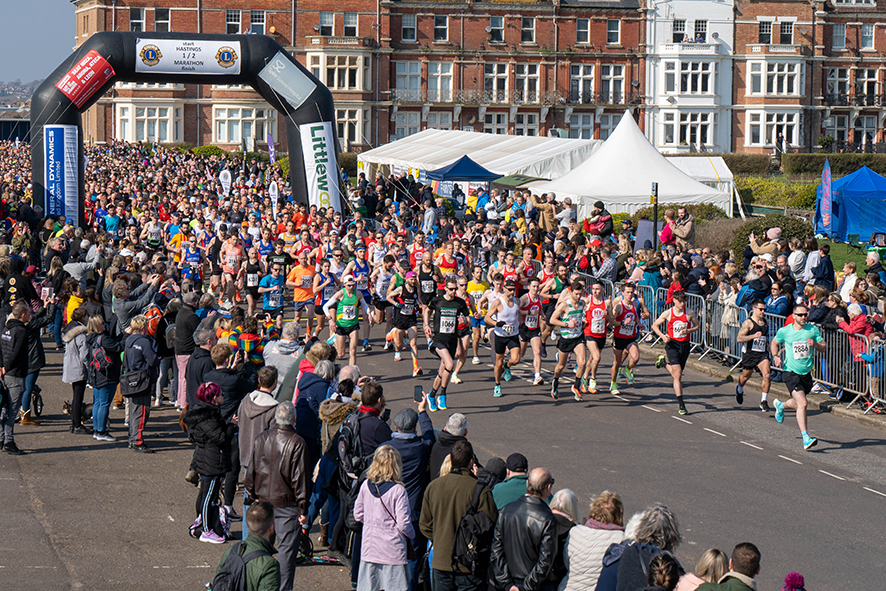
CREDIT: Ann Chown
Invitation to run
It still took another year to plan and measure out the route around Hastings, to be timed a month before the London run and aimed to some degree as a preparation for it.
It was difficult in those days, as it still is, to get an invitation to compete in London. Eric only managed it in 1984 (prior to the advent of the internet or even fax communications) by camping overnight outside Eastbourne Post Office so as to get his written papers delivered at the earliest hour on the appointed day of application.
He was determined that the Hastings event, by contrast, should be open to all, even those runners who turned up on the day, a policy which has been maintained since. And, until Covid restrictions put paid to the event in 2020 and 2021, he made it his personal responsibility to keep it as an annual highlight of the town’s public calendar.
Health and safety
One year, he was told that, for reasons of health and safety, the route would have to be significantly diverted in order to avoid excavations on the seafront promenade. His insistence that it had to conform with the precise distance measurements of the half marathon at first fell on deaf ears; he only succeeded in persuading the authorities to take their own preventative measures to keep the route secure after walking out of a meeting with a threat to cancel the event forthwith.
Another year, gale-force winds blew on the night before the race, sweeping away a tent erected by the Red Cross and putting the main marquee at severe risk of following on. He got there at around midnight to find a torn flap, which he recalls hanging onto in desperation until 4 am when the storm subsided.

Blustery March winds are par for the race, and often make the course, already a tough one by reason of its uphill and downhill slopes, even tougher. The last two-and-a half mile stretch along the seafront is flat but “can be a killer”, says Eric, if the prevailing south-west wind is blowing hard.
His own best time was around one hour 18 minutes – “but I’m not an elite runner, just an average plodder”.


Left: Eric Hardwick congratulates 2022 women’s race winner Rachael Mulvey (HY Runners)
CREDIT: Ann Chown
Race heyday
The heyday of the race in terms of elite performance was the late 1980s and 1990s. In 1989 a sponsor put up the prize sum of £5,000 to a runner who could win the race in a time below 1 hour 2 minutes. British athlete Paul Davies-Hale came within 10 seconds of this time that year, and over the subsequent decade the race attracted a core of international athletes with the winning time regularly below 1 hour four minutes. British star Eamonn Martin won in 1993 in 1:02:58 – he went on to win the London marathon in the same year. Eventually in 1999, by which time the sponsored prize sum had been upped to £10,000, Kenyan Samuel Otieno won the race in a time of 1:01:37, which is still the course record, thus attaining the prize with 23 seconds to spare.
The female record of 1:11:13 was set by British runner Andrea Wallace in 1993.
There are no longer lucrative sponsorship prizes – the award for the male and female winners this year was just £300 each, with £200 and £100 for second and third places respectively. And Eric points out that, on average, the times of the leading local runners haven’t improved over the past 20 years despite supposed improvements in the technology of running shoes and in the science of training schedules. But over this period the return by way of charitable receipts has soared. Eric calculates that, while the Lions Club itself has raised over £5m altogether for its own charitable purposes, runners who are encouraged to organise their own sponsorship programmes have probably raised at least five times this sum –i.e. £25m or more.
It’s a remarkable story, which Eric is properly proud of. “I believe in doing things as well as I can. If I’d been paid for it, I’d probably be a millionaire by now. But I always saw it as a question of service to the community”.
The Lions Club will continue to organise the race next year, but have appointed a private company Nice Work to undertake all the administration. “It won’t raise so much money for the Lions’ own charities then”, Eric admits, “but the runners will carry on as before”.

We hope you have enjoyed reading this article. The future of our volunteer led, non-profit publication would be far more secure with the aid of a small donation. You can also support local journalism by becoming a friend of HIP. It only takes a minute and we would be very grateful.

Leave a Reply