
HIP BOOK REVIEW: How the Vote was Won
Mary Raleigh Richardson: The suffragette arsonist who slashed the Rokeby Venus
By Helena Wojtczak, Hastings Press, 2025, pb £12.50, hb £25
REVIEW BY VICTORIA KINGHAM
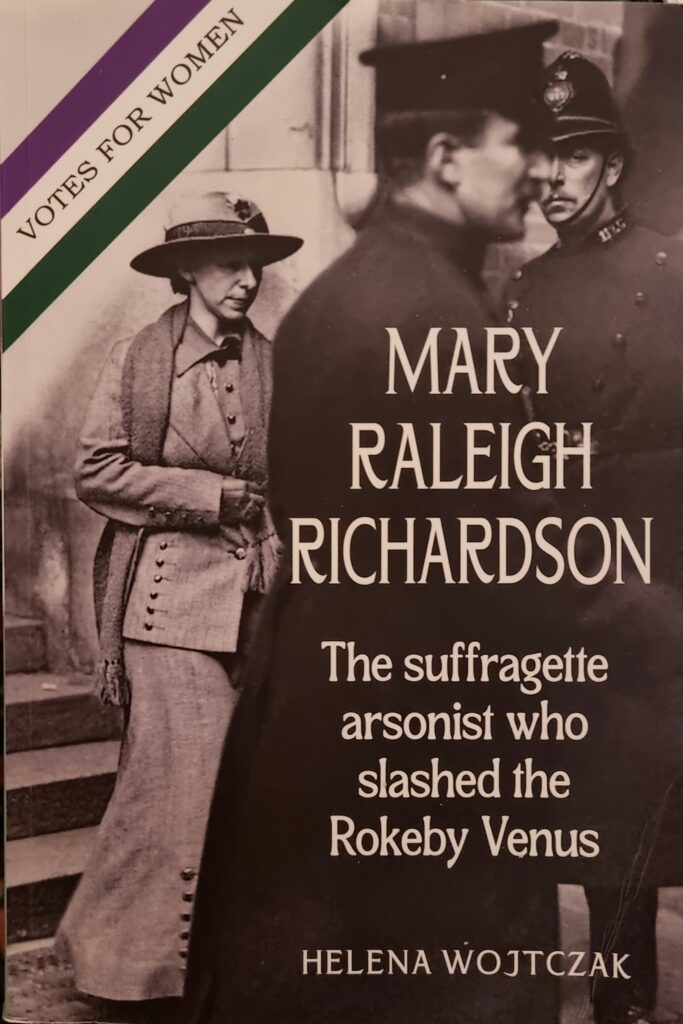
The vagaries of the Art world are wondrous strange. The ‘Rokeby Venus’ by Velázquez– so named because it was first brought to England by a prosperous Yorkshireman to hang in his neo-Palladian pile, Rokeby Park – is probably better known for having been slashed by a Suffragette in 1914, than for being among the most sinuous and sensuous (not to say lecherous) paintings of a female form.
The Suffragette slasher was known as Mary Raleigh Richardson, who said later that she did it because of ‘the way men visitors gaped at it all day long’. The act remains one of the more radical by the women who, just over a century ago, fought (even died) for the right to be treated as thinking citizens, who could reasonably decide whom they wanted to represent them in government. It has become, like women chaining themselves to railings and throwing themselves under horses’ hooves, symbolic of the movement, of a truly radical change in the position of women in this country.
It is absorbing, therefore, that in a new biography of Mary Richardson, local author Helena Wojtczak reveals her not as a stalwart political campaigner and long-time party activist but rather as a wealthy dilletante who readily changed her name from Perkins (probably to avoid the stigma of a court conviction for theft, which is documented), and henceforth maintained an extremely casual relationship with the truth. ‘After being immersed in studying Mary for over two years’, writes Wojtczak, ‘I am persuaded that it was not solely a yearning to choose between [male] parliamentary candidates that drove her to commit acts of destruction.’
DEBUNKING THE MYTH
Meticulously researched, illustrated and annotated, it’s a splendid debunking job. The author’s stated opinion is that Richardson (who later joined Mosley’s fascist party), though the perpetrator of many acts of violent protest, was not quite the principled heroine she later claimed. Her often-quoted autobiography, Laugh a Defiance, was a tissue of lies: her original motivation was probably attention-seeking and a ‘craving for excitement.’
The act of destruction of a publicly-owned painting is made to seem, in retrospect, impulsive and a little disingenuous rather than a carefully-considered act of rebellion. Not one of Richardson’s anecdotes of the movement ‘dovetails with primary source accounts’ and most of them are ‘a mixture of truth, distortion, embellishment, uncorroborated assertion and chronological inaccuracy or impossibility.’ Indeed, Richardson’s stated reason for the act, the release of Sylvia Pankhurst from prison, had actually been achieved before she entered the art gallery.
So far, so fascinating. But this book does not seek to denigrate the ultimate achievements of the Suffragist movement: on the contrary. Wojtczak relies on various trusted sources to document the events surrounding the various arrests of Mary, of Sylvia Pankhurst, and several other militant women. It’s harrowing: women were beaten up in demonstrations, treated on (frequent) arrest as common criminals, brutally and painfully force-fed in prison. A radical subgroup, the Young Hot Bloods, nevertheless escalated the protest action to arson and other acts of extreme violence.
LEGACY OF THE SUFFRAGISTS
In spite of the severity of the movement, many of the newspaper comments were patronising and belittling in the extreme – H. G. Wells, for example, called their activities, including those of Richardson, ‘skylarking’. Women in this country who feel that ‘politics don’t concern them’ may wish to consider exactly what it took to enable them, as women, to make such a choice in the first place. It should also not need to be restated that what they call ‘politics’ is not something apart but is present in every aspect of our lives, down to the cost of a pint of milk or a loaf of bread.
Though matters have progressed, there is still a deeply ingrained cultural inequality between men and women. It’s present in our advertising and in the assumptions behind much of our language. It’s rampant on social media, encouraged by the popular press, ratified by the more regressive media outlets. But whatever their personal vagaries, Suffragists made a groundbreaking change in the position of women in this country.
Available from Bookbuster,
39 Queens Road, Hastings TN34 1RE and other local bookshops or direct from hastingspress.co.uk
We hope you have enjoyed reading this article. The future of our volunteer led, non-profit publication would be far more secure with the aid of a small donation. You can also support local journalism by becoming a friend of HIP. It only takes a minute and we would be very grateful.


An important and indeed salient fact the reviewer has omitted to mention is that Mary Richardson moved to Hastings in later life, and lived here until she died, in her bedsitter.
Also she wrote a whole chapter in her biography about a visit to Hastings in 1913, which Ms Wojtczak dissects forensically until she gets to the shocking truth: it never happened!
There was so much more to Richardson than just slashing a painting. For example she also burned down the Duchess of Carlile’s seventeenth century mansion.
Mary spent a decade in the 1920s trying to get elected as a Labour MP.
There was much more to her than just slashing one painting.