
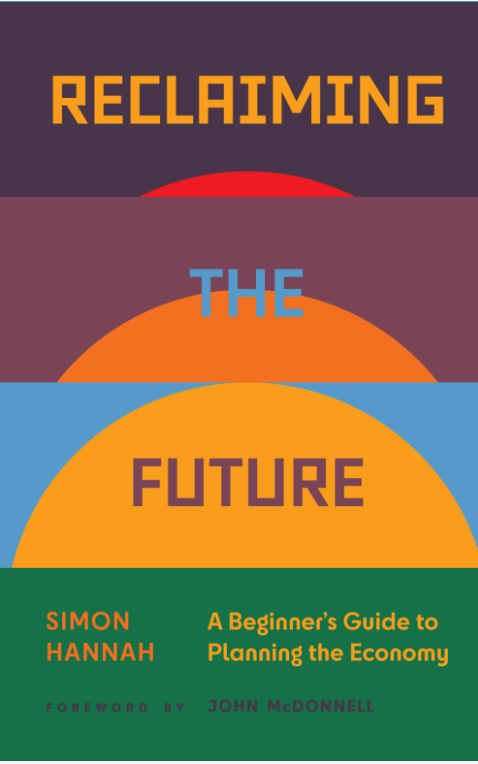
BOOKBUSTER REVIEW: Reclaiming the Future
By Simon Hannah
Published by Pluto Books, 2024, rrp £16.99
REVIEW BY TIM BARTON
The foreword to this excellent book is by John McDonnell MP, who contextualises Hannah’s topic by noting that an historical perspective is necessary. To reclaim the future we must also reclaim the past, a past that includes workers solidarity, the founding of the NHS and of welfare provision. I must add, as Starmer and Reeves continue what is a right-wing agenda better fitted to the Tories than to Labour, that our project must urgently be, as well, to reclaim the present.
McDonnell says of our current predicament, ‘The advocates of capitalism extol the setting free of uncontrolled animal instincts, combining to create the hidden hand of the market as the optimum method of economic decision making. Whilst socialists, recognising the chaos and crises this leads to, have looked to reason and rationality to control and plan economic processes. The reality is that planning has been an inherent feature of capitalism but it has been used to plan for profit maximisation and not to satisfy need.’
AN ’ECOSOCIALIST’ ALTERNATIVE
Hannah says that economic systems come and go, and insists that ‘capitalism can and must be replaced’. The urgency of confronting capitalism today is both about creating a resilient social fabric that can weather at least some aspects of an inevitable global economic recession, one that locally will be a depression, and about changing our lifestyles to proof ourselves against the worst of the coming ecological chaos. Both these issues are absolutely beyond the scope of capitalism, a greed oriented ‘I’m alright, Jack’, ‘the devil take the hindmost’ ecologically terminally destructive ideology.
The author takes us on a journey through the extremist economic ideology we live under, and argues for an ‘ecosocialist’ alternative. He explains that this should create social justice and ecological stability, where the current global free-for-all can only create inequality and exploitation. The first chapter asks ‘how does capitalism work?’, and runs through a standard Marxian analysis of, for example, surplus value and commodity fetishism. He also shows how ‘scarcity’ is a requirement of the system. A local example might be the deliberate withholding of land acquired for housing from development in order to artificially push the price up of what little developers do deign to build. This kind of land-banking should be illegal, but is a core economic tool for construction companies’ profits, at our expense.
ECONOMIC IDEOLOGIES DESTROYING OUR PLANET
Ecologically, it is obvious that the collapse of ecosystems under industrial productivism is creating real scarcity, which makes addressing the rapacious nature of capitalism all the more urgent. A ‘fix’ based on the premise that scarcity is an illusion created by greedy economic models can’t work if the bedrock of our ability to survive is under threat. And today, that threat is dire. In this context, Hannah introduces Marx’s concept of ‘metabolic rift’ – both class relations and ‘metabolic rift originate from a unique, global process of violent separation of people from their means of subsistence, which also disrupts the biosphere.’ There is some detail on this here, and it has long been contended that Marx addressed ecological issues in the nineteenth century, long before the emergence of a ‘green movement’. This has some truth, but in the context of his extensive writings can be exaggerated: it is typical of the traditional left to do so, as there is a tendency to want to continue an essentially hierarchical ‘dictatorship of the proletariat’ under the guise of ‘socialist democracy’. In reality many on the ‘green left’ have spent much of the last sixty years arguing that we urgently need to decouple left politics from ‘the state’ and pursue what Murray Bookchin termed ‘social ecology’. This includes localist decentralisation, and grassroots democracy, but also ‘internationalism’, a view we share with the traditional socialist movement, but one seemingly lost from mainstream Labour today.

Nonetheless, the traditional left has been right to interrogate the liberal idea that ‘democracy’ and ‘economics’ should remain distinct. A ‘soft’ version of this is seen in the pursuit of ‘economic democracy’ alongside ‘social democracy’, but in recent years this has not been remotely tough enough on the capitalist context in which it seeks a foothold. ‘Change from within’ can only come from below if it is to overthrow the economic ideologies destroying our planet, and only from the left if the resulting altered social relations are to be positive – at present the ‘right’ is stirring up those ‘below’ who need to act, directing them in ways that may ultimately help destroy current economic relations, but offering a bigoted exclusionary hell in its place. ‘Reform’ is needed, indeed revolutionary reform, but it is not ‘Reform UK’ that offer real alternatives that can help the people find a stable and peaceful new economic ecology, quite the reverse. Many of the arguments against a leftist planned economy are addressed in the second half of the book, including for example ‘human nature’, the role of automation, the arguments for and against a ‘universal basic income’, and green concepts such as ‘degrowth’.
Thus, books like this one become a necessary weapon to help resist the nationalist right-wing at the same time as seeking significant and real change. This is becoming urgent, and maintaining any optimism about the coming decades is not only hard, but possibly even stupid. Hannah acknowledges that ‘lack of empathy runs deep in the modern world, fostered by prejudice and hate to divide us from our common humanity. ‘ A realist position must see how it is not a polite argument that will help us now, but bloodied noses. After decades arguing for some of the radical changes Hannah suggests, it is disappointing, but ultimately inevitable, to see mitigation strategies as the only game in town.
Reclaiming the future is available from Bookbuster, 39 Queens Road TN34 1RE
We hope you have enjoyed reading this article. The future of our volunteer led, non-profit publication would be far more secure with the aid of a small donation. You can also support local journalism by becoming a friend of HIP. It only takes a minute and we would be very grateful.

Leave a Reply