
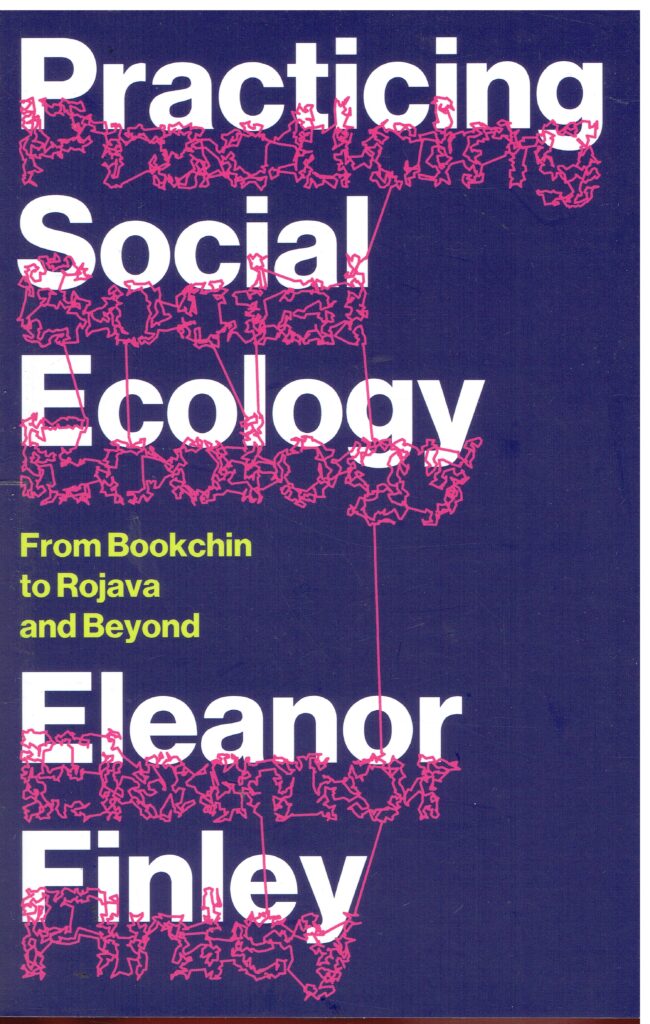
BOOKBUSTER REVIEW: Practicing Social Ecology
By Eleanor Finley
Pluto, 2025, rrp £16.99
REVIEW BY TIM BARTON
It is increasingly obvious that global capitalism, in its industrial mode, is creating an environmental crisis of epic proportions. It is also apparent that the post-Thatcherism and post-Reaganomics mode of capitalism, one which is focussed on ‘financialisation’, is increasing the wealth of a tiny minority at the expense of everybody else, as it is essentially fed on debt, not production. Decades ago, visionary thinkers, such as Ivan Illich and Murray Bookchin, saw the broad outlines of our current crises coming.
In Bookchin’s case he developed a political philosophy based on attempting to ‘square the circle’ between socialist, ‘anarchist’, and ecological ideas. Like Rachel Carson, he was early amongst radical thinkers in seeing the extent to which environmental degradation was a threat to life on our planet. Unlike Carson, his political experiences in the 1950s meant he saw solutions that were not merely ‘instrumental’ tinkering, but that would attack the capitalist and industrial productivist behemoth at its roots.
He named this ideology ‘social ecology’. Throughout his life, he amended the details as experience required. Much of his writing was focussed on critique of topical crises of the day, and on theoretical underpinnings to his ideas. But he also, and necessarily, was involved in real-world practice, and concerned with how to create new forms of political consociation that were compatible with a sustainable and liveable future society. Because, as we surely must admit by now, our current way of life is driving us off a cliff.
YOUR BOWELS WILL LOOSEN
This book, subtitled ‘From Bookchin to Rojava and Beyond’, is a welcome analysis of how the ideas central to ‘social ecology’, and thus central to our survival, have been expressed in the real world. Theory is all very well, but practice is where hope is forged. I have written here before about the Kurdish experiment in ‘socially ecological’ living. As with other areas on the periphery of the Western global hegemony, such as Bolivia, space has been, at least temporarily, available to experiment with Bookchin’s ideas. Within ‘developed’ nations there are fewer spaces to act, but the Occupy movement is one area in which Bookchinite ideas were able, in a few locations such as Oakland and New York, to flourish.

Primary among these ideas, and dating from his later writings, is ‘libertarian municipalism’, expressed in the ‘real world’ through ‘people’s assemblies’. Here in Hastings we have had a few attempts at creating such bodies. The idea would be to get as many local people as were interested and free to pop along to meetings where ideas can be shared and a consensus reached on actions. Optimally, decisions made would be able to be enacted. Town councils on a libertarian model find it hard to get traction where ‘representative’ councils exist, and even more so where these are embedded in local, county, and national bureaucracies. But their necessity is more apparent every day.
As is the necessity that discussions include as a core focus our relationship with the land. How much of our food is locally produced? How much is farmed in an ecologically sustainable manner? How is it integrated with the natural world? How much of our energy provision is local, under our control, and genuinely sustainable in the long term? Think about such things for a minute and your bowels will loosen. By these measures, and many more, we are nowhere near any kind of self-sufficiency and have no resilience to global supply issues. So eco-communities, direct democracy, education that teaches us to think and analyse for ourselves and thus function as citizens, are a necessity if we are to address any kind of survivable future.
WHAT LITTLE AUTONOMY HASTINGS HAS
The role of popular assemblies is about to be challenged: they were never easy, but dissolving local authorities and pushing the locus of power up to the level of county-wide or even larger ‘unitary boroughs’ will take what little autonomy Hastings has away from us. As Julia Hilton discussed in issue 273 of this paper, there may still be wiggle-room, but frankly right now is a ‘counter-revolutionary’ moment without the preceding ‘revolution’.
Meanwhile, Finley has found numerous examples of people-power, of eco-communities, directly democratic fora, and federalist alternatives to ‘nationalism’–in the best cases, based around ‘biomes’ and balanced ‘ecological footprints’. She says ‘there is no single blueprint for a democratic and ecological way of life. Indeed, if the last decades of emancipatory social movements and democratic experimentation have revealed anything, it is that each community must reinvent real democracy for itself.’
Currently, the nationalist-populist far-right is on the ascendant all across ‘the West’, clearly including the UK. They offer ‘business as usual’ whilst promising a better life for those who will buy into their tacit promises to deal with structural problems that their leaders are getting rich from, in fact increasing. Any kind of solutions must come from elsewhere, though none can contain the enormity of what’s coming. Finley’s approach to the praxis of social ecology gives us a few clues. ‘Our task is not to rehabilitate the past but to move forward with lessons in hand’, lessons which clearly preclude the kind of ‘reforms’ promised by our parliamentary system, least of all ‘ReformUK’.
A RESILIENCE AND LOVE OF FREEDOM
Some of Bookchin’s ideas were predicated on us acting in sensible ways in order to head off problems that today are like a tsunami we’d seen on the horizon and ignored but that ‘suddenly’ is upon us. Thus, he may seem optimistic where, when I first read his work, in the early 1980s, his ideas seemed realistic, as well as necessary. He did warn us, over and over. I argued as early as 1990 that the narrow window of opportunity was closing fast. Once slammed shut, only bad options would remain. Now, in 2025, it appears all too likely that we have passed significant ‘tipping points’, ones that lock in horrific changes in our biosphere, that will crash our civilisation, create wars, famines, and disease, and trash yet more of the natural world that we are entirely dependent upon, no matter how alienated from it we may be in our current siloed way of living.
Real positive change at the local and regional level is more urgent than ever, to at least mitigate the worst of what is coming. Of those who are acting for positive change in the face of a new great depression, or worse, she says ‘their perseverance speaks to a resilience and love of freedom embedded in nature itself’.

We hope you have enjoyed reading this article. The future of our volunteer led, non-profit publication would be far more secure with the aid of a small donation. You can also support local journalism by becoming a friend of HIP. It only takes a minute and we would be very grateful.

Leave a Reply