
BOOKBUSTER REVIEW: Left Behind
By Paul Collier
Published by Penguin Books, 2025, rrp £10.99
REVIEW (PART 1 OF 2) BY TIM BARTON
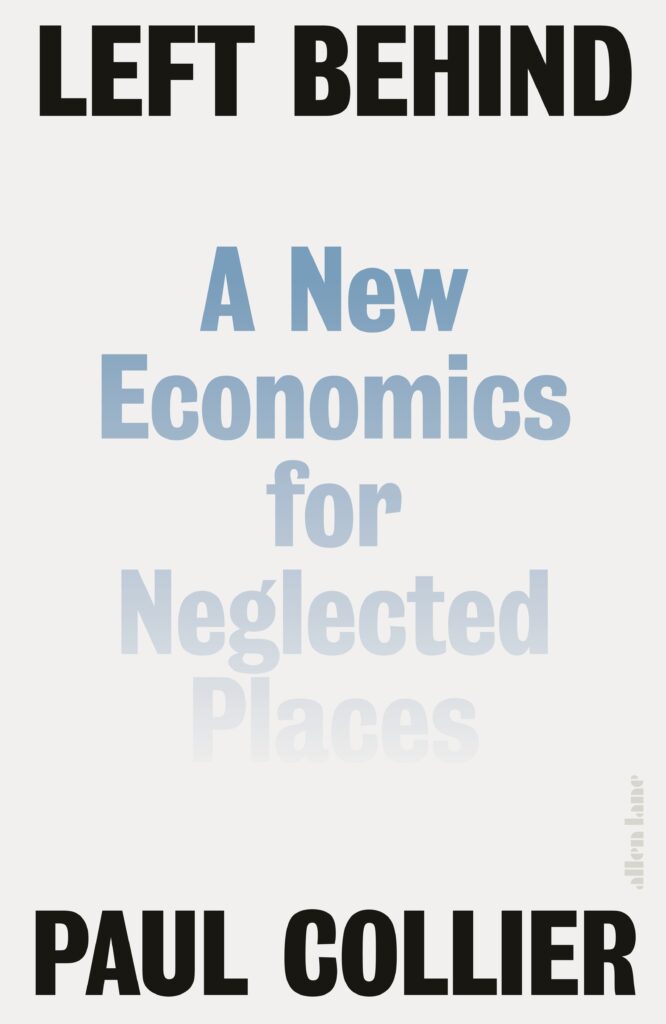
Collier’s project here is to discuss what he calls ‘a new economics for neglected places’, which we can readily apply here. The book has a global perspective, covering for example parts of Asia, Africa and Latin America. But he reserves a special place in his analysis for England. Part One of the book, ‘Spiralling Down’, ‘is the story of damaging ideologies and the politics of greed’ and how they impede attempts to narrow the wealth-gap and keep the base of an economy fluid and viable through investment and welfare. Thus, England is seen through the lens of an extreme version of the ‘free market’ imposed on us from Thatcher’s 1980s onwards, one he sees as more extreme than any other country: despite the propaganda, ‘far from remedying the syndrome, market forces accentuate it’. He also accounts for England’s special status as a failing economic state by reference to other countries’ choices to devolve power, investment, and both public and private finance.
Collier has relatively little to say about ‘class politics’, but does point out the need for workers unions, willingness to compromise and cooperate between workers and bosses, and the need for resilient welfare support. The latter has been especially badly dismantled in the UK, especially since 2008, with little sign of the recent change in government addressing that, with the Labour government instead stating that it is only interested in ‘working people’. And so we fall yet further behind.
MANY IN HASTINGS DRIVEN INTO THE GROUND
Let’s get an elephant in the room out of the way. Collier has a warped perspective regarding ‘the South-East’, one typically found ‘up north’. We are, apparently, all terribly well-off down here. Only the post-industrial North, Wales, and Cornwall are badly ‘left behind’. This is disappointing in what is, in many ways, a compulsory read, dense with information. And ironic, too, because he in general acknowledges that many places outside the capitals or resource-rich regions of countries can easily be ‘left behind’ as the wealth-gap expands, as it is doing, and rapidly, in our country. It is a patchwork with mixed results, such that areas such as Hastings can experience a growth in ‘average earnings’, driven in part by equity-rich blow-ins, and at the same time evisceration of the base economy that mainly impoverishes locals and previous generations of, equity-poor, blow-ins – also driven in part by recent equity-rich blow-ins. This has the effect of masking a detrimental ratcheting down of our community. This is a phenomenon Collier would be sure to recognise exists in ‘the South-East’ too, if he didn’t show such a caricatured anti-Home Counties bias.
Perhaps this is a misperception explained by the relative recentness of this phenomenon, at least in its current form. After years of austerity driven by elite economists’ and politicians’ choices in how to address the 2008 banking crisis, plus the rise in popularity of AirBnBs, the economic pressure pushing many away from an overly expensive capital, the effects of Brexit on small businesses, and the iniquities of the Universal Credit system that replaced the fairer and stabilising Working Tax Credit system, many in Hastings have been driven into the ground, compounding the growth in the wealth-gap.
Nevertheless, these pressures that we suffer here are acknowledged in other areas of the UK, and in other countries. So, if we put aside his biases, this first part of Left Behind is as important and valid for us here as for his much-lauded post-industrial Yorkshiremen, which means we, as readers, can roll our eyes at him but still join the dots ourselves. A ‘society’s spirit’ can be ‘crushed by despair’, and Collier analyses ‘social psychology’ to explain ‘social fragmentation’ in neglected places.
Part Two of the book, ‘Spiralling Up’, however, is a detailed look at how previously ‘left behind’ places have in fact triumphed and reversed the trends. This is much more positive, and represents the meat of the book, taking up two-thirds of the narrative, with chapters on, for example, ‘how places renew from the grass roots’, ‘inclusive prosperity’, ‘building the sinews of the State’, and ‘the morality of common purpose’. And it is to this I will return next time…
Left Behind is available from Bookbuster, 39 Queens Road, Hastings TN34 1RE
We hope you have enjoyed reading this article. The future of our volunteer led, non-profit publication would be far more secure with the aid of a small donation. You can also support local journalism by becoming a friend of HIP. It only takes a minute and we would be very grateful.

Leave a Reply